vLLM ecosystem guide: architecture, integrations, evaluation
A practical, evidence-grounded ecosystem map for vLLM covering the core repository, integration patterns, evaluation criteria, maintenance signals, licensing, and a discovery workflow.
vLLM is an open-source inference and serving engine for large language models hosted at the vllm-project/vllm GitHub repository. The repository combines a Python-centric user surface with a Rust frontend, multiple hardware backends, and a focus on high-throughput, flexible model execution. Key repository signals as of data retrieval include 86,079 stars, an Apache-2.0 license, and an active release (v0.25.0) published on 2026-07-11; see the canonical repo and release for details.[^repo][^release]
This guide maps the vLLM ecosystem for engineers and architects evaluating integration, operational, and licensing trade-offs. It synthesizes repository metadata and the project's latest release notes, identifies patterns for integrating vLLM (API, gRPC, HF models, hardware adapters), sets practical evaluation criteria, explains maintenance signals, and concludes with a step-by-step discovery workflow you can follow to validate fit for production.
Core repository snapshot
This table summarizes verifiable repository metadata and the latest release used as the basis for this guide. All repository facts below are taken from the project’s GitHub metadata and release notes cited in Sources.
| Field | Value |
|---|---|
| Repository | vllm-project/vllm ([repo]) |
| Description | A high-throughput and memory-efficient inference and serving engine for LLMs ([repo]) |
| Primary language | Python ([repo]) |
| License | Apache-2.0 ([repo]) |
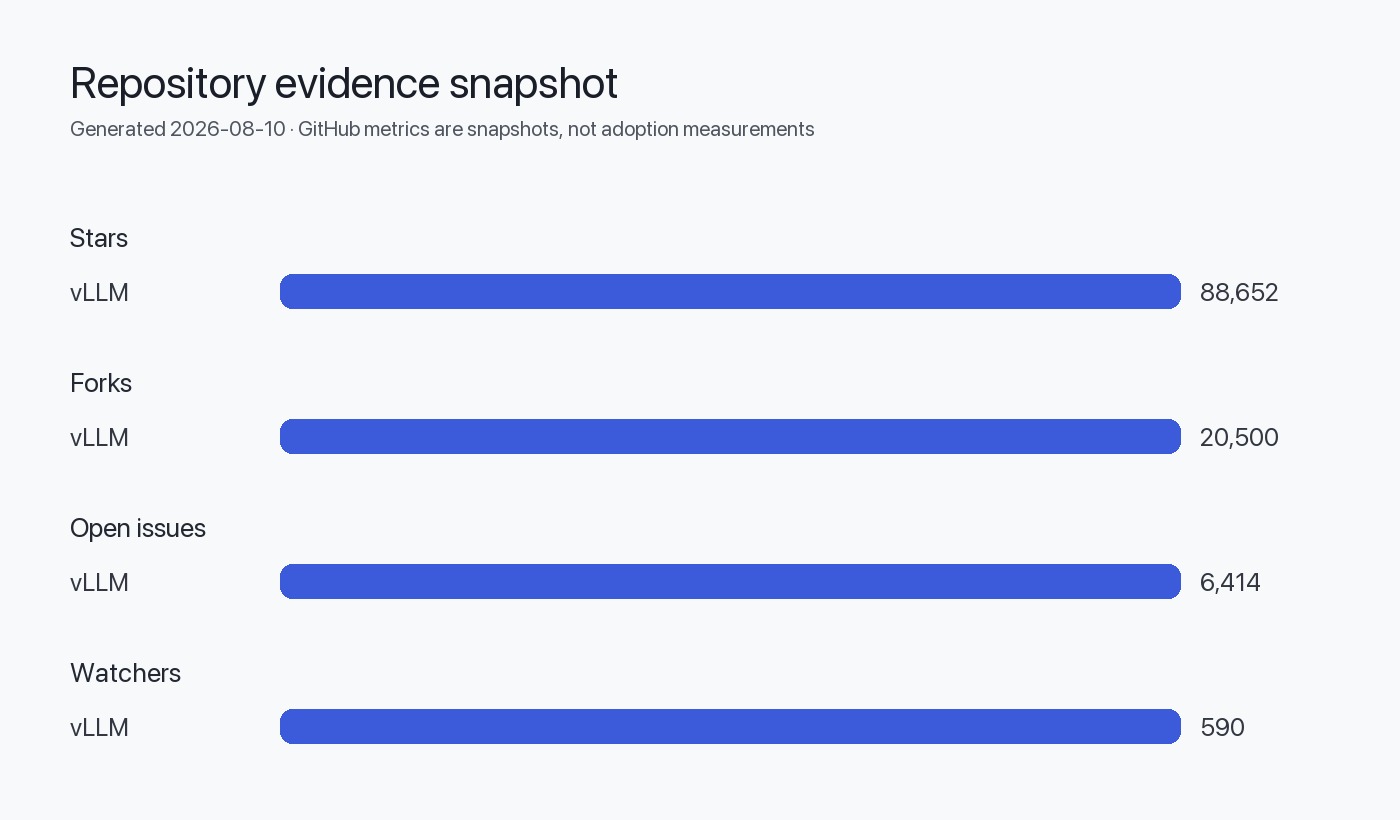
| GitHub stars | 86,079 ([repo]) |
| Forks | 19,320 ([repo]) |
| Open issues (repo) | 5,743 (count from repo metadata) ([repo]) |
| Latest release tag | v0.25.0 — published 2026-07-11 ([release]) |
| Default branch | main ([repo]) |
| Homepage | https://vllm.ai ([repo]) |
Project categories and integration patterns
This section organizes ecosystem components and integration patterns you will encounter when evaluating vLLM. Examples are synthesized from the repository README and release notes; where I infer architecture from structure or wording, that conclusion is explicitly labeled.
Table: High-level project categories and representative capabilities
| Category | Representative capabilities (from repo/release notes) |
|---|---|
| Core engine | High-throughput inference, Model Runner V2, streaming parser engine, speculative decoding ([release]) |
| Model compatibility | Hugging Face model compatibility, 200+ model architectures in supported models list (README) ([repo]) |
| Hardware adapters | NVIDIA (CUDA/Blackwell), AMD (ROCm), CPU (x86/ARM), TPU and others referenced in docs ([repo]) |
| Quantization & precision | FP8, INT8/4, NVFP4, GPTQ/AWQ, GGUF, ModelOpt — multiple quantization options cited in docs and release ([repo], [release]) |
| Distributed serving | Data & pipeline parallelism, disaggregated prefill and decode, KV offloading, PD connectors (release) ([release]) |
| APIs / frontend | OpenAI-compatible HTTP API, Anthropic Messages, gRPC, Rust frontend with HTTPS/mTLS (release) ([release]) |
| Tooling & UX | CLI utilities, docs, model zoo, streaming parsers and parser engines (release) ([release]) |
| Security & ops | Security advisories page, mitigations for decompression bombs and tokenizer bounds (release) ([release]) |
Integration patterns (practical):
- OpenAI-compatible API server: vLLM provides an API layer that can be used as a drop-in replacement for applications built against OpenAI-compatible endpoints. This reduces client changes where OpenAI semantics are required (described in release notes).[release]
- Hugging Face model import: The project advertises seamless integration with Hugging Face model formats and a supported model list. Expect a workflow where model artifacts are fetched/converted per vLLM documentation (in README/docs) ([repo]).
- Hardware-agnostic execution with plugins: The project enumerates multiple hardware targets and custom kernels; the integration pattern is a pluggable backend where vLLM routes model execution to a specific kernel or adapter based on available hardware (inferred from release details and topics). [Inferred from README and release notes.]
- Rust frontend + Python API: The repo mentions a Rust frontend for production serving and a Python surface for users; one common pattern is to use the Rust frontend for heavy I/O/server responsibilities and Python for model configuration and local development (inferred). [Inferred from README and release notes.]
Model support & backends
vLLM documents support for a wide set of decoder models, MoEs, hybrid attention and state-space models, and multi-modal models (README). Quantization and custom kernels are a first-class part of the project. When mapping models to backends, treat model precision and kernel availability as primary constraints — a model can only reach optimal throughput when a compatible kernel/quantization path exists.
APIs, frontends, and clients
The release notes call out an OpenAI-compatible API, an Anthropic Messages API, gRPC support, and a Rust frontend with mTLS/HTTPS. These are explicit project features to consider for secure production deployments and for interop with existing tooling ([release]).
Distributed & serving infrastructure
vLLM’s release notes describe multiple distributed-serving features: sequence parallelism, NCCL-related allreduce changes, disaggregated prefill, and a DP supervisor in the Rust frontend. These indicate the project targets both single-node high-throughput serving and larger distributed topologies ([release]).
Architecture map (inferred)
The diagram below is an architecture inference synthesized from the README and release notes: it identifies common components you will find around vLLM deployments. The topology and interfaces are inferred and labelled as such.
flowchart LR
  A[Clients / Apps]
  A -->|HTTP / OpenAI API| B[API Server (Python)]
  A -->|gRPC| C[Rust Frontend]
  B --> D[Engine Core (Model Runner V2)]
  C --> D
  D --> E[Hardware Backends]
  E -->|CUDA / ROCm / CPU| F[Custom Kernels & Quantization]
  D --> G[KV Cache / Offload]
  D --> H[Speculative Decoders]
  G --> I[PD / Disaggregated Storage]
  H --> A

  subgraph Inferred
    B
    C
    D
    E
    F
    G
    H
    I
endEvaluation criteria for adoption
When assessing vLLM for a project, evaluate along seven practical dimensions. Each criterion lists suggested evidence to collect and the rationale.
- Feature parity with your requirements
- Evidence: model formats supported (supported-models list in docs), API surface (OpenAI-compatible/gRPC features in release notes).
- Rationale: ensures minimal client-side changes and model compatibility.
- Hardware & kernel support
- Evidence: release notes and repo topics that mention CUDA, ROCm, NVFP4, FP8, etc.; kernel availability for your target accelerator.
- Rationale: performance and determinism depend on kernel maturity for chosen precision and hardware.
- Quantization & precision paths
- Evidence: quantization methods documented (NVFP4, FP8, INT8/4, GPTQ/AWQ listed in docs and release notes).
- Rationale: quantization impacts cost, latency, and accuracy; verify supported quantization path for target model.
- API compatibility & client interop
- Evidence: OpenAI-compatible API features and streaming/parsing behavior in release notes.
- Rationale: lower integration friction if you depend on existing SDKs.
- Distributed & scaling model
- Evidence: release notes on DP/EP/sequence parallelism, DCP, PD connectors, and KV offload.
- Rationale: production scale may need disaggregation, fault tolerance, and throughput knobs.
- Community & maintenance signals
- Evidence: stars, forks, recent commits, latest release date, contributors in release notes; see Maintenance Signals section for interpretation.
- Rationale: active maintenance reduces integration risk but requires governance due diligence.
- Licensing & legal fit
- Evidence: Apache-2.0 license file in repository metadata (repo).
- Rationale: determine compatibility with your product licensing and redistribution rules.
Use these criteria to create an acceptance matrix (pass/fail or risk tiers) for your specific deployment.
Maintenance signals and what they mean
This table summarizes common signals, how vLLM presents them, and how you should interpret each.
| Signal | vLLM observation (evidence) | Practical interpretation |
|---|---|---|
| Release cadence | Latest release v0.25.0 published 2026-07-11; release contains detailed changelog with contributors ([release]) | Active release cadence and detailed changelogs suggest active development; validate frequency against your maintenance window needs. |
| Contributors & PRs | Release notes cite hundreds of contributors for v0.25.0 ([release]) | Broad contributor base increases feature velocity; also increases surface area for governance and contribution policy reviews. |
| Issue backlog | 5,743 open issues reported in metadata ([repo]) | Large open-issue count mixes feature requests and bugs; review issue types and triage practices rather than raw count. |
| Stars / forks | 86k stars, 19k forks ([repo]) | High community interest; stars are not a measure of production adoption. |
| Security posture | Security advisories feature referenced and specific mitigations in release notes (e.g., decompression-bomb OOM fix) ([repo], [release]) | Presence of a security advisory process is important; check disclosed CVEs and response timelines. |
Licensing and compliance considerations
vLLM is distributed under the Apache-2.0 license (repository metadata). Apache-2.0 generally allows commercial use, modification, distribution, and patent grants with attribution requirements and a patent termination clause. For compliance:
- Review attribution requirements (NOTICE file) if you redistribute binaries or Docker images that include vLLM.
- Verify transitive dependencies: some bundled kernels, third-party drivers, or kernel binaries may be covered by other licenses. The release notes list a set of dependencies; consult the repo's dependency manifests for exact licensing on each component ([release]).
If you have strict export-control, patent, or indemnity requirements, involve legal counsel early. The Apache-2.0 license provides broad rights but does not remove the need to audit third-party kernels and platform-provided binaries.
Practical discovery workflow (step‑by‑step)
This workflow focuses on low-risk, reproducible checks you can perform in a day to validate fit.
- Repository & docs reconnaissance (30–60 minutes)
- Read the README and the supported-models list in the docs; confirm your target model is listed ([repo]).
- Scan the release notes for recent changes affecting kernels, quantization, or APIs ([release]).
- Local smoke test (1–3 hours, depends on hardware)
- Clone the repo, follow docs for a local/CPU-only run path, or use the recommended installation method documented in README. Confirm that the server starts and the OpenAI-compatible endpoints respond (see docs in repo). ([repo])
- Verify test model loading and a basic generation/streaming test.
- Quantization and kernel validation (1–2 days)
- If you need quantized models, confirm the toolchain that converts your model (or the model zoo format) and test inference using the quantized path documented in the repo and release notes.
- Hardware validation (1–2 days)
- On target hardware, run representative workload tests to validate kernel stability, memory consumption, and any platform-specific notes the release highlights (e.g., NVFP4, ROCm paths) ([release]).
- Integration & API compatibility (1–2 days)
- Test your clients against the OpenAI-compatible endpoints and gRPC surface mentioned in the release notes; validate streaming, error cases, and edge behaviors.
- Distributed & scale smoke (multi-day)
- If needed, deploy a small distributed setup using the documented DP/EP features to validate disaggregation, KV offload, and fault behaviors described in release notes ([release]).
- Security and compliance checklist
- Review security-related notes in the release (decompression-bomb mitigation, tokenizer bounds) and validate your deployment pipeline and input validation.
- Operationalization plan
- Based on the experiment outcomes, create an SLO and rollout plan, including rollback triggers and observability points (metrics and logs). The release notes reference per-request metrics fields which can be useful for observability ([release]).
Hardware backend ecosystem (v0.26.0 release notes)
vLLM supports seven major hardware platforms with varying maturity levels inferred from release activity:
NVIDIA CUDA (primary platform): Full feature set including Blackwell (SM10x/SM110) support, CUTLASS and CuTeDSL optimized kernels, FlashAttention 3 (pinned to torch stable-ABI commit), and TensorRT-LLM GEN kernels. v0.26.0 added specialized DeepSeek-V4 routing kernels, FP32 router GEMV, and BF16x3 router GEMM.
AMD ROCm: Production-grade support with DeepSeek-V4 two-stage compressor kernel for HCA prefill, sparse decode/prefill optimizations, MXFP8 GEMM for MiniMax-M3, and HybridW4A16 linear kernel. ROCm-specific optimizations include MLA KV-split heuristics for DeepSeek-V3.2 and AITER sparse paged attention.
Intel XPU/Gaudi: Batch-invariant kernels, HND KV layout support, DSpark speculative decoding for DeepSeek-V4, INT2 weight-only quantization. Nightly and release images published as of v0.26.0.
Google TPU: Supported via tpu-inference v0.24.0 dependency. Repository topics list "tpu" but release notes contain limited TPU-specific optimization detail.
Apple Silicon / x86 CPU: Native macOS arm64 CPU wheel builds, s390x NUMA topology support, IBM Power VSX math function optimization, and Docker builds for IBM Power using prebuilt wheels. DFlash speculative decoding for GDN models on CPU.
Specialized NPUs: Repository README mentions Huawei Ascend, Rebellions NPU, IBM Spyre, and MetaX GPU through "diverse hardware plugins." Integration depth varies; no detailed release-note coverage in v0.26.0.
Quantization and compression methods
vLLM implements quantization through a pluggable layer supporting multiple frameworks:
| Method | Precision | Maturity Signal | Hardware Scope |
|---|---|---|---|
| NVFP4/MXFP4 | 4-bit floating-point | Online MoE quantization (v0.26.0); CuTe-DSL FlashInfer integration | NVIDIA (Hopper+) |
| FP8 | 8-bit floating-point | Core production feature; MXFP8 GEMM for AMD | NVIDIA, AMD |
| INT8/INT4 | Integer quantization | XPU weight-only INT2 (v0.26.0); emulation MoE backend INT4 | Cross-platform |
| GPTQ/AWQ | Weight-only | Long-standing support; integrated via Transformers | NVIDIA-primary |
| GGUF | Llama.cpp format | Import support | CPU, cross-platform |
| ModelOpt | NVIDIA toolkit | Standard stack for Inkling NVFP4 | NVIDIA |
| TorchAO | PyTorch native | Listed in core features | Cross-platform |
| compressed-tensors | Humming w[2-7]a[4,8] | Added in v0.26.0 for weight-only inference | NVIDIA |
Performance improvements in v0.26.0 include bounded peak memory when repacking FP4 MoE weights for Marlin and NVFP4 MoE weight loading. The kv_cache_dtype can be configured separately for speculative decoding as of v0.26.0, and MLA models support kv_cache_dtype_skip_layers to selectively apply quantization.
Speculative decoding and acceleration techniques
vLLM implements multiple speculative decoding strategies:
- n-gram matching: LongCat-Flash-Lite n-gram embedding support.
- Suffix matching: Listed in core features.
- EAGLE: Tokenspeed MLA backend integration with DCP.
- DFlash: Hybrid (sliding-window + full attention) drafters; GDN model support on CPU.
- DSpark: Gemma4-12B drafts, DeepSeek-V4 on AMD ROCm and Intel XPU.
Runtime draft weight updates were added in v0.26.0, allowing dynamic model switching. Separate kv_cache_dtype configuration for speculative_config enables mixed-precision drafting. Optimizations for thinking-budget TPOT when combined with speculative decoding improve reasoning-model performance.
Decision checklist / Action checklist
Evidence, assumptions, and limitations
- Primary evidence is the vllm-project/vllm GitHub repository metadata and the v0.25.0 release notes. Repository facts (stars, forks, license, latest release date) were taken from the repository metadata at the time the article was generated.
Data retrieval / generation date
- This guide used repository metadata and the latest release notes retrieved or generated on Jul 13, 2026. Where the guide references dates or the latest release, those refer to the v0.25.0 release published 2026-07-11 ([release]).
Key assumptions and limitations
- The architecture diagram is an inference synthesized from README and release notes. It is explicitly labeled as inferred and should be validated against current official documentation and code paths.
- This guide does not make performance claims or invent benchmarks. The release notes reference throughput and kernel work; any numbers in the release notes are to be consulted directly in the release artifacts for context ([release]).
- This guide relies only on the supplied sources listed in Sources. No third-party measurements or unverifiable adoption numbers are introduced.
FAQ
Is vLLM production-ready?
The project shows active releases (v0.25.0 published 2026-07-11) and a broad contributor base; production readiness depends on your model, quantization, and hardware needs. Follow the discovery workflow to validate stability on your stack ([repo], [release]).
What license governs vLLM?
vLLM is released under the Apache-2.0 license per repository metadata. Review transitive dependency licenses (kernels, drivers) before redistribution or bundling to ensure compliance ([repo]).
Does vLLM provide an OpenAI-compatible API?
Yes. The project documents an OpenAI-compatible API in the release notes and related API work; you should test the exact response shapes, streaming behavior, and error semantics your clients depend on ([release]).
Which hardware platforms does vLLM support?
The project references NVIDIA (CUDA/Blackwell), AMD (ROCm), CPUs, TPUs, and multiple platform-specific kernels in the docs and release notes. Kernel maturity varies, so validate on your target hardware ([repo], [release]).
How can I validate quantization for my models?
Use the documented quantization paths (e.g., FP8, INT8/4, NVFP4, GPTQ/AWQ) and run accuracy and stability tests on your target backend; the release notes list supported quantization features and recent fixes ([release]).