Twenty CRM Ecosystem Guide: map, integrations, and risk
A practical ecosystem guide to Twenty (twentyhq/twenty): repository anatomy, integration patterns, evaluation checklist, licensing considerations, and a discovery workflow for engineering teams.
Twenty (twentyhq/twenty) is an open-source CRM monorepo that positions itself as an alternative to proprietary CRM platforms. The repository metadata shows active maintenance: a high star count (52,850), regular pushes (last pushed 2026-07-12), and a recent release (twenty/v2.20.0 published 2026-07-10). Those repository facts are signals of community interest and activity; they are not direct measurements of production adoption or security posture. See the Evidence section for source details and the retrieval date.
This guide maps the Twenty ecosystem for engineers and architects evaluating adoption or integration. It covers repository anatomy, project categories, integration patterns, practical evaluation criteria, maintenance signals to watch, licensing considerations (the repository reports "NOASSERTION" for license), and a step-by-step discovery workflow you can follow before committing to a proof-of-concept or self-host. Each architectural inference that comes from README/structure is explicitly labeled as such.
Repository snapshot and what the data means
Key repository metadata (retrieved and summarized from the canonical source below):
- Repository: twentyhq/twenty — https://github.com/twentyhq/twenty
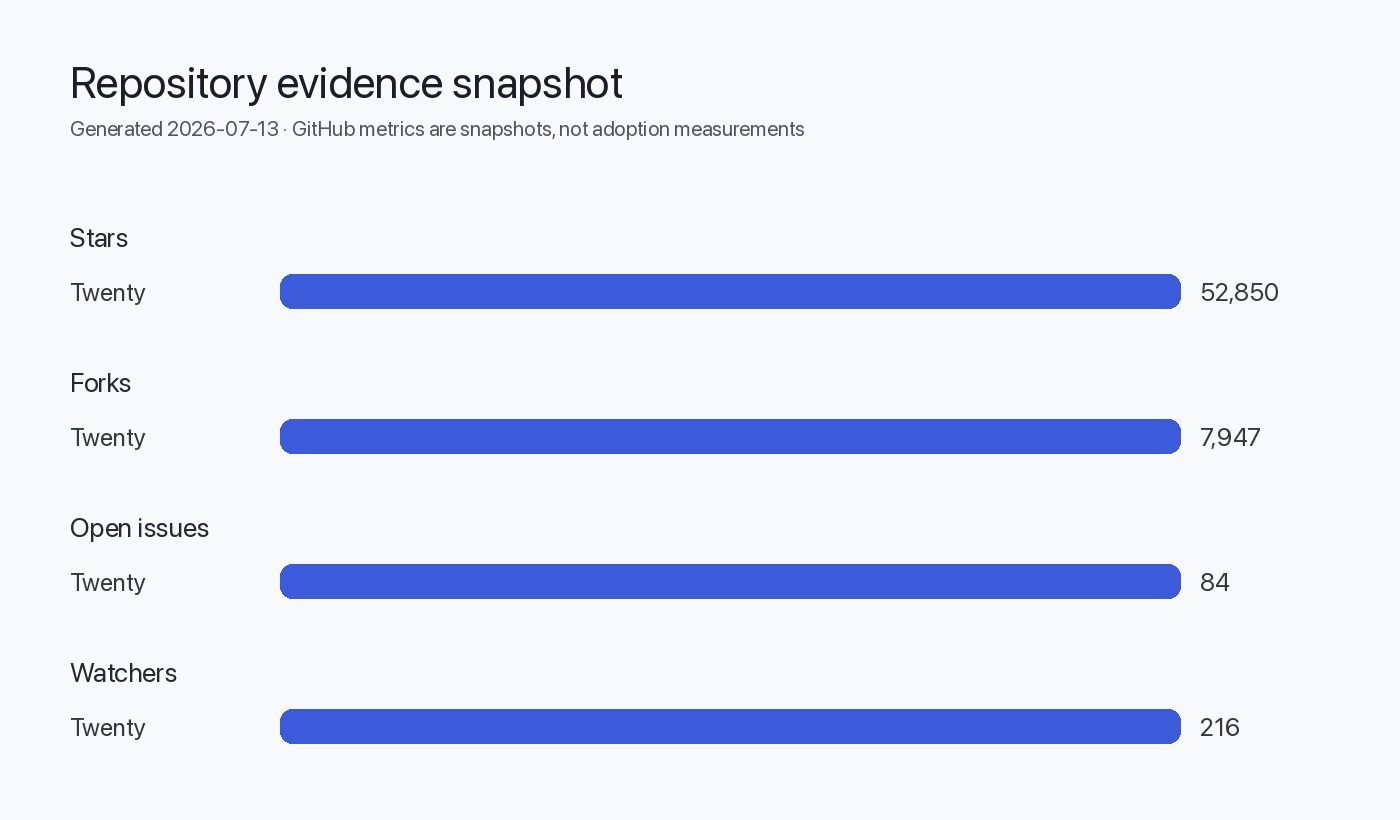
- Stars: 52,850 (signal of interest, not a usage metric)
- Forks: 7,947
- Watchers: 216
- Open issues: 84 (open issue counts are not the same as defect counts)
- Language: TypeScript
- License: reported as "NOASSERTION" in repository metadata
- Topics include: crm, graphql, nestjs, react, postgresql, redis, monorepo
- Created at: Dec 1, 2022
- Default branch: main
- Last pushed at: Jul 12, 2026
- Latest release: twenty/v2.20.0 published 2026-07-10
All of the above items are direct facts from the repository metadata and the latest release entry. Per repository semantics, stars and forks indicate interest and engagement signals; they should not be treated as precise adoption or market-share metrics. Similarly, open issue count is a snapshot and not an absolute defect indicator.
Core repository anatomy and inferred architecture
This section summarizes the repository's structure and the main technology choices you can reliably infer from public repository metadata and README-derived stack notes.
- Inferred: a TypeScript monorepo using Nx (monorepo tooling) that contains a React frontend and a NestJS backend, with PostgreSQL and Redis as core persistence and cache layers. This inference is drawn from the README stack list and repository topics.
- Inferred: background job processing is handled via BullMQ (mentioned in the README stack list).
- Inferred: the project exposes extension points for apps and an SDK/CLI for scaffolding and publishing app code (README references create-twenty-app and a CLI-based publish flow — paraphrased).
Why these inferences matter
- Technology alignment: the TypeScript/Nx/NestJS + React combination indicates a full-stack JavaScript/TypeScript development model where teams familiar with Node/React tooling can onboard more rapidly.
- Operational footprint: PostgreSQL + Redis + BullMQ implies stateful components (persistent DB, cache, job queue) that will affect backup, scaling, and operational planning.
Project categories and extension points
The Twenty repository organizes functionality into several logical categories. The table below consolidates common categories you should look for when evaluating the project for extension or integration.
| Category | What to look for in the repo | Why it matters |
|---|---|---|
| Core server | NestJS services, API schemas, GraphQL resolvers, core domain entities | Central business logic lives here; changes affect all workspaces and apps |
| Frontend UI | React apps, page layouts, widget libraries, layout metadata | Client-side extendability and theming; impacts UX consistency |
| SDK & CLI | SDK packages, dev CLI tools, app publishing commands, scaffolding | How teams develop, test, and publish custom apps and integrations |
| App marketplace & templates | Public app catalog, vetted/featured app resolver, marketplace metadata | Enables one-click installs and a discoverable app ecosystem |
| Integrations & connectors | Email/IMAP/SMTP code, calendar webhooks, call-recording, external API clients | Direct integration points with external systems and data flows |
| Data & persistence | Postgres schema migrations, seeds, RLS (row-level security) definitions | Operational and compliance concerns (backups, migrations, multi-tenancy) |
| Infra & deployment | Docker Compose manifests, self-host docs, CI workflows, deployment scripts | The path to self-hosting and CI/CD automation |
| Tests & QA | Integration/e2e tests, flaky test fixes, CI timeouts | Signal for test maturity and release readiness |
Additional note: The repository README and release notes reference features like AI chat/agents and marketplace scaffolding. Those are extension areas that teams can evaluate for alignment with their business use cases.
Integration patterns and deployment topologies
This section presents common integration patterns for adopting or integrating Twenty in your environment. The diagram below captures standard topologies; follow-up paragraphs describe each pattern.
flowchart LR
  A[Twenty Core (monorepo) ] -->|Expose APIs| B[Hosted Cloud Workspace]
  A -->|Self-host| C[On-prem / Customer Cloud]
  B --> D[Third-party SaaS (email, calendar, telephony)]
  C --> D
  A --> E[Apps marketplace / SDK]
  E --> F[Custom Apps / Agents]
  F --> D
  C -->|DB & Queue| G[Postgres + Redis]
  B -->|Managed DB| H[Managed Postgres]
Integration patterns (details)
- Cloud-first (hosted workspace): Spin up a workspace on the vendor-hosted service. Integration points are primarily API-based or via an app marketplace. Operational responsibilities (patching, backups) rest with the vendor.
- Self-hosted / on-prem: Run the production stack via Docker Compose or orchestrator. Expect responsibility for database backups, Redis uptime, and job queue sizing. The README suggests Docker Compose as an available self-host path (paraphrased from docs listing).
- App-based extension: Develop custom apps using the SDK/CLI scaffolded by the project. Apps can provide UI components, agents (AI), and business logic versioned alongside the repository's app publishing model.
- Connector-based integrations: Use built-in connectors (email, calendar, telephony) or build custom connectors that call external APIs. The release notes reference messaging and call-recording features, indicating existing connector types.
Integration patterns table
| Pattern | When to use | Key operational concerns |
|---|---|---|
| Cloud workspace | Fast evaluation, low ops budget | Vendor SLA, data residency, integration rate limits |
| Self-host with Docker Compose | Full control, regulatory constraints | Backups, upgrades, scaling, security patching |
| App marketplace + SDK | Reusable business logic, shareable features | Versioning, compatibility, app review process |
| API-first integration | Existing systems need programmatic access | API rate limits, auth (OAuth/workspace scoped tokens) |
Evaluation criteria: technical and operational checklist
Use the table below to score Twenty against essential topics during a 1–2 week technical evaluation. The table maps signals to interpretation and recommended next actions.
| Signal | Source (where to verify) | What it tells you | Action if signal is weak |
|---|---|---|---|
| Recent commits / pushes | GitHub repo "pushed_at" and commits history | Project activity level | Ask maintainers on discussions/Discord about release cadence; run a small local build to validate |
| Release cadence | Latest release published date and changelog | How frequently breaking/non-breaking changes are shipped | Plan for pinned versions and automated upgrade testing |
| CI and tests | Presence of CI workflows, passing build badges | Investment in QA and integration testing | Run tests locally; request CI logs for failing branches |
| Issue triage | Open issues, PR activity, labeled good-first-issue | Community responsiveness and onboarding friendliness | Try a small PR (documentation or trivial fix) to observe response time |
| Documentation depth | Docs site, API references, dev guides | Onboarding friction for developers | Allocate time for internal docs or request clarification in discussions |
| Packaging & upgrade strategy | SDK/CLI tools, app publish flow, version checks | How easily apps are deployed and upgraded | Validate install/uninstall flows in a sandbox |
| Licensing clarity | Repository license field and contributor license info | Legal constraints for use, redistribution, and modifications | Consult legal counsel if license is unclear (see Licensing section) |
Maintenance signals and how to interpret them
Key maintenance signals available from the public repository and release: stars, forks, last pushed time, open issues, and latest release published_at. Below are factual items from the repository and a short interpretation for each.
| Metric | Repository value (as of data retrieval) | Interpretation |
|---|---|---|
| Stars | 52,850 | Strong community interest signal (not a usage metric) |
| Forks | 7,947 | Many forks can indicate experimentation or derivative work |
| Open issues | 84 | Active issue backlog; open issues are not defect counts |
| Last pushed at | Jul 12, 2026 | Recent activity and commits to default branch |
| Latest release | twenty/v2.20.0 published 2026-07-10 | Recent release with a detailed changelog in the release body |
Embed: repository activity visualization
Interpreting signals
- Active pushes and a recent release indicate ongoing maintenance. Use these as prompts to review the changelog for breaking changes and the release notes for security-related fixes.
- High star/fork counts indicate interest but do not prove enterprise-grade support; verify SLAs and commercial offerings separately.
Licensing considerations and next steps
Fact: the repository metadata shows the license field as "NOASSERTION". That is the only licensing information that can be stated as fact here (see Sources). "NOASSERTION" is a GitHub metadata value that indicates no SPDX-compatible license string was asserted in the metadata API.
What this means for you
- A missing or unclear license field means you cannot rely on an implicit permission grant for reuse. Do not assume permissive use.
- You should obtain a clear license statement from the repository maintainers, check packaged files for LICENSE text, and consult legal counsel before using the code in a production system, especially in commercial settings.
Recommended steps
- Inspect the repository root for a LICENSE file (if present). The GitHub API license field may be NOASSERTION while a LICENSE file still exists in the tree — verify both.
- If no license is present, ask maintainers in the repository discussions or on their official channels (Discord, issues, or contact paths shown in the README) for clarification.
- If you plan to self-host or distribute modified code, consult legal counsel to determine acceptable terms.
Practical discovery workflow (step-by-step)
This workflow is designed for engineering teams doing a pilot or evaluating Twenty for 2–6 weeks.
- Snapshot & read: Fork or clone the repository; note key metadata (stars, pushes, releases). Verify the license file and read the release notes for the latest release (twenty/v2.20.0 published 2026-07-10). [Source links at the end.]
- Local build: Follow the project CONTRIBUTING or self-host docs to run a local development environment (README references Docker Compose and local setup). Confirm you can run a single-node sandbox and access the UI.
- Smoke test core paths: Create sample objects, run a simple workflow, and confirm agents (if present) and API endpoints respond. Note any missing docs or CLI discrepancies.
- App scaffold test: Use the SDK/CLI scaffolding flow (paraphrased, not verbatim) to scaffold a minimal app, publish it to a private/test workspace, and validate the install/uninstall lifecycle.
- Integration test: Connect one external service (email or calendar) in a sandbox and verify message flows and webhook delivery.
- Security & compliance check: Run dependency scanning, verify secrets handling, and consult the legal team about the license status.
- Load & resilience test: For self-hosted candidates, run a small load test on APIs and background jobs; measure resource use for Postgres and Redis.
- Decision point: Use the Decision Checklist below to determine whether to proceed to a staged pilot or discontinue.
Decision checklist -- Action checklist
Mermaid: high-level integration diagram
(See the earlier mermaid block for an integration topology sketch.)
Evidence, assumptions, and limitations
Evidence (facts used in this article):
- All repository metadata (stars, forks, watchers, open issues, language, topics, created_at, updated_at, pushed_at, default branch, homepage) are taken from the canonical repository source: the Twenty canonical repository on GitHub and the latest release entry. See Sources for links.
- Latest release: twenty/v2.20.0 published 2026-07-10; release body text was used to summarize recent changes as a factual signal of activity.
- Inferred: The stack is TypeScript + Nx + NestJS backend + React frontend with PostgreSQL and Redis. This is inferred from the repository README stack list and repository topics. Treat this as an architecture inference to be confirmed in code and docs.
- Inferred: App/SDK/CLI-based extension model exists (scaffolding and publishing). This inference is based on README references to a CLI scaffold and app publishing flow; confirm exact commands in official docs.
- This guide is based only on publicly available repository metadata and the README/release notes supplied. It does not include proprietary telemetry, enterprise contracts, or private deployment configurations.
- Repository signals (stars, forks, open issues) are indicators; they do not substitute for direct performance, security, or legal validation in your environment.
Data retrieval / generation date
- The repository and release facts used in this article were retrieved from the supplied sources and summarized with a generation timestamp of Jul 13, 2026. Use that timestamp to evaluate freshness when you read this guide.
FAQ
Is Twenty production-ready for enterprise use?
This guide does not assert production readiness. Repository activity (recent pushes and a recent release) indicates active maintenance, but production adoption requires validating the license, operational requirements, upgrade behavior, and security posture in your environment.
What license applies to Twenty?
The repository metadata reports the license as "NOASSERTION". Verify by checking for a LICENSE file in the repository tree and seek clarification from maintainers or legal counsel before using or redistributing the code.
Can I self-host Twenty?
Project docs reference self-hosting paths (Docker Compose and local setup). Treat that as an inference from public docs and confirm by following the self-host instructions in a sandbox.
How can I extend Twenty with custom features?
The repository references SDK and CLI scaffolding for app development and publishing. Validate the scaffold → publish → install → upgrade lifecycle in a private workspace before production rollout.
Do GitHub stars indicate enterprise usage?
No. Stars are interest signals and should not be interpreted as proof of enterprise adoption or support. Use additional verification channels for adoption claims.
What operational components should I plan for when self-hosting?
Based on inferred stack signals, plan for PostgreSQL backups, Redis availability, job queue sizing (BullMQ), and container/orchestration resources for frontend and backend services.