Laravel (laravel/framework) — Repository Spotlight
A practical, evidence-based profile of the laravel/framework GitHub repository: purpose, maintenance signals, release behavior, strengths, limitations, and a checklist for responsible adoption.
Laravel's core repository (laravel/framework) is the canonical home for the framework's core code. The repository shows active maintenance: a recent release (v13.19.0 published 2026-07-07), recent repository activity (pushed and updated timestamps on 2026-07-12), and a visible CI badge and dependency badges in the README. These facts indicate a project that continues to receive feature work, bug fixes, and CI validation as of the data retrieval date.
This profile summarizes purpose, maintenance signals, observable strengths and limitations, an evaluation checklist for technical teams, and a responsible adoption path. All claims below are grounded in the repository metadata and release notes; where an architectural conclusion is inferred from README or repository structure it is explicitly labeled as such.
Repository snapshot
This table collects the factual metadata for the repository as pulled from the supplied repository data (data retrieval/generation date: Jul 13, 2026).
| Field | Value |
|---|---|
| Repository | laravel/framework |
| Description (short) | Laravel is a web application framework with expressive, elegant syntax. |
| Primary language | PHP |
| License | MIT |
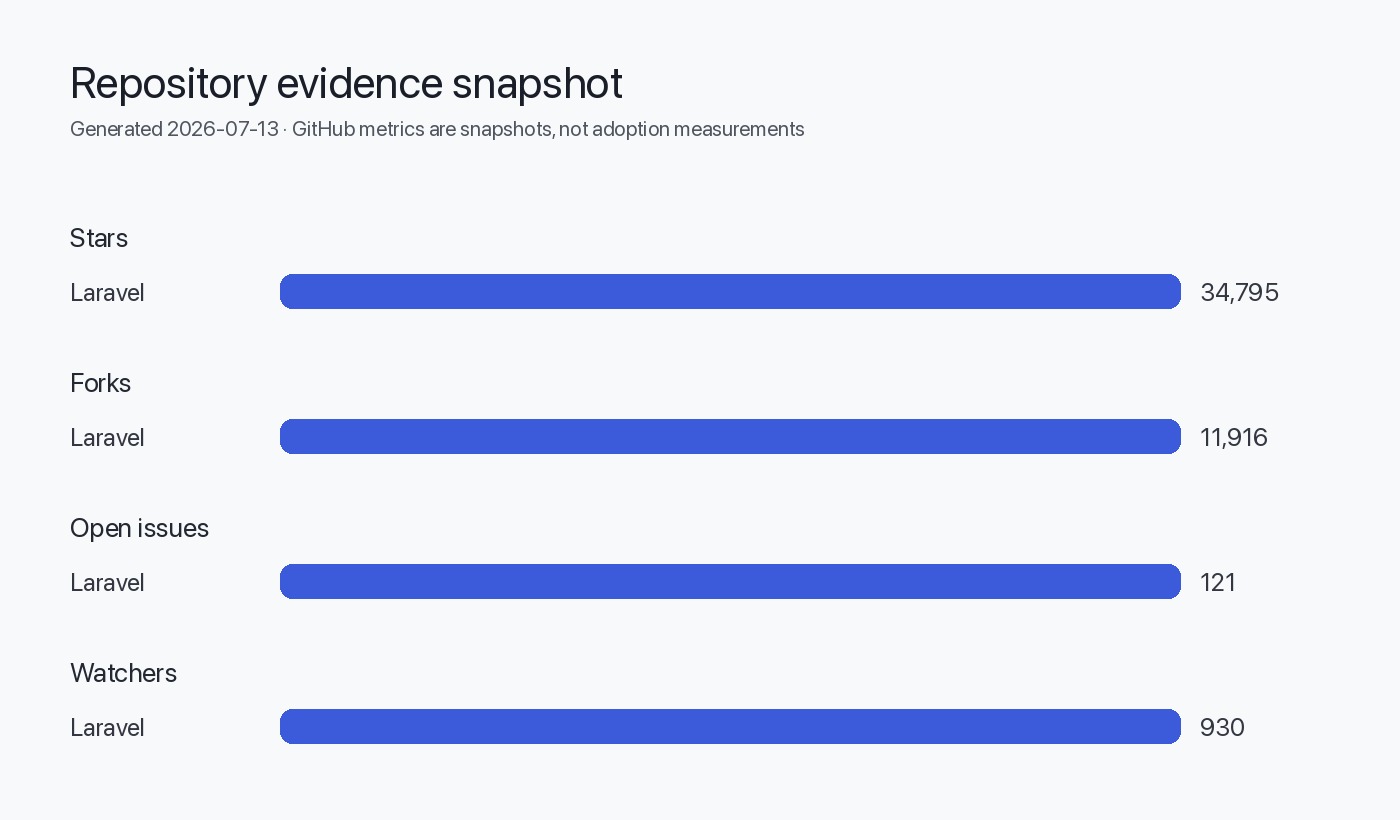
| Stars (signal) | 34,795 |
| Forks | 11,916 |
| Watchers | 930 |
| Open issues (count) | 121 |
| Default branch | 13.x |
| Created at | Jan 10, 2013 |
| Latest release | v13.19.0 (published 2026-07-07) |
| Latest release notes | See release details (includes a list of PRs merged into 13.x and 12.x) |
| Repository homepage | https://laravel.com |
Sources: repository metadata and latest release record cited inline where relevant below (see Sources section).
Purpose and scope
- The repository contains the core code for the Laravel framework — the reusable components and the runtime API that frameworks and applications rely on. The repository README explicitly states this repo contains the "core code of the Laravel framework" and directs application authors to a separate project for application scaffolding ([laravel/laravel]) — this is a factual note taken from the repository README [source: repository].
- The README lists primary framework capabilities that the repository surfaces, including: routing, dependency injection (container), session and cache back-ends, schema migrations, background job processing (queues), and broadcasting. These features are enumerated in the README and represent the functional surface the framework claims to provide [source: repository].
- The repository is intended for framework consumers (developers building PHP web applications), contributors (people who implement core fixes/features), and integrators who rely on the framework as a dependency. The README includes links to documentation and learning resources for application authors [source: repository].
Maintenance signals and health indicators
This section lists maintenance signals that are observable from the supplied repository metadata and release record, and what each signal typically implies for engineering decision-making.
| Signal | Data point (from repository) | Interpretation / Evidence-based implication |
|---|---|---|
| Recent release | v13.19.0 published 2026-07-07 | The project publishes releases; the provided release body shows merged PRs and incremental feature/bug work [source: latest release]. |
| Recent commits / pushes | pushed_at: Jul 12, 2026 | Repository had commit activity the day before data generation (2026-07-13), indicating ongoing maintenance. |
| Repo metadata updated | updated_at: Jul 12, 2026 | Metadata or documentation updates occurred recently. |
| CI presence | README contains a GitHub Actions tests badge | The repository uses CI as part of its workflow (badge present in README) [source: repository]. |
| Health badge | README references a Linux Foundation "health-score" badge | A health score badge is shown in the README (badge presence is evidence the project tracks or exposes a health metric) [source: repository]. |
| Community signals | Stars: 34,795; Forks: 11,916; Watchers: 930 | High interest and forking activity suggest an active community; these are indicators, not usage counts. |
| Open issues count | 121 open issues | An open issue count is listed; this is a snapshot and not a direct defect count. |
Visual: maintenance timeline and release activity
(Visual above: release published 2026-07-07; repository pushed_at and updated_at 2026-07-12; data generation 2026-07-13.)
Evidence-backed strengths
All strengths below are derived from explicit README statements, repository metadata, or the latest release notes.
- Feature-rich core surface (README enumerated capabilities)
- The README lists a routing engine, dependency injection container, session/cache back-ends, schema migrations, job queues, and broadcasting as core capabilities. These are part of the framework's documented surface and are a factual representation of the repository's intended functionality [source: repository].
- Active maintenance and release cadence (release + push timestamps)
- The repository has recent commits and a recent release (v13.19.0 published 2026-07-07; pushes 2026-07-12), which shows the project is being maintained and updated as of the data retrieval date [sources: repository, latest release].
- Visible CI and QA signals
- The README includes a GitHub Actions tests badge, which is evidence the repository exercises CI workflows as part of its validation pipeline (badge is visible in README) [source: repository].
- Community interest and contribution surface area
- Stars and forks (34,795 and 11,916) indicate sustained community attention and an active forking/extension ecosystem; the release notes show many PRs merged into the 13.x line, which indicates contributions are reviewed and merged into the codebase [sources: repository, latest release].
- Documentation and learning resources linked
- The README directs users to extensive documentation and learning platforms (Laravel docs, Laracasts, Laravel Learn). These references are factual items in the README and indicate an emphasis on developer onboarding [source: repository].
Limitations and cautions
All limitations below are grounded in the repository content and metadata.
- Core vs application scaffold: The README explicitly states this repository contains the framework core and directs application builders to a separate "main Laravel repository" for application scaffolding. For teams starting a project, this means you should use the designated application template repository rather than building an app directly on this core repo [source: repository].
- Language and runtime constraints: The repository's primary language is PHP. Any platform or hosting decisions must account for PHP runtime compatibility, versions, and hosting considerations (fact: language is PHP; runtime details beyond that are not provided in the supplied sources). Refer to upstream docs for supported PHP versions.
- Interpreting issue counts and stars: The repository shows 121 open issues and ~34.8k stars. These are signals (interest, potential backlog), not direct measures of code quality, security posture, or adoption breadth. Triage and historical metrics are required to draw those conclusions.
- Security surface: The README includes a link to a security policy page for reporting security vulnerabilities. The repository metadata does not provide an exhaustive list of advisories here; investigate the security policy and any external advisories before production adoption [source: repository].
Inferred architecture and workflow (explicitly labelled)
The following items are architectural or workflow inferences made from the README text, release notes, and repository structure. These are explicitly labeled as inferences and should be validated against official docs or maintainers if they matter to your decision.
- Inferred: Branch-based maintenance model with 13.x and 12.x lines
- Evidence: The latest release notes include entries marked "[13.x]" and "[12.x]", and the repository's default branch is named "13.x". This suggests the project maintains multiple supported release lines concurrently (inferred from release notes and default branch) [source: latest release].
- Inferred: Use of GitHub Actions for CI
- Evidence: The README displays a GitHub Actions tests badge; presence of such a badge typically signals a CI-driven pipeline for tests and validations (inferred from README badge) [source: repository].
- Inferred: Community-driven contributions and PR review workflow
- Evidence: The release body lists many contributors' GitHub handles and pull request references, indicating an active PR-based contribution workflow and maintainer merges (inferred from release notes) [source: latest release].
flowchart LR
  A[Contributor (PR)] --> B[CI / Tests (GitHub Actions)]
  B --> C[Maintainer Review]
  C --> D[Merge into branch (e.g., 13.x)]
  D --> E[Release (tagged, e.g., v13.19.0)]
  E --> F[Publish release notes]
  note_right of A,C : Inferred from README badges
  note_right of D,E : Inferred from release notes and default branch
(Above diagram models the repository contribution->CI->merge->release flow; the role of CI and branch naming is inferred from README badges and release notes.)
Evaluation checklist (technical due diligence)
Use this checklist when evaluating laravel/framework for inclusion in a project or for upgrading an existing project.
- Repository provenance
- Release policy and branches
- CI and automated tests
- Documentation and learning resources
- Security and policy
- Dependency surface and PHP versions
- Community and support
Responsible adoption path and decision checklist
Below is a pragmatic adoption path for teams evaluating Laravel for a new project or upgrading an existing application. These steps are grounded in repository signals and README guidance.
Decision checklist (high level):
| Decision point | Action |
|---|---|
| Start a new app | Use the application scaffold repository (the README explicitly directs application builders away from the core repository). Confirm which repo is intended for app scaffolding. [source: repository] |
| Upgrade major branch | Review release notes for the target branch (e.g., 13.x) and test your application against the new branch in a branch or staging environment. The release notes enumerate changes merged. [source: latest release] |
| Contribution policy | Read the contributing guide and code of conduct linked from the README before contributing. [source: repository] |
| Security | Check the repository's security policy and any relevant advisories; plan for dependency updates. [source: repository] |
Action checklist (practical steps for teams)
- Clone the canonical repository for local study: https://github.com/laravel/framework [source: repository].
- Review the release notes for the branch you plan to target (e.g., v13.19.0 notes for 13.x). Identify breaking changes or noteworthy behavior changes [source: latest release].
- Inspect composer.json and CI workflow files in the repo to understand PHP version constraints and test coverage (files to inspect are in the repository; not provided here).
- Build a small proof-of-concept application using the recommended application repo (README guidance) to validate hosting, runtimes, and extensions.
- Run the repository's test suite locally and examine CI logs (README shows CI badge; running tests verifies compatibility in your environment).
- Establish a security and dependency update policy aligned with your deployment cadence; subscribe to repository releases or tags for notifications.
Evidence, assumptions, and limitations
- Evidence used in this profile is limited to the supplied repository metadata and the latest release record (data retrieval/generation date: Jul 13, 2026). The two supplied sources are the repository root and the v13.19.0 release page; all inline references point to those sources [see Sources].
- Assumptions explicitly called out:
- Any architecture or workflow descriptions that are not verbatim from README or release text have been marked as "Inferred". These inferences are based on standard GitHub workflows and the artifacts visible in the README (badges) and release notes (PRs and branch labels).
- Statements about runtime compatibility, exact test coverage, or internal module interactions are not asserted here because the supplied data does not contain composer.json, CI logs, or code-level analysis.
- Limitations of this profile:
- The supplied data does not include the repository's full codebase, dependency manifests, or test reports. For low-level or security-sensitive decisions, conduct code-level review and run dependency vulnerability scans.
- Community dynamics and support levels evolve; stars/forks/watchers are snapshots and do not guarantee future responsiveness.
Sources
- Laravel canonical repository: https://github.com/laravel/framework
- Laravel latest GitHub release (v13.19.0): https://github.com/laravel/framework/releases/tag/v13.19.0
FAQ
Is laravel/framework the right repo to start a new Laravel application?
No. The README explicitly states this repository contains the framework core and directs application authors to the main application repository for scaffolding; use that application template to start new projects.
How active is development for laravel/framework?
As of the supplied data, a release (v13.19.0) was published on 2026-07-07 and repository activity (push/update) occurred on 2026-07-12, indicating recent maintenance.
Can GitHub stars be used to measure adoption?
Stars are interest signals and community indicators, but they are not direct measures of production usage or market share. Use them alongside other metrics.
Does the repository run CI?
The README includes a GitHub Actions tests badge, which is evidence that CI workflows are used for validation.
Are multiple minor/major branches maintained?
Release notes and the default branch (13.x) show entries for both 13.x and 12.x, indicating multiple supported lines may be maintained (this is inferred from release notes and branch naming).
Where do I report security vulnerabilities?
The repository README links to a security policy page that explains the process for reporting security vulnerabilities; follow that policy for disclosure.