Svelte: tsdproxy token-forwarding advisory (GHSA)
A critical GHSA (GHSA-g936-7jqj-mwv8) describes tsdproxy forwarding an internal auth token to proxied backends allowing management API escalation. Svelte itself is not named; this briefing explains infrastructure impact, dependency-chain relevance, verification examples, and an incident-response checklist.
Svelte is not named in the published advisory; this security alert explains a critical vulnerability disclosed in the tsdproxy project (GHSA-g936-7jqj-mwv8) that forwards an internal management auth token to proxied backend services. The advisory describes how a backend with the forwarded token can replay it from localhost to the tsdproxy management API and obtain administrative capabilities.
If your Svelte applications are only consuming Svelte packages or compiled outputs, they are not directly affected by this advisory. However, if your deployment or dev infrastructure uses tsdproxy, or if backend services that host Svelte applications run on hosts or containers alongside an affected tsdproxy instance, this advisory can affect your operational environment. This briefing differentiates factual advisory content from guidance and lists safe verification commands and prioritized actions for maintainers and operators.
What this alert covers
This article is a focused, evidence-grounded briefing of the GitHub Security Advisory GHSA-g936-7jqj-mwv8 concerning tsdproxy. It: (1) extracts factual statements from the advisory and repository metadata, (2) clarifies whether and how Svelte—the primary technology referenced by this article—could be involved, and (3) gives safe verification commands and concrete remediation guidance for maintainers and operators.
Facts cited here are limited to the advisory content and repository metadata supplied by the editorial data. Data retrieval/generated timestamp used for freshness: Jul 13, 2026 (provided in editorial data).
Executive facts from the advisory
- Advisory identifier: GHSA-g936-7jqj-mwv8 (GitHub advisory link).
- Affected package: github.com/almeidapaulopt/tsdproxy (ecosystem: go).
- Summary from the advisory: "TSDProxy: Internal proxy auth token forwarded to backend services enables management API escalation." The advisory describes an internal per-process authentication token forwarded to proxied backends when
identityHeadersis enabled. - The advisory demonstrates that tsdproxy injects
x-tsdproxy-auth-tokeninto every upstream HTTP request whenidentityHeaders=true, and that the token can be replayed from localhost to the management port to bypass Tailscale authentication checks. - Affected files and code excerpts are listed in the advisory (examples:
internal/proxymanager/port.goandinternal/core/admin.go) showing the conditional injection and a local-trust path in the management API. - The advisory lists a vulnerable range and a patched version: vulnerable range is "< 1.4.4-0.20260603142855-434819b4421e", patched to "1.4.4-0.20260603142855-434819b4421e" (as shown in the advisory data).
- Advisory severity: critical (as published in the advisory metadata).
- No CVE identifier is listed in the advisory metadata supplied.
- The advisory includes a remediation suggestion in source: remove forwarding of
HeaderAuthTokento backends and inject identity headers only for actually authenticated users (checkuser.ID != "").
All of the above statements are derived from the supplied advisory and metadata; see the advisory on GitHub for the source material.
Is Svelte directly affected?
Short answer: No. The advisory does not name Svelte, its repositories, or Svelte's release artifacts.
Longer clarification:
- The primary technology for this article is Svelte (repository: sveltejs/svelte). The supplied security advisory targets tsdproxy, a separate Go-based proxy project.
- Because Svelte is not referenced in the advisory, there is no factual basis to claim Svelte itself is vulnerable.
- The risk for Svelte projects is contextual: if your Svelte application or its hosting infrastructure runs on a host or in a container that also runs an affected tsdproxy instance (or shares its network namespace), an attacker who can obtain or exploit the forwarded token could affect the management plane that controls proxies and proxied services for that host or network namespace. That is a deployment-level risk, not a code-level vulnerability in Svelte's codebase.
Dependency-chain relevance and threat scenarios
This section outlines how a tsdproxy flaw could affect systems that serve Svelte applications. These are architectural conclusions inferred from the advisory text and standard deployment patterns (explicitly labelled as inferred):
- Inferred architecture: a common deployment pattern is a frontend (e.g., a Svelte app) served by a backend that is reachable by tsdproxy. If tsdproxy and a backend process run on the same host or share a network namespace/container, tsdproxy may forward its management token to that backend. A compromised or malicious backend could replay that token to the local management API and gain control.
- Realistic threat scenarios (derived from advisory text):
- Non-Docker or host deployments where tsdproxy and backend processes share localhost access.
- Docker containers running in host-network mode or containers that share tsdproxy's network namespace.
- Any environment where an attacker can execute code in a proxied backend (e.g., remote code execution, malicious build, or compromised container) and where that backend receives forwarded
x-tsdproxy-auth-tokenheaders.
- Impact on Svelte-hosted services (inferred): If your Svelte frontend is served by a backend that runs alongside tsdproxy, the management API escalation could allow an attacker to enumerate proxy configurations, pause/restart proxies (DoS), or trigger webhooks that influence network interactions (SSRF) — potentially affecting availability and confidentiality of proxied services.
Affected range and remediation table
| Package | Ecosystem | Vulnerable range (from advisory) | Patched version (from advisory) | Advisory link |
|---|---|---|---|---|
| github.com/almeidapaulopt/tsdproxy | go | < 1.4.4-0.20260603142855-434819b4421e | 1.4.4-0.20260603142855-434819b4421e | GHSA-g936-7jqj-mwv8 |
Verification commands (examples only, safe)
These are non-destructive, generic checks you can run to discover whether tsdproxy appears in your environment or whether your backends and proxies share a host/network namespace. Use them as examples — adapt to your environment and operational policies.
| Goal | Example command (example only) | Notes | |
|---|---|---|---|
| Find running containers with "tsdproxy" in the name or image | docker ps --format '{{.Names}} {{.Image}}' | Grep for tsdproxy; adjust for container runtime (podman, containerd) | |
| Find processes with "tsdproxy" on Linux host | ps aux | grep tsdproxy | Requires host shell access |
| Check whether localhost:8080 (management) is listening on the host | sudo ss -lntp | grep 8080 | Replace with management port if different |
| Check for Go module dependency in a Go service | go list -m all 2>/dev/null | grep almeidapaulopt/tsdproxy | Run in the module root; safe read-only command |
| Inspect Docker container network mode | docker inspect -f '{{.HostConfig.NetworkMode}}' <container> | HostNetwork mode may indicate shared network namespace |
Examples above are safe, read-only commands. Do not run exploitation steps from the advisory; do not attempt to replay or capture tokens in production environments unless you are performing an authorized incident response.
Recommended actions for maintainers and operators
This guidance is editorial (recommendations) and labelled accordingly. Priorities reflect the advisory's severity (critical) and the potential for management-plane compromise.
Action matrix — recommended immediate steps
| Priority | Audience | Recommended action | Rationale |
|---|---|---|---|
| P0 (Immediate) | Infrastructure operators | If you run tsdproxy, upgrade to the patched version listed in the advisory immediately. If immediate upgrade isn't possible, disable identity header forwarding (identityHeaders=false) or otherwise block access to the management API from proxied backends (restrict to a management-only network/port). | Advisory indicates token is forwarded by default and can be replayed; stopping token forwarding or eliminating backend access to management API mitigates exploitation paths. |
| P0 | All deployers | Audit hosts and container network configurations to determine if tsdproxy and backend services share a network namespace or host. If so, isolate management API (bind to management-only interface or firewall to localhost-only where possible). | Exploitation requires backend-to-management localhost access per advisory. |
| P1 | CI/CD teams | Search your artifacts and images for tsdproxy or the package name and rebuild images that embed vulnerable versions. | Build-time inclusion could create attack surface when deployed on shared hosts. |
| P1 | Developers & DevOps | Add monitoring/alerting for unexpected requests to management API endpoints or sudden changes to proxy configurations. | Detects post-compromise actions such as enumeration or restarts. |
| P2 | Maintainers & security teams | Review any internal code that reuses forwarded headers and ensure sensitive tokens are never forwarded to upstream services. | Matches the fix recommended in the advisory. |
Implementation notes (editorial):
- The advisory recommends removing forwarding of the management auth token and ensuring identity headers are injected only for actually-authenticated users (check
user.ID != ""). If you maintain tsdproxy in your stack, apply the upstream patch or the equivalent fix. - If you maintain Svelte applications, verify where and how they are hosted. If your Svelte app is purely client-side and served from a CDN or static host, it's unlikely to be impacted directly by tsdproxy. If your app is bundled with a server component that may run on hosts with tsdproxy, follow the steps above.
Incident-response checklist
This checklist is an operational guide for investigating and responding to possible exploitation in environments where tsdproxy is deployed.
- Contain
- Isolate affected host(s): remove network routes between proxied backends and the management API or take the host offline if required.
- If you cannot isolate immediately, disable
identityHeadersin the tsdproxy configuration to stop token forwarding.
- Preserve evidence
- Collect process lists, open network sockets, container configs, docker/podman inspect outputs, and tsdproxy logs.
- Preserve application logs for proxied backends (header logs, request logs) that may show forwarded tokens.
- Identify scope
- Enumerate all hosts and containers running tsdproxy and determine which backends share their network namespace.
- Use read-only discovery commands (see verification commands table) to avoid contaminating evidence.
- Eradicate
- Upgrade tsdproxy instances to the patched version listed in the advisory.
- Remove or rotate any secrets that may have been exposed to proxied backends if you have evidence of token leakage.
- Recover
- Restore services in a controlled fashion after verifying upgrades and network restrictions are in place.
- Post-incident
- Review access logs for management API calls from localhost that may indicate token replay attempts.
- Rotate credentials and webhook secrets if you suspect they may have been exposed through webhook deliveries triggered by an attacker.
Decision / Action checklist (quick reference)
- Do we run tsdproxy anywhere in our infrastructure? If yes -> immediate.
- Are any tsdproxy instances at versions older than the patched version in the advisory? If yes -> upgrade now.
- Do any backends share the host or network namespace with tsdproxy? If yes -> isolate management API and consider disabling identity headers until patched.
- Are our Svelte projects only served as static builds from CDNs or separate hosts? If yes -> low priority, but still verify hosting environment.
Visual diagram: how the described escalation works
flowchart LR
  A[Client request -> tsdproxy]
  A --> B[tsdproxy forwards to backend]
  B --> C[Backend receives x-tsdproxy-auth-token]
  C --> D[Backend (compromised) -> connects to 127.0.0.1:8080]
  D --> E[Management API trusts token and forwarded x-tsdproxy-id]
  E --> F[Attacker gains management actions: enumerate, restart, webhooks]
  style E fill:#f8d7da,stroke:#a94442,stroke-width:2px
Evidence, assumptions, and limitations
Evidence (facts from supplied data)
- Advisory content and code excerpts are taken from GHSA-g936-7jqj-mwv8: GitHub advisory. The vulnerable range and patched version are provided in the advisory metadata.
- Svelte repository metadata (stars, recent release, default branch) is available from the supplied Svelte repository details: sveltejs/svelte and latest release.
- Any statements about how a Svelte application might be affected are inferred from typical deployment patterns where a Svelte frontend is served by a backend on the same host or container as tsdproxy. These are architectural inferences based on the advisory text and common practices; they are not direct facts from the advisory.
- The advisory targets tsdproxy; it does not mention Svelte. This briefing does not and cannot assert any vulnerability in Svelte itself.
- This article does not contain exploit code or reproduction steps that would enable exploitation. The advisory includes a reproduction outline; we have deliberately omitted destructive reproduction commands and replaced them with safe verification examples.
- Dates and repository metadata are accurate as of data generation: Jul 13, 2026 (provided). The advisory was published on 2026-07-10 (advisory metadata).
Data and trends snapshot
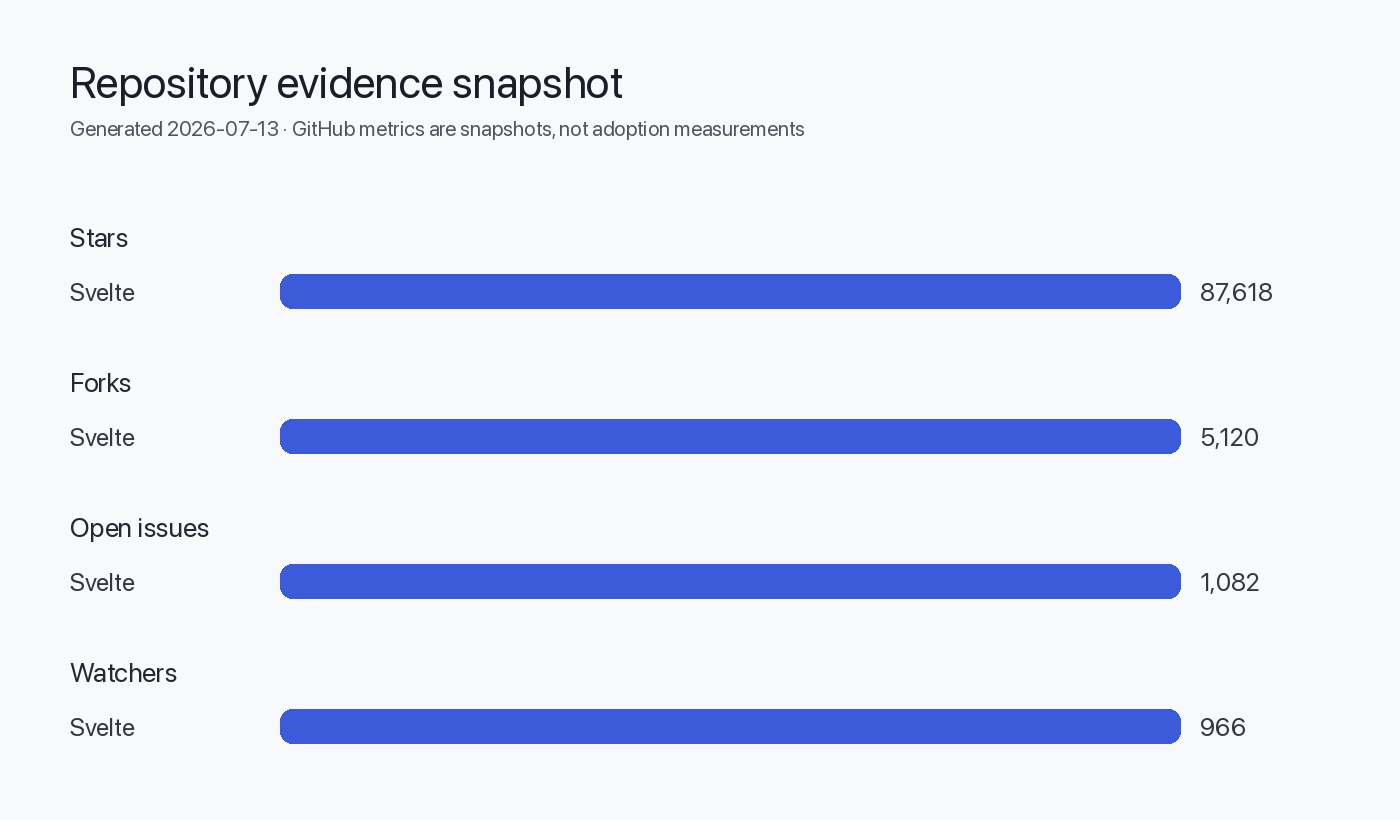
Table: Quick reference for Svelte repository metadata (editorial data provided)
| Field | Value |
|---|---|
| Repository | sveltejs/svelte ([source])(https://github.com/sveltejs/svelte) |
| Stars | 87618 (metadata signal only) |
| Default branch | main |
| Latest release (supplied) | [email protected] published 2026-06-23 |
| Repo language | JavaScript |
Note: GitHub stars are interest signals and are not a measure of usage or vulnerability. Open issues counts are not defect counts; they are provided as metadata.
Sources
- Svelte canonical repository: https://github.com/sveltejs/svelte
- Svelte latest GitHub release: https://github.com/sveltejs/svelte/releases/tag/svelte%405.56.4
- GitHub Security Advisory GHSA-g936-7jqj-mwv8: https://github.com/advisories/GHSA-g936-7jqj-mwv8
FAQ
Does this advisory mean Svelte is vulnerable?
No. The advisory explicitly targets tsdproxy and does not name Svelte. Any impact on Svelte applications would be via shared infrastructure where tsdproxy is deployed.
I deploy Svelte apps to a host that also runs tsdproxy. What should I do first?
Prioritize containment: check whether tsdproxy versions are vulnerable and whether the management API is accessible from proxied backends. If so, upgrade tsdproxy or disable identity-header forwarding and restrict management API access.
Is there a patched version to upgrade to?
Yes. The advisory lists the patched version as 1.4.4-0.20260603142855-434819b4421e for github.com/almeidapaulopt/tsdproxy; follow the advisory link for exact details: GHSA-g936-7jqj-mwv8.
Can I safely test for this in production?
Use only non-destructive, read-only verification commands. Do not attempt token replay or exploitation in production without authorization. Follow the incident-response checklist if you find evidence of compromise.
Where can I find the advisory and affected code excerpts?
The advisory and the code excerpts mentioned are published on the advisory page: GHSA-g936-7jqj-mwv8.
Who reported this issue?
The advisory credits Vishal Shukla (reporter) and notes the audit originates from an AI-assisted research agent at sechub.dev, per the advisory text.