Saleor adoption analysis: signals and selection checklist
A technical adoption analysis of Saleor (saleor/saleor) focused on repository signals, release cadence, issue load, license, ecosystem signals, selection risks and actionable evidence teams should collect.
Saleor (saleor/saleor) is an open-source, GraphQL-native, headless commerce API whose canonical repository shows active maintenance: the default branch is main, recent pushes and an up-to-date release (3.23.17) are present, and the project uses a permissive BSD-3-Clause license. These repository facts, combined with a multi-repo ecosystem (dashboard, storefront, CLI) and documented cloud offering, indicate a project designed for composable commerce and team-driven integrations. Data retrieved/generated: Jul 13, 2026. See the repository and release sources cited below for details: the GitHub repository and the 3.23.17 release notes.
For teams evaluating Saleor, treat repository signals as directional evidence, not proof of market share or product–fit. This article synthesizes the repository facts, release notes, and repo metadata into a practical adoption checklist: what the repository says, what it doesn’t, the selection risks it raises (integration surface, upgrade effort, operational model), and the additional evidence you must collect (performance testing, dependency scan, real-world references, SLA requirements). All repository facts cited are sourced from the Saleor GitHub repository and the 3.23.17 release page.
Quick repo facts snapshot
This section lists repository metadata extracted from the canonical repository. These are factual attributes of the GitHub repository and the latest release as of the retrieval date above.
| Attribute | Value |
|---|---|
| Repository | saleor/saleor |
| Description | "Saleor Core: the high performance, composable, headless commerce API." |
| Primary language | Python |
| License | BSD-3-Clause |
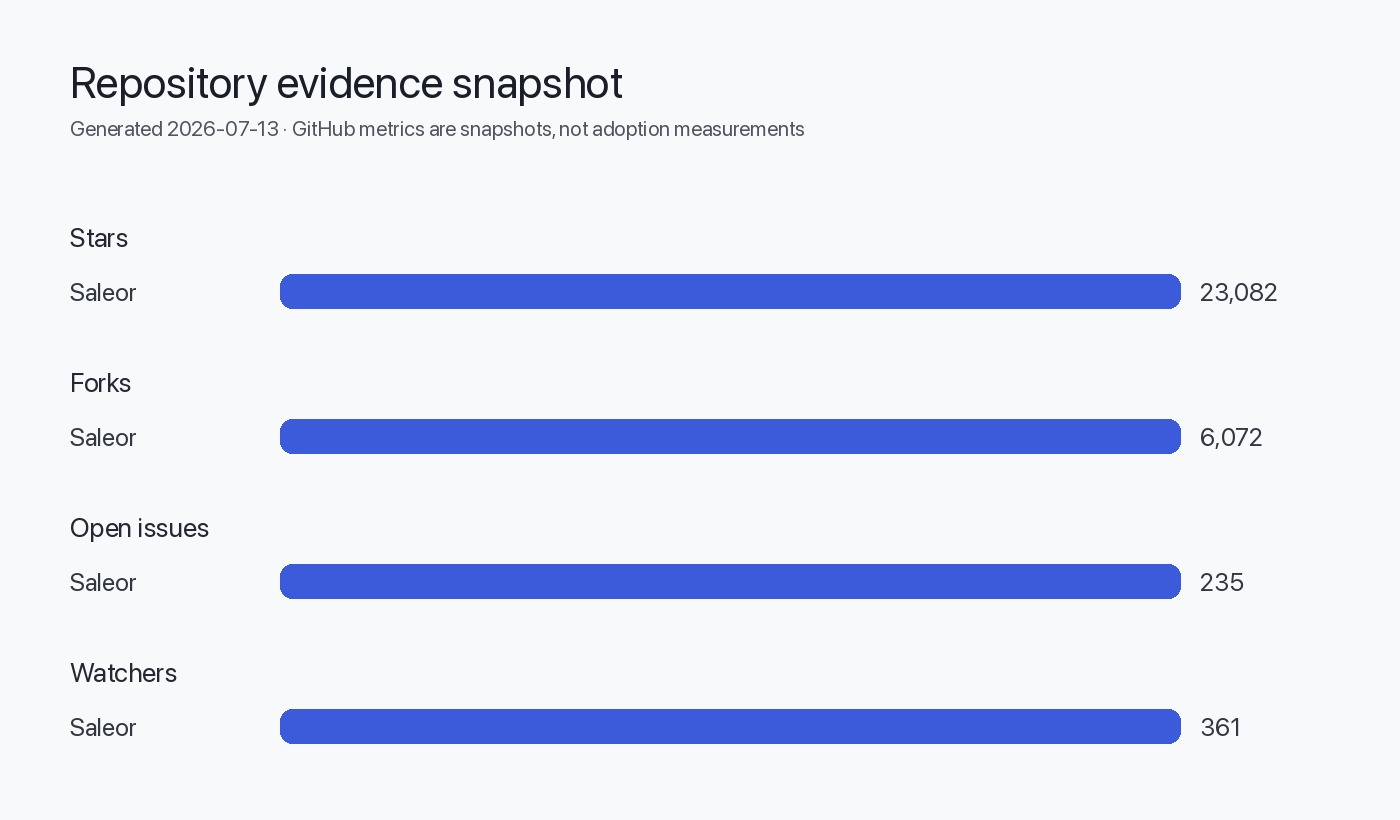
| Stars | 23,082 |
| Forks | 6,072 |
| Watchers | 361 |
| Open issues (repo) | 235 |
| Default branch | main |
| Created at | Feb 12, 2013 |
| Latest push | Jul 10, 2026 |
| Latest repo update | Jul 12, 2026 |
| Latest release | 3.23.17 (published 2026-07-07) |
Notes:
- Stars and forks are public GitHub counters and are included as interest signals; see the later interpretation section about what they represent.
- Open-issue count is a snapshot of the repository metadata and is not a count of defects alone. See interpretation section.
Interpreting repository signals (what the data actually means)
Repository metrics are proxies. Use them to form evidence-backed hypotheses, then validate those hypotheses with additional data.
Key evidence-grounded interpretations
- Activity and recency: The default branch is main, there are recent pushes (pushed_at: 2026-07-10) and a release published 2026-07-07. These are direct facts indicating ongoing maintenance and releases as of July 2026. They do not guarantee stability for your specific use-case; they only show the project is actively developed.
- License: BSD-3-Clause is permissive; the factual implication is fewer licensing constraints for commercial use compared to copyleft licenses. It does not substitute for legal review in regulated environments.
- Stars and forks: These are interest signals. They suggest attention from the ecosystem but are not usage, revenue, or market-share metrics. Treat them as indicators of visibility rather than adoption volume.
- Open issues (235): Per policy, open-issue counts are not defect counts. Issues include feature requests, discussions, and maintenance tasks. The raw number signals community activity and potential backlog, but needs qualitative sampling.
- Multi-repo ecosystem: The README and repository links reference separate repositories (dashboard, storefront, CLI, platform). Architectural conclusion inferred from README/repo structure: Saleor is designed as a composable, multi-repo platform with separate responsibilities split into API (this repo), a dashboard repo, a storefront repo, and platform/CLI tooling. (Explicitly labeled inference: inferred from README content and repository links.)
Repository metrics should be starting points, not decisions. Confirm operational constraints (hosting, scaling, integrations) before committing.
Release cadence and security signals
Facts from the latest release: the repository has a release tagged 3.23.17 published 2026-07-07. The release notes for 3.23.17 reference an upgrade of Django to v5.2.16 and list three CVEs addressed in that upstream upgrade: CVE-2026-48588, CVE-2026-53877, CVE-2026-53878. The release notes and changelog are available on the project's release page.
| Release element | Fact (source) |
|---|---|
| Latest tag | 3.23.17 |
| Published at | Jul 7, 2026 |
| Notable content | Upgrade to Django v5.2.16; fixes referencing CVE-2026-48588, CVE-2026-53877, CVE-2026-53878 |
Security interpretation guidance:
- The repository's latest release explicitly reports dependency upgrades and listed CVEs; this is evidence the maintainers track upstream security fixes and incorporate them into releases.
- For operational security, teams must run dependency scans against the exact component versions they plan to deploy and validate which CVEs apply to their deployment matrix (OS, Python runtime, optional packages).
Do not assume a release that mentions upstream CVE fixes eliminates all risk for your deployment. You must verify your installed dependency graph and the versions running in your environment.
Ecosystem, integrations, and architectural inference
Saleor positions itself as GraphQL-native and API-only, and the repository README links to storefront and dashboard projects. From these facts we infer an architecture that favors composability and separation of concerns.
Architectural conclusion (inferred from README and repository structure):
- Saleor uses an API-first approach with GraphQL as the primary protocol; storefront and dashboard are separate repositories intended to consume the API. This implies that production deployments typically involve multiple components (API server, frontend storefront, dashboard) and often additional services (datastore, payment gateways, apps/extensions). This conclusion is based on the README and linked repos, not on runtime inspection.
Ecosystem signals to check (factual starting points you can confirm in the repos):
- Separate dashboard and storefront repositories (mentioned in README). See links in the canonical repo.
- Presence of a CLI project and a saleor-platform repository for local/runtime composition (mentioned in README).
When a project separates UI and API into different repos, expect upgrade, versioning, and compatibility considerations across repos. Document which versions of dashboard/storefront are compatible with a chosen Saleor API release.
Risk matrix and selection checklist (tables and decisions)
Table A — Signal-to-Action mapping (factual values from the repo and recommended verification steps)
| Signal (repo fact) | What it suggests | Immediate verification step |
|---|---|---|
| Recent push (2026-07-10) and release (2026-07-07) | Active maintenance | Review the CHANGELOG for relevant fixes and breaking changes (see release page) |
| BSD-3-Clause license | Permissive license for commercial use | Run legal review for your jurisdiction and confirm third‑party dependency licenses |
| Language: Python | Implementation and extension model | Verify team Python expertise and required runtime versions in requirements/dev docs |
| Open issues: 235 | Community activity / backlog | Sample open issues (by label) to measure bug vs. feature vs. discussion ratios |
| Multi-repo ecosystem (dashboard/storefront links) | Composable architecture | Map components you must deploy and check cross-repo compatibility docs |
Table B — Operational readiness checklist (questions to answer before adoption)
| Area | Question to answer | Source of truth to collect |
|---|---|---|
| Compatibility | Which Saleor API release matches the dashboard/storefront versions you need? | Cross-repo compatibility matrix or release notes in each repo |
| Security | Which CVEs affect your planned deployed versions and infrastructure? | SBOM / dependency tree and vulnerability scanner results |
| Scalability | How is the API horizontally scaled and what resource profiles are required? | Load testing on representative traffic patterns; architecture docs |
| Extensibility | How will you integrate payments, PIM, analytics? | App/API extension docs and example apps |
| Support & SLA | Do you need vendor SLA (Saleor Cloud) or community support? | Saleor Cloud offerings and contract terms; community channels |
Tables summarize repository facts and suggested verification actions. They do not claim usage numbers or stability guarantees.
Operational considerations and selection risks
Key selection risks you should evaluate (evidence-led):
- Integration breadth and operational complexity
- Fact: The repo and README point to a multi-repo architecture (API, dashboard, storefront, CLI). Risk: running a production store often requires assembling several components and third‑party integrations (payments, PIM, analytics). Mitigation: prototype a minimal deployment, document required services, and perform end-to-end tests.
- Upgrade coupling across repos
- Fact: A release in the API repo does not automatically imply compatible releases for storefront or dashboard. Risk: breaking changes during upgrades across components. Mitigation: identify compatibility matrices and pin versions in production.
- Security patching and dependency management
- Fact: The 3.23.17 release included an upstream Django upgrade and referenced CVEs. Risk: downstream deployments could still be vulnerable if they include older transitive dependencies. Mitigation: maintain an SBOM and automated vulnerability scanning in your CI/CD.
- Community issue backlog vs. responsiveness
- Fact: Open issues are 235 (repo snapshot). Interpretation: indicates active reporting but requires qualitative review. Risk: high volume might hide priority security or stability issues. Mitigation: sample issues and review maintainers’ response times and labels.
- Operational support model
- Fact: README links to Saleor Cloud and commercial contact points. Risk/benefit: a cloud offering can reduce operational burden but may carry vendor lock-in considerations; the repo remains open-source under BSD-3-Clause. Mitigation: define whether you will self-host or use Saleor Cloud, and document SLAs and exit paths.
Do not treat open-source availability as an automatic substitute for vendor support or a managed SLA. If your business requires guaranteed uptime, procure explicit support arrangements.
What additional evidence your team should collect
Collect the following before a production decision. Each item maps to a verification activity you can perform quickly.
- Compatibility matrix and upgrade policy
- Ask: which dashboard/storefront tags are compatible with the API release? Gather explicit cross-repo compatibility docs or statements.
- Dependency SBOM and vulnerability scan for your intended pinned versions
- Generate a Software Bill of Materials (SBOM) for the exact version(s) you plan to deploy and run an SCA (software composition analysis) scan.
- Performance and scale profile
- Run representative load tests on the API with your catalog size and traffic patterns; collect latency, throughput, and resource usage.
- Sample issue audit
- Pull a representative sample (e.g., 30) of open issues and read maintainers’ replies to measure responsiveness and issue classification (bug, feature, docs, question).
- Real-world references and architecture examples
- Request references or case-study links from the project or vendors (Saleor Cloud) that match your scale and use-cases.
- Integration matrix for payments and external systems
- Confirm supported payment gateways and the complexity of integrating any payment provider you require.
- Backup, recovery, and operational runbooks
- Confirm recommended backup procedures for the data stores and how to perform restores; document required operational runbooks.
- Licensing and third-party dependencies legal review
- Ensure the BSD-3-Clause license and all transitive dependencies are compatible with your legal requirements.
Decision checklist / Action checklist
Use this checklist to move from repository signals to a go/no-go decision.
- Confirm target API release (pick a release tag and record it).
- Generate an SBOM for that tag; run a vulnerability scan and triage findings.
- Identify compatible storefront and dashboard tags; pin versions in deployment manifests.
- Run a short proof-of-concept: deploy API + storefront + dashboard in a sandbox environment and run smoke tests (checkout, payments sandbox, product import/export).
- Perform a load test with representative catalog size and traffic; collect scaling metrics.
- Audit 30 open issues and 10 recent pull requests to evaluate responsiveness and maintenance patterns.
- Decide support model: self-host vs Saleor Cloud; if Cloud, request SLA and exit terms.
- Document operational runbooks (deploy, upgrade, backup, restore, incident escalation).
- Legal: confirm license compatibility and third-party dependency licenses.
- If satisfied, plan a staged rollout with canary traffic and rollback tooling.
Record each checklist item as a deliverable with an owner and a deadline; this turns exploratory signals into actionable decision evidence.
Diagram: adoption decision flow
flowchart TD
  A[Start: Evaluate Saleor] --> B{Pick evaluation target}
  B --> |API repo tag| C[Generate SBOM & SCA]
  B --> |Cloud offering| D[Request SLA & References]
  C --> E{Vuln findings}
  E --> |Critical| F[Reject or delay]
  E --> |Acceptable| G[Deploy PoC (API+storefront+dashboard)]
  D --> G
  G --> H[Run smoke tests]
  H --> I[Run load tests]
  I --> J{Pass?}
  J --> |No| K[Investigate bottlenecks]
  J --> |Yes| L[Plan staged rollout]
  K --> G
  L --> M[Production decision]
Evidence, assumptions, and limitations
- Repository metadata for saleor/saleor (language, license, stars, forks, watchers, open_issues, created_at, updated_at, pushed_at, default_branch, homepage) and README contents were taken from the canonical repository. Source: Saleor canonical repository.
- Latest release information (3.23.17 published 2026-07-07) and the release notes referencing Django upgrade and CVEs are taken from the release page. Source: Saleor latest release 3.23.17.
- Architectural conclusions marked above are explicitly labeled as inferred from README and repository structure; they are not runtime validations.
- Where the article recommends tests (load, SBOM, SCA), those are steps teams should perform; no synthetic performance claims are made here.
- This analysis uses public repository metadata and release notes available at the time noted above (Data retrieved/generated: Jul 13, 2026). It does not include private customer telemetry, enterprise contracts, or unpublished deployment practices.
- Stars and forks are included only as public interest signals and are not treated as usage or market-share metrics, per the editorial rules.
FAQ
Do Saleor's GitHub stars mean many companies use it in production?
No. GitHub stars are interest signals and do not measure production usage or market share. Seek customer references, vendor case studies, or telemetry from your pilot to confirm production adoption.
Is Saleor actively maintained?
As of data retrieval (2026-07-13) the repository shows recent pushes (2026-07-10) and a release (3.23.17 published 2026-07-07), which are direct facts indicating active maintenance. Validate ongoing cadence by sampling recent commits and PR activity.
Can I use Saleor commercially under BSD-3-Clause?
BSD-3-Clause is a permissive license that generally allows commercial use, but perform a legal review for your organization and check the licenses of all transitive dependencies.
What does an open-issue count tell me?
Open-issue counts are not defect counts; they reflect community activity and the backlog. Inspect issue labels and response timelines to understand the nature and priority of those issues.
If a release mentions security fixes, am I safe?
A release that incorporates upstream security fixes is positive evidence, but you must still scan the exact dependency graph and deployed versions in your environment to determine applicable vulnerabilities.
Should I self-host Saleor or use Saleor Cloud?
That depends on your operational capacity and SLA needs. The README links to Saleor Cloud indicating a managed option exists; evaluate SLA terms, pricing, and exit strategies before deciding.