PrestaShop architecture analysis and scale review
Architecture analysis of the PrestaShop repository: component layout, extension points, deployment hints, scaling implications, and what public metadata cannot tell you.
PrestaShop's canonical GitHub repository (PrestaShop/PrestaShop) is a PHP-based open-source e-commerce platform whose public metadata shows an active upstream with CI, a Docker development environment, and clear extension points for modules and themes. Repository indicators include a develop default branch (for 9.1), multiple CI badges, a nightly status endpoint, and a recent release (9.1.4 published 2026-06-04) — all of which signal regular upstream maintenance and a development workflow oriented around releases and automated testing (PrestaShop/PrestaShop).
From the README and repository metadata we can establish concrete facts (language, branch, release tag, Docker development support) and draw explicit architectural inferences. Where those inferences rely on README text or repository structure rather than source-code inspection, they are labeled as such. This report maps repository evidence to architecture concepts (modules, themes, front/back office, database), explains operational implications (runtime requirements, recommended stack), surfaces scaling boundaries that are visible from the project metadata, and lists what cannot be concluded from public metadata alone.
Repository snapshot and provenance
| Field | Value | Note |
|---|---|---|
| Repository | PrestaShop/PrestaShop | GitHub source |
| Primary language | PHP | From repository metadata |
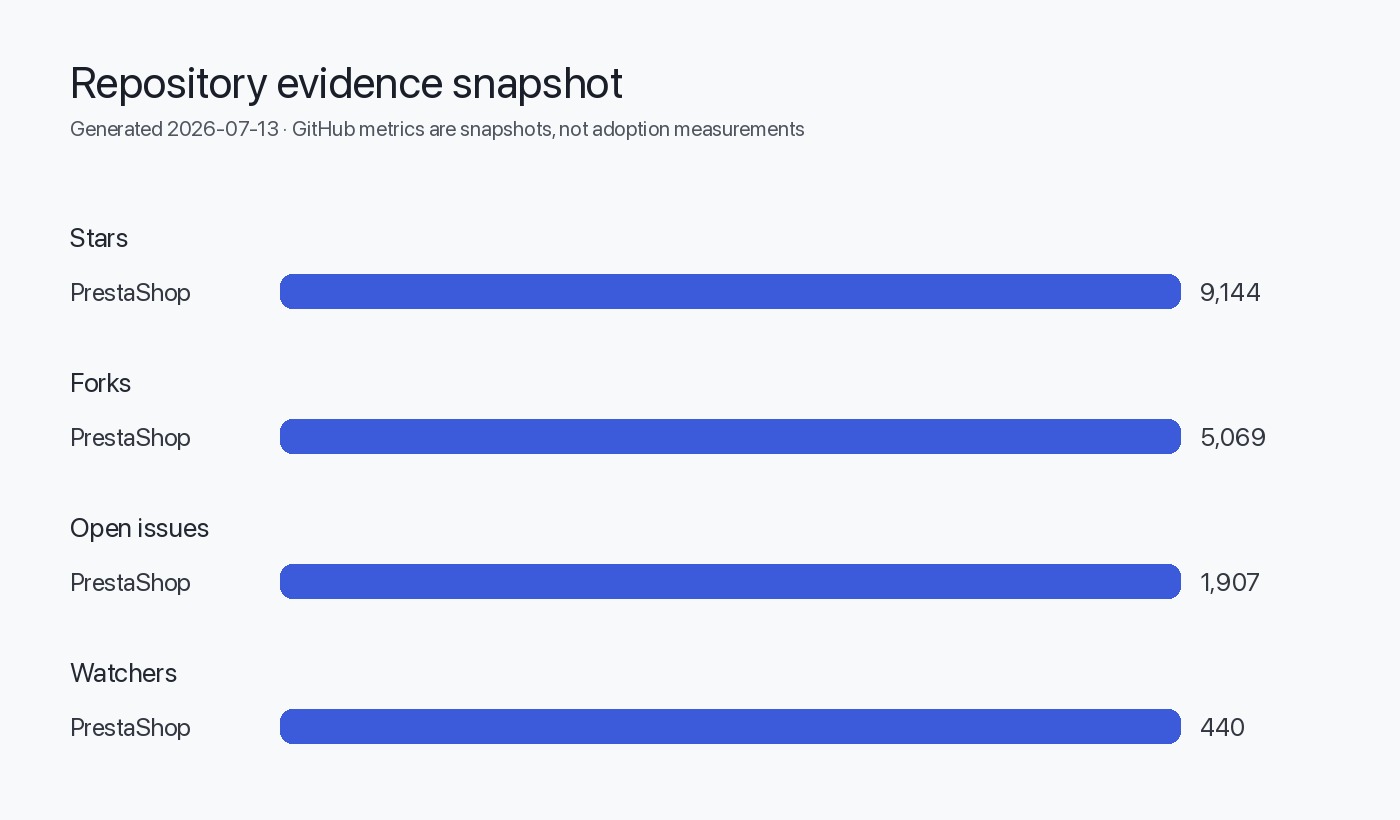
| Stars | 9,144 | GitHub stars supplied; treated as an interest signal, not usage or market share |
| Forks | 5,069 | From repository metadata |
| Watchers | 440 | From repository metadata |
| Open issues | 1,907 | Open-issue count from metadata; not a defect count |
| Default branch | develop | README states develop contains WIP for 9.1 |
| Latest release | 9.1.4 (published 2026-06-04) | Release link: 9.1.4 |
| License (metadata) | NOASSERTION | As reported in repository metadata |
High-level component model (fact + inferred)
This section maps what is explicitly stated in repository metadata and README to a component model. Items labeled "Fact" are direct from the supplied README/metadata; items labeled "Inferred" are architectural conclusions drawn from README descriptions or standard e-commerce platform patterns and are explicitly marked.
| Component | Evidence (from README/metadata) | Architectural conclusion |
|---|---|---|
| Platform language/runtime | PHP 8.1+ required (README) | Fact: PrestaShop core runs on PHP (server-side monolith with modular extension points). |
| Data store | MySQL 5.6+ (README) | Fact: Relational DB is required; typical shop persistence is SQL-based. |
| Web servers | Apache or Nginx recommended (README) | Fact: Designed to run under typical PHP web servers. |
| Front office / Back office | README shows front/backoffice screenshots and URLs | Inferred: The codebase separates storefront (customer-facing) and admin back office components. (Inferred from README content.) |
| Modules & themes | README: "extensible... through modules and themes" | Fact: Modules and themes are official extension mechanisms. |
| Overrides / customizations | README: "override the default components and behaviors" | Inferred: architecture supports overriding core behavior via runtime overrides or hook system. (Inferred from README.) |
| Docker dev environment | README provides Docker quick start (make docker-start / docker compose up) | Fact: The repository includes a Docker-based development environment and sample compose configuration. |
| CI and tests | CI badges (php.yml, integration.yml, sanity.yml) and nightly badge | Fact: Automated CI and nightly builds are part of the repo. |
Modules, themes and extension points
What the repository documentation provides
- Fact: The README explicitly states PrestaShop is extensible via modules and themes and provides links to developer documentation for modules and themes ([devdocs][devdocs]). See the README for developer guides.
- Fact: The README mentions the ability to override default components and behaviors.
- Inferred: PrestaShop exposes a module API and a theme system that integrates with the core via hooks, service registration, or an event system. This inference is based on the README's repeated emphasis on modules/themes and conventional architecture of PHP e-commerce platforms.
- Inferred: Modules likely include install/uninstall lifecycle, database migrations, and admin configuration screens (inferred from standard module responsibilities described in the devdocs links from the README).
- Inferred: Overriding default components suggests an extension mechanism that allows either class overrides, template overrides, or a plugin dispatcher; the README statement about overriding components is the source for this inference.
Component-evidence mapping
| Extension point | Evidence | Inferred responsibilities | Confidence (based on README/metadata) |
|---|---|---|---|
| Module system | README: "extensible... through modules" | Provide features like payment gateways, shipping, catalog extensions | Medium (README states modules; exact API not published in metadata) |
| Theme system | README: "themes" and back-office screenshot | Control storefront UI, responsive templates, assets pipeline | Medium |
| Overrides | README: "override the default components" | Allow custom behavior without core edits; may be runtime or build-time | Medium-Low |
Deployment and operational implications
Facts from README/metadata:
- PHP 8.1+ is required.
- MySQL 5.6+ (MySQL, MariaDB, Percona, etc.) is supported.
- Apache or Nginx are recommended web servers; example Nginx configuration is linked in the README.
- A Docker development environment and convenience scripts (e.g.,
make docker-start,docker compose up) are provided in the README.
Operational implications (inferred — explicitly labeled):
- Inferred: Production deployments will require configuring PHP-FPM or equivalent, a tuned RDBMS, a web cache (Varnish or reverse proxy) and persistent storage for uploaded assets. This is inferred because PHP + RDBMS platforms typically rely on these components for production scalability and because the README references example Nginx configs and system requirements.
- Inferred: The Docker development environment is intended for development and preview only (the README explicitly states the repo is for development/preview), so production deployment practices (scaling, backups, HA) are outside the provided compose setup unless additional ops documentation is supplied.
Operational checklist (fact + inferred)
| Task | Evidence in repo/README | Recommended action (inferred) |
|---|---|---|
| Validate runtime | README: PHP >= 8.1 | Use CI to pin a PHP container matching required version (inferred) |
| DB sizing | README: MySQL family supported | Provision RDS/managed MySQL and test with product data volume (inferred) |
| Assets and CDN | README: responsive design and front/back office assets | Serve static assets via CDN in production to reduce load (inferred) |
| Backups | Not specified in README | Implement DB and file backups as part of production deployment (inferred) |
Scaling boundaries and performance considerations (inferred)
The public metadata does not include benchmark data or an architecture diagram for horizontal scaling; the following are explicit inferences drawn from the stack requirements and common architecture patterns for PHP e-commerce platforms.
- Inferred: Read-heavy workloads should be addressed with caching layers (HTTP reverse proxies, full-page cache, opcode cache) because PHP and database round-trips are expensive at scale.
- Inferred: The DB is likely the primary scaling bottleneck for writes (orders, customer data); scale-out would require read replicas, sharding, or moving to a service that supports horizontal scaling of transactional workloads.
- Inferred: Session storage and long-running tasks (order processing, catalog indexing) should be externalized to Redis/Queue systems to avoid session stickiness and to enable multi-frontend scaling.
Scaling implications table
| Area | Visible evidence | Inferred scaling strategy | Confidence |
|---|---|---|---|
| Web tier | PHP + Nginx/Apache (README) | Stateless PHP frontends behind load balancer + shared file store (inferred) | Medium |
| Database | MySQL family (README) | Master for writes + read replicas; use connection pooling; monitor slow queries (inferred) | Medium |
| Caching | Not in metadata | Use opcode cache, full-page cache, CDN for static assets (inferred) | Low-Medium |
| Background jobs | Not explicit | Use message queue workers for heavy tasks (inferred) | Low |
CI, release cadence and quality signals
Facts:
- The README displays CI badges for PHP checks, integration tests, and UI tests. There is a separate nightly status badge endpoint.
- The README indicates a
developbranch used for work in progress (9.1) and a release (9.1.4) published 2026-06-04.
Operational inference (explicit):
- Inferred: The project uses automated pipelines to run unit and integration tests and performs nightly builds. This structure suggests maintainers prioritize automation and regression testing, which improves release reliability (inferred from CI badges and the nightly endpoint in the README).
Release metadata table
| Release / Branch | Evidence | Practical implication |
|---|---|---|
| develop (default branch) | README states develop contains WIP for 9.1 | Development work targets 9.1 on develop; use release tags for production installs (fact + inferred guidance) |
| 9.1.4 release | Release metadata: published 2026-06-04 | Patch release available with changelog entry (fact) |
Security posture and responsible disclosure
Facts from README/metadata:
- The README documents a Responsible Disclosure process and a Bug Bounty program and provides links for reporting security issues.
What this implies (inferred):
- Inferred: The project maintains a coordinated disclosure channel and incentivizes security reporting via a bug-bounty program; this demonstrates an organized security process but does not reveal the current vulnerability state, CVE counts, or which versions are affected.
What public metadata does not reveal
The repository metadata and README provide a starting point but cannot—and must not be used to—prove several operational and architectural properties. This list is important for decision-making.
- Not available: Real-world production performance or benchmark numbers for typical catalogs or traffic patterns.
- Not available: Concrete upgrade stability for specific third-party modules or the cost of migrating from earlier major versions.
- Not available: Internal module API stability guarantees or long-term semantic versioning policy beyond release tags.
- Not available: Telemetry about active deployments, merchant counts, or customer metrics.
- Not available: Security vulnerability history across all versions (unless published advisories are present elsewhere).
Each item above is an explicit limitation of public repository metadata and must be validated via testing, vendor communication, or operational trials.
Architecture diagram (inferred)
flowchart TB
  subgraph Frontend
    FO["Front Office (storefront)"]
  end
  subgraph Admin
    BO["Back Office (admin)"]
  end
  subgraph Core
    CoreApp["PrestaShop Core (PHP)"]
    Modules["Modules / Plugins"]
    Themes["Themes / Templates"]
  end
  DB[(MySQL family DB)]
  CDN["CDN / Static Assets"]
  Queue["Queue/Background Workers (inferred)"]

  FO -->|HTTP| CoreApp
  BO -->|HTTP| CoreApp
  CoreApp -->|reads/writes| DB
  CoreApp -->|loads| Modules
  CoreApp -->|renders| Themes
  FO --> CDN
  CoreApp --> Queue
  Queue --> DB

  note right of Modules: Inferred: install/uninstall lifecycle
note right of Queue: Inferred: background processing for heavy tasksDecision checklist / Action checklist
- Confirm production install source: use the official release tarball/ZIP rather than the development branch for production. (Fact: README recommended release downloads for production.)
- Verify PHP runtime exactly matches project minimum (>= 8.1). (Fact: README states system requirements.)
- Plan DB hosting: choose managed MySQL/MariaDB and capacity for transactional write load. (Inferred.)
- Evaluate important third-party modules in a staging environment and test upgrades. (Inferred.)
- Implement caching (opcode, full-page, CDN) before scaling user-concurrency. (Inferred.)
- Review module/theme extension points and define upgrade strategy for overrides. (Fact + Inferred: README mentions overriding components.)
- Use CI pipelines and nightly builds in staging to detect regressions early. (Fact: CI and nightly badges exist.)
Evidence, assumptions, and limitations
- Repository metadata and README content from the canonical PrestaShop GitHub repository: PrestaShop/PrestaShop.
- Latest release metadata for tag 9.1.4: PrestaShop 9.1.4 release.
- Any conclusion derived directly from the README or metadata is labeled "Fact."
- Any conclusion that extends README statements into runtime architecture, operational practice, or scaling strategy is explicitly labeled "Inferred."
- Where the README references developer docs (modules, themes), we used that as evidence of extension points but not of the detailed API surface; detailed API behavior requires reading the source files or devdocs pages.
- This analysis does not inspect repository file contents beyond the README/metadata supplied. It does not run code, perform static analysis, or execute tests.
- Performance, scalability, and security claims are inferred from platform type and requirements; they must be validated by environment-specific tests and security audits.
Data retrieval / generation timestamp
- Analysis generated at: Jul 13, 2026 (supplied generation timestamp). Where freshness matters (release tags, CI badges, counts), refer to those timestamps in the repository.
Sources
- PrestaShop canonical repository: https://github.com/PrestaShop/PrestaShop
- PrestaShop latest GitHub release: https://github.com/PrestaShop/PrestaShop/releases/tag/9.1.4
FAQ
Is PrestaShop a PHP application?
Yes — the repository metadata and README indicate PrestaShop is written for PHP and requires PHP >= 8.1.
Can I run PrestaShop using Docker?
The README provides a Docker-based development environment and quick-start commands for development. The repository is intended for development/preview; use releases for production installs.
Does PrestaShop support plugins or modules?
Yes — the README explicitly states PrestaShop is extensible through modules and themes and links to developer documentation.
Does the public repo tell me how it performs at scale?
No — performance and scalability characteristics are not included in repository metadata and require load testing and production telemetry to determine.
Is the project actively tested?
The README displays CI badges for PHP checks, integration tests, and UI tests and includes a nightly status endpoint, indicating automated testing in the project workflow.
Where should I get a production-ready copy of PrestaShop?
The README recommends downloading the latest stable public version from the releases page for production; the GitHub repository is meant for development and preview.
Does the repository indicate a security reporting process?
Yes — the README documents a responsible disclosure process and a bug-bounty program for reporting security issues.