OpenCart guidance for Clauster GHSA auth advisory
A GitHub security advisory (GHSA-h4g2-xfmw-q2c9) describes an auth misconfiguration in the Python 'clauster' package. This briefing explains facts, whether OpenCart is affected, dependency-chain relevance, verification steps, and actions for maintainers.
OpenCart is not named in the upstream GitHub Security Advisory GHSA-h4g2-xfmw-q2c9. The advisory describes a high-severity configuration/logic error in the Python package "clauster" that can cause non-loopback deployments to serve the dashboard and API without authentication when auth.enabled is left unset. The advisory includes the affected range (clauster <= 0.2.1) and the patched version (0.2.2) — see the cited advisory for full details GitHub Security Advisory GHSA-h4g2-xfmw-q2c9.
This briefing distinguishes facts from recommended actions, explains whether the primary technology (OpenCart) is directly affected, describes how to evaluate dependency-chain relevance, provides verification commands (examples only), and gives an incident-response checklist. Data retrieval/generation date: Jul 13, 2026 (see Evidence section).
Facts from the advisory
These are the explicit facts as published in the GitHub Security Advisory (all quoted facts are paraphrased from the advisory):
- Advisory identifier: GHSA-h4g2-xfmw-q2c9 GitHub Security Advisory GHSA-h4g2-xfmw-q2c9.
- Package: clauster (ecosystem: pip / Python).
- Vulnerability summary: A Clauster instance bound to a non-loopback address (for example
0.0.0.0or a LAN IP) can serve the dashboard and its API without any authentication whenauth.enabledis unset (left at the defaultfalse), even if passwords or reverse-proxy settings are present. - Impact described: An unauthenticated network attacker can list projects, spawn/stop
claude remote-controlbridges in project directories, editCLAUDE.md, read bridge logs, and (if configured) clone repositories. The advisory characterizes this effectively as remote code execution in host project directories via bridges. - Affected configurations: All released versions <= 0.2.1 where the following concurrently hold: the bind host is non-loopback;
auth.password_required: trueand/orauth.reverse_proxy.enabled: trueis set; andauth.enabledremains at defaultfalse(unset). - Docker deployments were called out as affected because the image binds
0.0.0.0and the previously documenteddocker runomittedauth.enabled. - Loopback (
127.0.0.1) deployments are explicitly not affected (they need no auth by design). - Root cause summary: A mismatch between a runtime auth guard (which checks
config.auth.enabled) and the config validator (which did not requireauth.enabledfor a non-loopback bind) allowed a configuration that appeared protected but actually bypassed auth enforcement. - Proof-of-concept shown in advisory: issuing a curl request to the API endpoint (e.g.,
/api/instances) returned200without credentials in an affected configuration; explicitly settingauth.enabled: truecaused the endpoint to return401. - Patched versions: The advisory states a patch release that refuses a non-loopback bind unless authentication is actually enforced; patched version is listed as 0.2.2.
The above facts are paraphrased from the published GitHub advisory. Do not treat them as the operational state of any specific deployment until you verify your own systems.
Severity box and affected-range table
Severity: HIGH
>
- Advisory: GHSA-h4g2-xfmw-q2c9 — Clauster: Non-loopback deployments can serve the dashboard unauthenticated when auth.enabled is unset
- Published: Jul 10, 2026
- Patched in: clauster 0.2.2
>
Important: This advisory affects the Clauster package (Python/pip). OpenCart itself is not named in the advisory.
| Package | Ecosystem | Vulnerable range | Patched version | Advisory URL |
|---|---|---|---|---|
| clauster | pip (Python) | <= 0.2.1 (affected when specific config conditions hold) | 0.2.2 | https://github.com/advisories/GHSA-h4g2-xfmw-q2c9 |
Is OpenCart directly affected?
Short answer: No direct evidence in the supplied sources indicates that OpenCart (the PHP ecommerce project at https://github.com/opencart/opencart) is named or listed as affected by the Clauster advisory. The advisory explicitly names the Python package "clauster" and describes deployment/configuration issues for that package; it does not list OpenCart.
Facts about the primary technology (from the supplied OpenCart repository metadata):
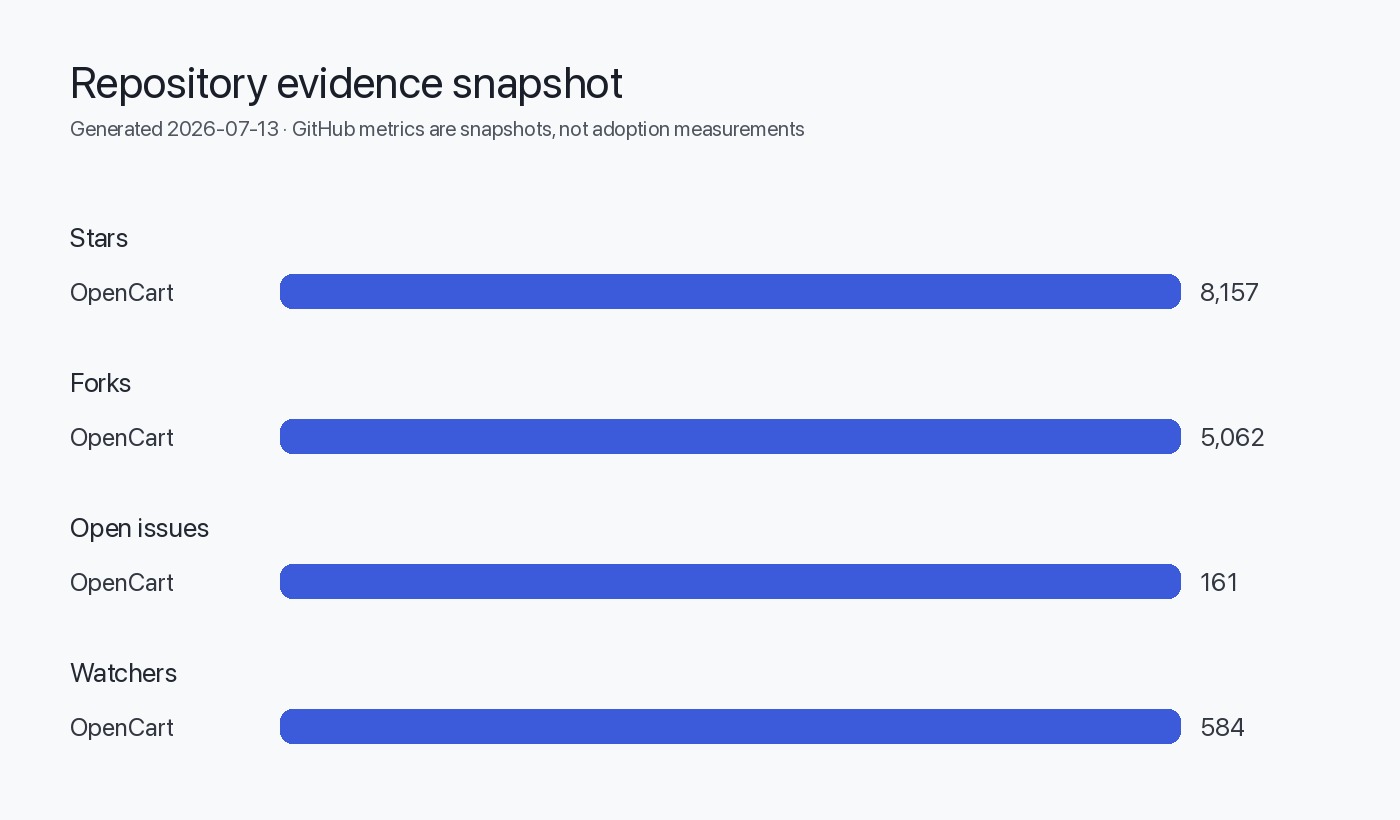
- OpenCart is a PHP-based open-source ecommerce platform (OpenCart canonical repository).
- The repository language is PHP; the project ships with Docker-based local-development tooling (README), and its latest release (as provided) is 3.0.5.0 (OpenCart latest GitHub release).
Architectural conclusion (inferred): Based on the repository metadata and README, OpenCart is a PHP application with development and optional Docker tooling. This is an inference drawn from the README and repository structure, not an assertion about runtime environments in production OpenCart deployments.
Because Clauster is a Python package, any direct impact on an OpenCart installation would require that an operator or automated process running alongside/around OpenCart has deployed Clauster (for example in administrative tooling, CI/CD, or developer utilities). There is no evidence in the supplied OpenCart repository metadata or release notes that OpenCart depends on or bundles the Clauster package.
Do not assume that absence from this advisory implies absence from your infrastructure. Many organizations run mixed-language toolchains (Python services alongside PHP applications). You must verify your own environment.
Dependency-chain relevance — how this could touch OpenCart deployments
Even though OpenCart (the PHP project) is not named in the advisory, the vulnerability can matter to OpenCart operators in several realistic ways (these are procedural pathways, not assertions of any specific compromise):
- Developer or operations tooling: if your team uses a local or remote administrative utility that runs Clauster to manage developer tasks, dashboards, or bridges, an exposed Clauster instance could provide an attacker an avenue into project directories that contain OpenCart code.
- CI/CD and build agents: build or deployment agents (which may be written in or run Python tools) could include Clauster as a dependency. An unauthenticated dashboard could be used to trigger actions that affect build artifacts or deploy code.
- Hosting sidecars: if a hosting environment runs additional services (monitoring, admin UI) that include Clauster and bind to non-loopback addresses, those services could be the exposure vector.
These are chain-of-control scenarios; they require that Clauster is present somewhere in the environment that has file-system or repository access to OpenCart code or to the host running OpenCart.
Practical implication for OpenCart maintainers: verify whether Clauster appears in your infrastructure, CI/CD pipelines, containers, or tooling images. If present and in a vulnerable range and configured to bind non-loopback without auth.enabled=true, follow remediation guidance below.
Search for evidence of "clauster" in your infrastructure and code repositories (examples provided in the next section). Focus on tooling and agent hosts that can access project directories.
Immediate verification: safe commands and checks
The commands below are examples for maintainers to verify whether Clauster is present and whether a running instance is using a vulnerable configuration. Run them in your environment where appropriate; they are illustrative and generic.
- Search your source control and deployment manifests for the package name:
- Example (search source and infra repositories):
```bash
Search for the string 'clauster' in a checked-out repo
grep -RIn "clauster" . || true
Search container images or Dockerfiles for 'clauster'
grep -RIn "clauster" docker/ || true
```
- Search running hosts for Python packages named clauster:
```bash
On a host or in a virtualenv where you suspect Python tooling runs
pip show clauster 2>/dev/null || true
```
- Check container images for installed pip packages (example safe flow):
```bash
Inspect a running container (replace CONTAINER with your container id/name)
docker exec -it CONTAINER pip show clauster 2>/dev/null || true
```
- If you find a running Clauster instance and you can reach it safely from an admin host, verify whether the dashboard responds without auth (the advisory used a curl example). Only perform such a check against systems you own/operate and never against third-party hosts.
```bash
Example: check if the API returns instances without auth (only against your own host)
curl -s -o /dev/null -w "%{http_code}\n" http://<host>:7621/api/instances
```
- A 200 response on an affected version/config likely indicates the issue is present; setting auth.enabled:true should change behavior to 401 per the advisory.
Safety and legal note: do not attempt to probe or exploit systems you do not own or administer. The curl example above is shown as a verification step for operators of affected systems.
Recommended actions for maintainers
Below is a prioritized action table and accompanying guidance. This maps short-term steps and longer-term actions. Follow your organization’s change-control process before modifying production systems.
| Priority | Action | Summary / Example command (illustrative) |
|---|---|---|
| Critical (now) | Inventory: find any Clauster installation or running service in your environment | grep -RIn "clauster" . ; pip show clauster ; docker exec CONTAINER pip show clauster |
| High (immediate remediation) | If Clauster is in use on a non-loopback bind and version <= 0.2.1, set auth.enabled=true or upgrade to patched 0.2.2 | Edit clauster.yml or set env: CLAUSTER_AUTH_ENABLED=true; or upgrade pip package: pip install --upgrade clauster==0.2.2 |
| High | If a running instance binds non-loopback, temporarily restrict binding to loopback while you validate | Change host to 127.0.0.1 in clauster.yml or firewall rule to block external access |
| High | If Docker: ensure the docker run or container configuration sets CLAUSTER_AUTH_ENABLED=true or uses updated image | docker run -e CLAUSTER_AUTH_ENABLED=true ... (example) |
| Medium | Rotate credentials and secrets associated with affected instances if you determine they were exposed | Rotate any passwords/hashes used by Clauster or related systems; rotate deploy keys if needed |
| Medium | Inspect logs and bridge usage to detect suspicious activity | Review clauster logs and host audit logs for unexpected bridge spawn/remote-control operations |
| Medium | Apply available patch to clauster (0.2.2) as soon as practical | pip install --upgrade clauster==0.2.2 or update image tag |
| Low | If policy requires, audit CI/CD and developer tooling to remove unintended admin-facing services | Review tooling manifests and container images for extraneous services |
Action notes (facts and guidance):
- The advisory explicitly states that setting
auth.enabled: trueinclauster.ymlor setting the environment variableCLAUSTER_AUTH_ENABLED=trueis an effective workaround for non-loopback deployments. The advisory also notes the long-term fix is a patch that refuses non-loopback binds unless auth is actually enforced. - The advisory cites Docker images binding to
0.0.0.0as an exposure vector; ensure your Docker usage explicitly sets the auth flag or uses the patched image.
Do not change production firewall rules or authentication configuration without following your organization’s change control. Blocking access or rotating credentials can have operational impact.
Long-term mitigations and monitoring
Recommended longer-term steps:
- Upgrade to the patched clauster release (0.2.2) where available in your environment and images.
- Harden deployment manifests so non-loopback binds require explicit opt-in for unauthenticated access (the upstream fix implements a fail-closed validator for this exact issue).
- Add detection rules: monitor access to clauster admin endpoints, alerts on unexpected bridge spawns, and suspicious reads/writes of project directories.
- Ensure developer and ops tooling that has access to repository or host directories runs under least privilege and is isolated from public networks.
Incident-response checklist
Use this incident checklist when you confirm an affected instance was exposed or when you need to remediate quickly.
- Triage and scope
- Identify all hosts, containers, and environments where Clauster is installed (pip packages, containers, images, orchestrations).
- Identify which instances bind to non-loopback addresses.
- Immediate containment
- If an instance is exposed and cannot be rapidly patched, restrict network access (firewall rules, host-level ACLs) or change bind to loopback (127.0.0.1) while you remediate.
- Set
auth.enabled: trueinclauster.ymlor set environmentCLAUSTER_AUTH_ENABLED=trueas a stop-gap.
- Patch
- Upgrade to clauster 0.2.2 in all affected environments and rebuild images where applicable.
- Evidence collection
- Preserve logs and capture relevant process listings, container snapshots, and filesystem change logs for investigation.
- Record timestamps and configuration files (clauster.yml), preserving original copies in a forensics-safe manner.
- Investigate
- Review Clauster logs for API calls, bridge spawns, and file modifications.
- Check repository access logs and CI/CD logs for unexpected activity.
- Remediate secrets and integrity
- If you find evidence of unauthorized access, rotate any secrets, deploy keys, or tokens that may have been exposed.
- Rebuild and redeploy containers from known-good images when appropriate.
- Post-incident
- Document the incident, root cause, and mitigation steps. Update runbooks to prevent recurrence.
Decision checklist -- Action checklist
Mermaid: decision flow
flowchart TD
  A[Start: Do you run OpenCart?] --> B{Do you run Clauster anywhere in infra?}
  B -- No --> C[No direct Clauster exposure; standard monitoring]
  B -- Yes --> D{Is clauster version <= 0.2.1?}
  D -- No --> E[Not vulnerable per advisory; still audit config]
  D -- Yes --> F{Does instance bind non-loopback?}
  F -- No --> G[Not affected (loopback only) per advisory]
  F -- Yes --> H{Is auth.enabled=true?}
  H -- Yes --> I[Auth enforced; still upgrade to 0.2.2]
  H -- No --> J[High risk: set auth.enabled=true and/or upgrade to 0.2.2; restrict access]
  J --> K[Follow incident-response checklist]
Evidence, assumptions, and limitations
- GitHub Security Advisory GHSA-h4g2-xfmw-q2c9 (clauster) — primary source for the vulnerability facts: https://github.com/advisories/GHSA-h4g2-xfmw-q2c9 (published Jul 10, 2026). This advisory supplies the vulnerability summary, affected range, proof-of-concept behaviour, and patch guidance.
- OpenCart canonical repository metadata (https://github.com/opencart/opencart) and OpenCart latest release notes (https://github.com/opencart/opencart/releases/tag/3.0.5.0) — used only to establish what OpenCart is and that it is not named in the advisory.
- Inference: OpenCart is a PHP-based e-commerce platform with Docker development tooling. This conclusion is drawn from the OpenCart README and repository metadata supplied and is explicitly labeled as an inference.
- Assumption: Any impact on OpenCart installations would be via collateral tooling or sidecar services that include Clauster — the advisory does not mention OpenCart. This is a reasoning path, not a fact from the advisory.
- We have not performed an environment scan of your systems. This briefing uses only the supplied sources and does not assert presence of Clauster in your environment.
- The advisory concerns configuration and version combinations; only operators can verify whether their specific installations meet the affected conditions.
- Dates and patch numbers are taken from the advisory as published; always confirm with upstream package repositories and your package-index mirrors before changing production images.
Data retrieval/generation date: Jul 13, 2026.
Sources
- OpenCart canonical repository: https://github.com/opencart/opencart
- OpenCart latest GitHub release: https://github.com/opencart/opencart/releases/tag/3.0.5.0
- GitHub Security Advisory GHSA-h4g2-xfmw-q2c9: https://github.com/advisories/GHSA-h4g2-xfmw-q2c9
FAQ
Is OpenCart itself listed as vulnerable in this advisory?
No. The advisory names the Python package "clauster". OpenCart (the PHP project) is not named in the advisory.
Could an OpenCart site be affected indirectly?
Yes — if your site’s operational environment includes Clauster (for example in developer tooling, CI/CD agents, or sidecars) and that Clauster instance is in the vulnerable range and bound to a non-loopback address with auth.enabled unset.
What is the immediate workaround if I find a vulnerable Clauster instance?
On non-loopback deployments, set auth.enabled: true in clauster.yml or set the environment variable CLAUSTER_AUTH_ENABLED=true. Alternatively, temporarily bind the service to loopback or restrict network access while you patch.
What is the definitive fix?
The advisory reports a patch release (clauster 0.2.2) that changes validation to require authentication for non-loopback binds. Upgrade to the patched version as soon as feasible.
Are Docker deployments impacted?
The advisory explicitly notes Docker deployments can be affected because the image binds 0.0.0.0 by default and the previously documented docker run omitted auth.enabled.
How should I check my environment for Clauster usage?
Search code and infrastructure repositories for the string "clauster", inspect container images and running containers for the pip package, and verify any admin dashboards or tooling hosts for non-loopback binds.
Where can I read the advisory myself?
See the upstream advisory: https://github.com/advisories/GHSA-h4g2-xfmw-q2c9