Odoo (odoo/odoo) — Repository Spotlight for ERP/CRM
A rigorous technical profile of the odoo/odoo GitHub repository: what it contains, how actively it is maintained, observable strengths and limitations, and a practical checklist for adoption.
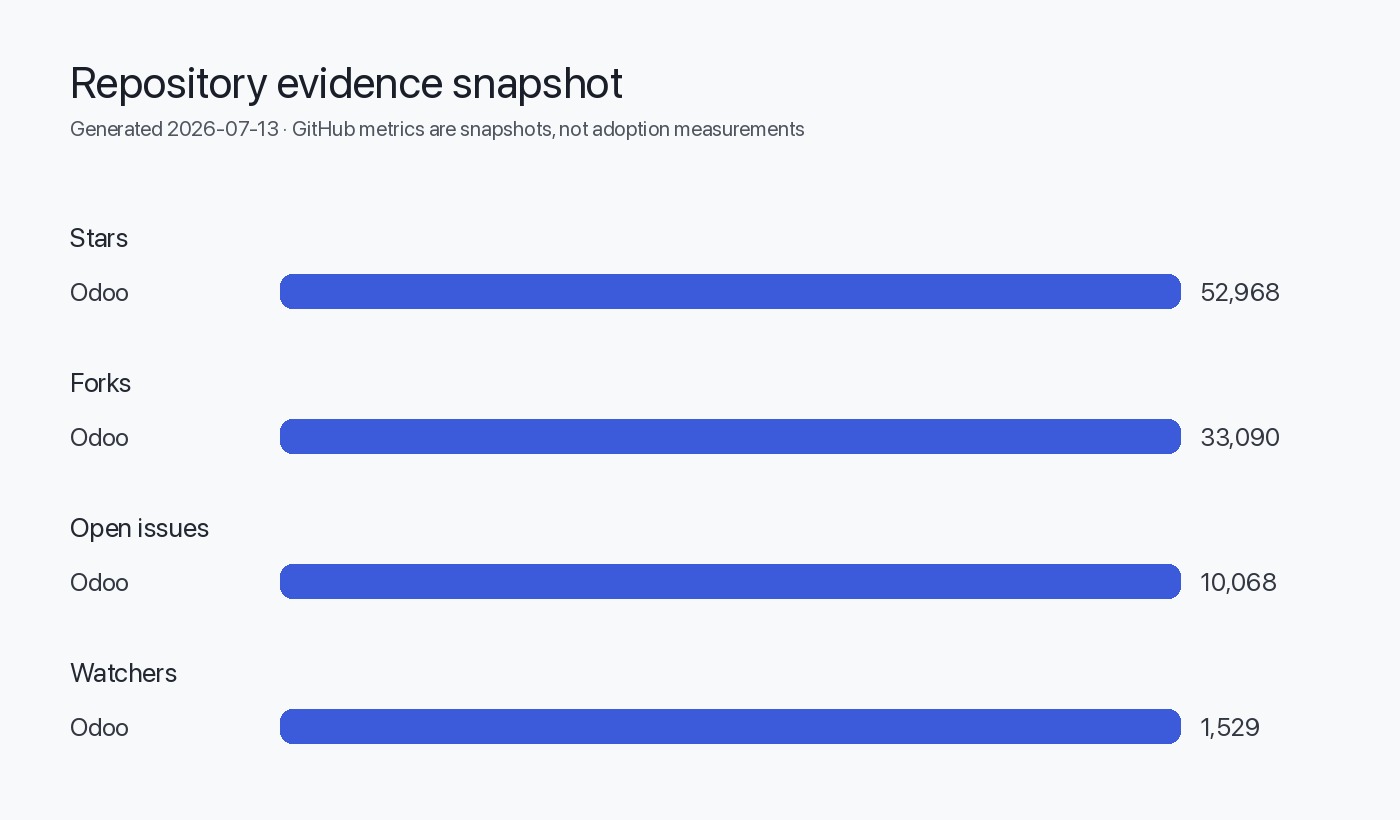
Odoo (GitHub: odoo/odoo) is an actively pushed, large Python codebase that serves as a suite of web-based business applications (CRM, eCommerce, Inventory, Accounting, HR, and more). The repository shows strong community interest (52,968 stars, 33,090 forks) and frequent activity as of the data retrieval timestamp; however, several repository-level signals require careful review before adopting Odoo in production: the license field on GitHub is listed as "NOASSERTION," the repository has a high open-issues count (10,068), and the default branch is 19.0 with recent pushes documented on 2026-07-13. All numerical facts in this profile come from the canonical GitHub repository snapshot cited in Sources and were collected/generated on Jul 13, 2026.
This profile synthesizes repository metadata, README content, and observable maintenance signals to provide a pragmatic evaluation for technical teams considering Odoo. It includes concrete evaluation checklists, an action checklist for safe adoption, an inferred high-level architecture diagram (explicitly labeled as inferred), and an evidence, assumptions, and limitations section to keep conclusions grounded in the supplied repository data.
Quick facts
| Field | Value (source: GitHub repository snapshot) |
|---|---|
| Repository | odoo/odoo |
| Description | Odoo. Open Source Apps To Grow Your Business. (paraphrased from README) |
| Stars | 52,968 |
| Forks | 33,090 |
| Watchers | 1,529 |
| Open issues | 10,068 |
| Primary language | Python |
| Default branch | 19.0 |
| License (GitHub field) | NOASSERTION |
| Created at | May 13, 2014 |
| Last pushed at (repo) | Jul 13, 2026 |
| Last updated at (repo metadata) | Jul 13, 2026 |
| Homepage | https://www.odoo.com |
| Latest release (GitHub API field) | null (no latest_release value provided in snapshot) |
Notes:
- Stars and forks are indicators of interest and forks for contribution or customization, but they are not direct usage or market-share measurements. All numeric values above are taken from the repository snapshot and are factual as of Jul 13, 2026 (source link).
Purpose and scope
The repository positions Odoo as a collection of web-based business applications that can be used standalone or combined into a fuller ERP solution. The README enumerates main apps such as CRM, Website Builder, eCommerce, Warehouse Management (Inventory), Project Management, Billing & Accounting, Point of Sale, Human Resources, Marketing, and Manufacturing. The README also links to documentation, developer tutorials, nightly builds, and community support pages.
All descriptions above are synthesized from the repository's README and linked documentation references available in the canonical repo snapshot. See the repository README for the list of apps and the starting points for setup and developer guides (odoo/odoo README).
Repository health and maintenance signals
This section compiles observable, factual signals and pragmatic interpretations (where labeled).
| Signal | Observed fact | Practical interpretation |
|---|---|---|
| Activity (push) | Last push: Jul 13, 2026 | The repository received a push on the snapshot date, indicating recent development activity. (fact) |
| Default branch | 19.0 | A major-version branch named 19.0 is the default; indicates a versioned mainline. (fact) |
| Updated at | Jul 13, 2026 | Metadata updated shortly before the documented push. (fact) |
| Open issues | 10,068 | Large volume of open issues; review issue labels and trends before relying on issue tracker as a support metric. (fact + guidance) |
| Latest release | null | Snapshot shows no latest_release value; check GitHub releases and project documentation for release practices. (fact) |
| License field | NOASSERTION | GitHub license field is not populated with a standard SPDX identifier at the time of snapshot. This requires legal verification. (fact + WARNING) |
Maintenance context (evidence-based observations):
- The repository README includes badges and links to build/runbot, documentation, help forum, and nightly builds; these are pointers to project infrastructure but do not by themselves guarantee SLAs or enterprise support. (paraphrase from README)
Intended users and adoption signals
Who the repository targets (from README and metadata):
- Organizations and teams that want a suite of integrated business applications.
- Developers and integrators: README contains links to developer tutorials and how-tos.
- Administrators: README references setup/installation instructions.
Adoption signals strictly grounded in repository data:
- High star and fork counts indicate broad interest and many forks for customizations or contributions.
- Presence of documentation links and a developer how-to section in the README suggests the maintainers expect external contributions and integrations.
Inferred architecture and codebase shape
The repository README and its links provide conceptual information about Odoo as a suite of web apps. The following high-level architecture is an inferred model synthesized from README pointers (documentation, apps list, runbot/nightly builds) and common patterns in monorepo app suites.
Note: The diagram and statements in this section are explicitly labeled as inferred and are not authoritative architectural documentation. Use them as a starting hypothesis to verify against the official documentation and by inspecting the repository tree and module layout in the codebase.
flowchart TD
  A[Source repository: odoo/odoo] --> B[Build/CI (runbot/nightly)]
  B --> C[Package/artifact: core + modules]
  C --> D[Deployment options]
  D --> D1[Single-server install (all apps)]
  D --> D2[Containerized services (DB + web + workers)]
  D --> D3[Standalone apps (pick modules)]
  C --> E[Custom modules / forks]
  E --> F[Third-party integration]

  classDef inferred fill:#f9f,stroke:#333,stroke-width:1px;
class A,B,C,D,E,F inferred;- The project supports both single-install and multi-module use, since the README lists standalone apps and an integrated ERP that results from installing several apps. This is an operational inference from README wording.
- The README's badges and link to nightly builds (runbot) imply an automated build or CI system for branch builds; this is inferred from links but not confirmed as CI implementation details.
Evidence-backed strengths
All strengths listed below are derived from repository metadata or README content in the supplied snapshot.
- Breadth of functionality: README enumerates many distinct business applications (CRM, Website, eCommerce, Inventory, Project, Accounting, POS, HR, Marketing, Manufacturing). The project is positioned as a suite rather than a single-purpose app. (README)
- Active development signals: repository push timestamp and updated_at values on the snapshot date indicate recent code changes. (metadata)
- Community interest: a high star count (52,968) and a very large fork count (33,090) reflect significant attention and third-party forks. These are interest signals, not definitive usage metrics. (metadata)
- Documentation and onboarding links: README points to setup instructions, developer how-tos, eLearning, and community help pages, which supports self-service evaluation and development. (README)
Limitations and risks (observable)
- License ambiguity: the GitHub license field is "NOASSERTION." This is a material legal consideration and requires explicit verification of the license that applies to distributions, modules, and third-party addons. (metadata)
- High open-issues volume: 10,068 open issues is a large number. This does not directly measure defect density or responsiveness, but it does indicate a need to sample issues and measure triage/close behavior. (metadata)
- Release metadata not present in snapshot: latest_release is null in the supplied data. Confirm release cadence and LTS support via project documentation or release tags. (metadata)
- Complexity surface: Supporting or customizing a large suite of apps usually involves integration and configuration work; this inference is consistent with the README's claim that apps can be used standalone or together.
Evaluation checklist (detailed tables)
Table: Repository metadata and immediate verification steps
| Item to verify | Evidence in repo snapshot | Recommended verification step |
|---|---|---|
| License | GitHub license: NOASSERTION | Locate LICENSE files in repository and project packaging; request clarification from maintainers or legal review. |
| Release strategy | latest_release: null | Inspect Git tags and the project's release page, and check documentation for LTS policy. |
| Activity | last pushed: Jul 13, 2026 | Review recent commits, PR merges, and contributor list for sustained activity. |
| Issue triage | open_issues: 10,068 | Sample recent issues, check labeled priorities, and measure time-to-close for critical/bug labels. |
| Documentation | README links to docs, developer howtos | Open the referenced documentation (linked in README) and confirm API stability and upgrade notes. |
| Build/integration | README links to runbot/nightly builds | Verify CI pipelines, build badges, and whether artifacts are produced for consumer use. |
Table: Technical fit checklist (tailor to your project)
| Question | How to check in repo/documentation | Pass/Fail/Notes |
|---|---|---|
| Does the default branch version match required feature set? | Default branch: 19.0 — inspect CHANGELOG/tags for 19.0 features. | |
| Is there clear upgrade documentation between major versions? | Check the project's documentation links from README for upgrade guides. | |
| Are extension points and module APIs documented? | See developer howtos linked in README. | |
| Are official Docker/containers supported? | Search repository and docs for Docker images or container deployment examples. | |
| Does the project publish security reporting procedures? | README links to a "Responsible Disclosure" page. Verify content and contact procedure. |
Responsible adoption path (action checklist)
The following steps are designed to reduce risk when evaluating and adopting Odoo from this repository snapshot.
- License verification
- Action: Locate and read the LICENSE file(s) in the repo or official distribution packages; request written license confirmation if needed.
- Release and upgrade policy
- Action: Inspect tags/releases, contact maintainers for LTS info, and identify upgrade paths from the version you plan to run.
- Issue sampling
- Action: Query open issues for labels such as bug/security/regression; sample the last 50 closed vs. open issues to understand triage speed.
- Documentation verification
- Action: Follow the README links to installation, developer howtos, and API reference; reproduce a local development environment using recommended steps.
- Security process check
- Action: Review the security-report link referenced in the README and confirm contact and response expectations.
- Pilot deployment
- Action: Run a pilot (staging) install using your planned subset of modules; test backup, restore, and upgrade procedures and measure operational costs.
- Legal and compliance
- Action: Legal review for license implications and dependencies; ensure third-party modules you intend to use do not introduce incompatible licenses.
- Support model
- Action: Decide on community vs. paid support; document escalation and maintenance responsibilities.
Decision checklist
- Is the license applicable and acceptable for your organization's risk policy? (Yes/No)
- Does the project's active branch/release align with your target feature set? (Yes/No)
- Can your team or vendor support necessary customizations and upgrades? (Yes/No)
- Have you validated the security-reporting process and tested a staged installation? (Yes/No)
- Are critical integrations and data migration paths documented and rehearsed? (Yes/No)
If any answer is No, do not proceed to production without remediation steps documented and tested.
Evidence, assumptions, and limitations
Evidence (data retrieval):
- All numerical and string facts (stars, forks, open issues, push dates, branch name, language, license field) are taken from the canonical repository snapshot for odoo/odoo and were generated/retrieved on Jul 13, 2026. The canonical source is listed in Sources below.
- Any architectural conclusions or deployment patterns are labeled as "inferred" and derive from README wording (apps available standalone vs integrated) and links to infrastructure (runbot/nightly builds). They should be validated by inspecting code and official documentation.
- Statements about community interest are limited to GitHub signals (stars/forks/watchers) and do not assume broader market share or specific customer adoption.
Limitations:
- The supplied data is a single repository snapshot and does not include the full set of repository contents (for example, the full tree, license files within subdirectories, or the content of linked documentation pages). For legal and operational decisions, inspect the repository directly and consult project documentation outside the snapshot.
- The license field being NOASSERTION in GitHub metadata is a caution flag; the actual license terms applicable to delivered packages or modules may be present elsewhere (packaging metadata, module manifests, or distribution archives).
Sources
- Odoo canonical repository: https://github.com/odoo/odoo (data and README content used in this profile; snapshot generated Jul 13, 2026)
FAQ
Is Odoo open source based on this repository snapshot?
The README describes Odoo as open source, but the GitHub license field in the supplied snapshot is "NOASSERTION." You must verify LICENSE files and distribution terms before treating it as legally open source for your use case.
Does the repository appear actively maintained?
Yes: the snapshot shows recent push and metadata update timestamps on 2026-07-13, indicating ongoing activity. For deeper assessment, inspect commit history, PR merges, and contributor activity.
Are stars and forks reliable measures of production readiness?
No. Stars and forks are interest signals; they do not measure production readiness, quality, or support. Combine them with issue triage, CI/build status, and documentation quality.
What immediate risks should I check before adopting Odoo?
Verify the applicable license (GitHub lists NOASSERTION), sample open issues for severity and triage, confirm release and upgrade policies, and run a staged pilot to validate operational procedures.
Where can I find setup and developer documentation?
The repository README includes links to setup instructions, developer howtos, and documentation. Use those links to access official docs referenced by the project snapshot.
What does the default branch '19.0' imply?
It indicates a major-version branch. Check the project's release notes and upgrade guides for 19.0-specific stability and migration guidance before planning production usage.