NestJS Ecosystem Guide — Core Repo, Patterns & Evaluation
A practical, evidence-based ecosystem guide for NestJS covering the core repository, integration patterns, evaluation checklist, maintenance signals, licensing, and a discovery workflow.
NestJS Ecosystem Guide — Core Repo, Patterns & Evaluation
NestJS is a TypeScript-first Node.js server framework whose canonical repository is nestjs/nest on GitHub. The project combines an Angular-inspired architecture with adapters for common Node platforms (Express and Fastify are explicitly referenced in the repository README and recent release notes). The repo is actively maintained; as of data retrieval (2026-07-13) its latest published release tag is v11.1.28 and it carries repository metadata such as 76,242 stars and an MIT license — all facts pulled from the project repository and release notes listed in Sources.
This guide maps the observable ecosystem: the core repository structure and maintenance signals, common integration patterns (HTTP platforms, microservices, websockets, GraphQL), objective evaluation criteria for adopting or auditing NestJS in a project, licensing considerations, and a practical discovery workflow you can apply when assessing the framework or related packages. Where an architectural conclusion is inferred from the README or repo layout, that inference is explicitly labeled.
Quick facts and repository snapshot
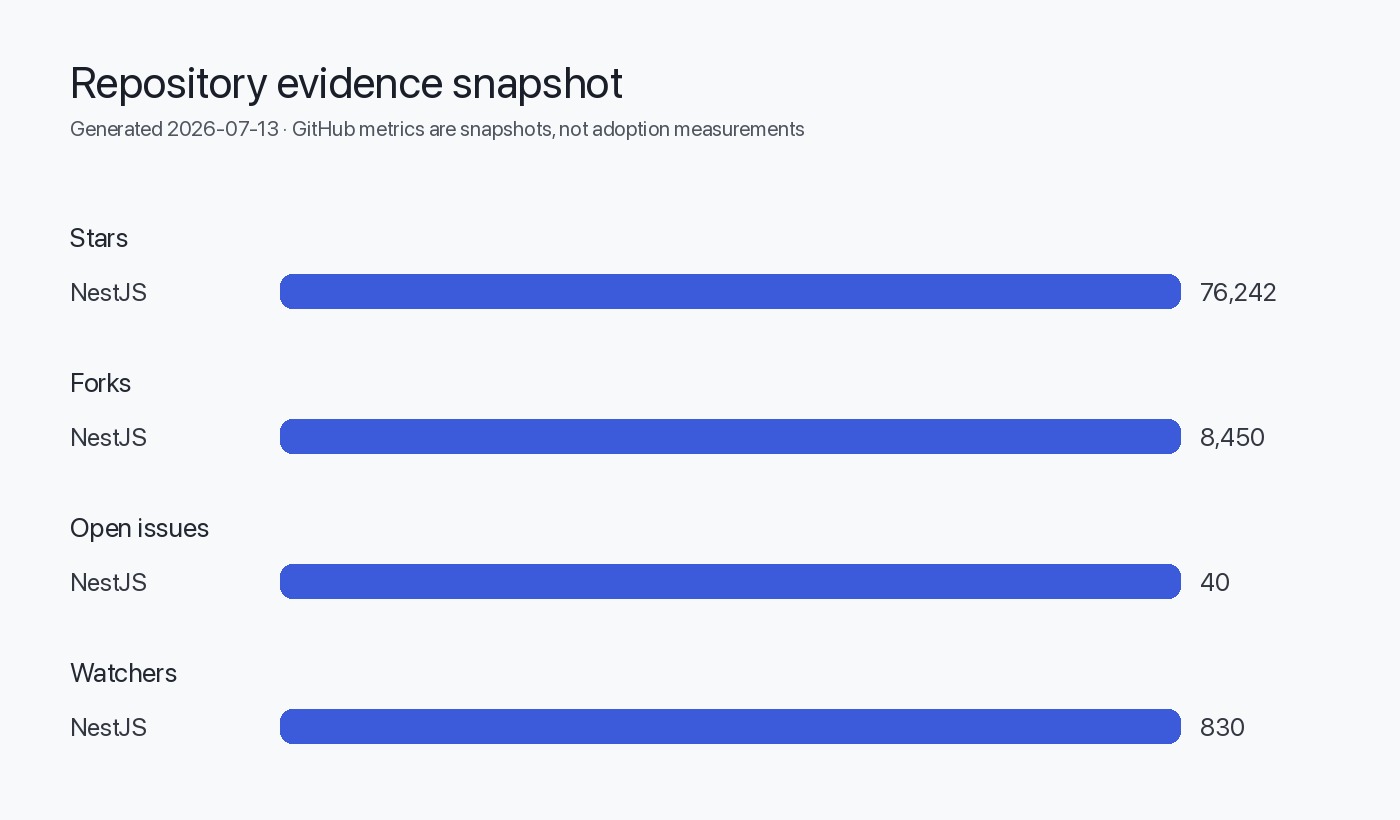
This table summarizes the canonical repository metadata as retrieved from the project's GitHub repo and its latest release. Data retrieval / generation date: 2026-07-13 UTC (see Sources).
| Field | Value |
|---|---|
| Repository | nestjs/nest |
| Description (short) | Progressive Node.js framework for efficient, scalable server-side apps (TypeScript/JavaScript) |
| Stars | 76,242 |
| Forks | 8,450 |
| Watchers | 830 |
| Open issues (repo) | 40 |
| Primary language | TypeScript |
| License | MIT |
| Default branch | master |
| Latest release tag | v11.1.28 (published 2026-07-08) |
Inline evidence: repository metadata and release notes are in Sources at the end of this article. See the release entry for v11.1.28 and the repo page for metadata links (NestJS canonical repository, latest release v11.1.28).
Ecosystem map: categories and integration patterns
This section synthesizes observable ecosystem categories and common integration patterns that emerge from the repository README and recent release notes. Any architectural conclusion relying on README language or repository layout is labeled.
Ecosystem categories (high-level)
| Category | What it covers | Evidence source |
|---|---|---|
| Core framework | @nestjs/core and the main repo providing the dependency injection container, module system, controllers/providers | README and repo structure ([repo]) |
| HTTP platform adapters | Adapters and platform integrations for Express and Fastify | README text and release dependency bumps referencing platform-fastify/platform-express ([release]) |
| Microservices & transport layers | Built-in patterns for microservices, transport adapters (observed as topics in repo) | Repo topics and README references ([repo]) |
| Websockets | Websocket gateway support and related modules | Repo topics (websockets) and README ([repo]) |
| GraphQL and third-party integrations | Optional modules and community packages for GraphQL, ORMs, etc. (community-driven) | README states compatibility with a wide range of libraries ([repo]) |
| CLI & tooling | Project scaffolding and dev tooling | README references guides and docs ([repo]) |
Core pieces and inferred architecture
The README and repository structure indicate an architecture influenced by Angular (stated in the README). From those descriptions and the repo layout, we can infer common architectural primitives used by NestJS-based applications:
- Modules: a packaging unit for related controllers/providers. [INFERENCE: Module-based composition is inferred from README philosophy and common Nest patterns in docs referenced by the repo.]
- Controllers: HTTP route handlers mapped to modules. [INFERENCE: Controller concept is indicated by README and typical framework structure.]
- Providers (services): injectable classes for business logic and shared concerns. [INFERENCE: Dependency injection and providers are described or implied in README.]
- Platform adapters: the framework delegates HTTP serving to an adapter layer (Express / Fastify). This is explicit in the README and release dependency updates referencing platform-fastify and platform-express.
These items collectively form the runtime integration surface that user applications interact with.
Integration patterns diagram
Below is a simplified integration diagram showing how the core framework, platform adapters, and optional layers (GraphQL, microservices, websockets) typically connect. This diagram is an inferred architecture based on README and release entries; the inference label appears here because internal code structure is not exhaustively enumerated in the supplied README text.
flowchart TD
  App[Application Module]
  Core[@nestjs/core]
  Express[Express Adapter]
  Fastify[Fastify Adapter]
  HTTP[HTTP Server]
  Controllers[Controllers]
  Providers[Providers / Services]
  Micro[Microservices Transport]
  WS[Websockets]
  GraphQL[GraphQL Module]

  App --> Core
  Core --> Controllers
  Core --> Providers
  Core --> Express
  Core --> Fastify
  Express --> HTTP
  Fastify --> HTTP
  Core --> Micro
  Core --> WS
  Core --> GraphQL

  style Core fill:#e8f4ff,stroke:#9fc5ff
style App fill:#fff5e6,stroke:#ffd086Evaluation criteria and signals to check
When evaluating NestJS or packages that claim to integrate with it, use objective signals. The table below lays out criteria, why it matters, and observable signals you can verify in the repository or package page.
| Criterion | Why it matters | Observable signals to check |
|---|---|---|
| Maintenance cadence | Frequent and recent maintenance reduces long-lived regressions | Latest release date, recent commits, CI status, active issue triage (repo data) |
| API stability / releases | Breaking changes across major versions impact upgrades | Presence of changelog, release tags (e.g., v11.1.28), migration guides (repo release notes) |
| Compatibility claims | Framework adapters and integrations need explicit compatibility notes | README mentions platform adapters (Express/Fastify) and release notes reference platform package bumps ([release]) |
| Licensing | License must be compatible with your project’s licensing policy | Repository license file (MIT in this repo) |
| Community signal | Community interest and support channels affect long-term viability | Stars, forks, official Discord link and sponsorship support listed in README ([repo]) — interpret stars as interest only |
| Security posture | Known vulnerabilities and dependency updates matter for production use | Release notes mentioning dependency bumps with security fixes (v11.1.28 release mentions dependency updates) ([release]) |
Maintenance signals and release behavior
Observed repository maintenance signals (from supplied sources):
- The repo publishes releases with changelogs; the latest listed tag is v11.1.28 published 2026-07-08 ([release]).
- The latest release notes include dependency bumps for platform packages (platform-fastify, platform-express) and a security-oriented update for a dependency (multer) as described in the changelog body ([release]).
These are direct repository facts. From them you can infer practices about active maintenance (regular releases and dependency updates), but do not assume release frequency or upgrade policies beyond what is documented in the repo.
Licensing and commercial support
License: MIT (stated in the repository). This is a permissive license commonly used in open-source projects. The README also points to paid support and consulting options (the repo mentions an enterprise support page); this is a repository assertion about commercial offerings, not a licensing change.
Considerations when using MIT-licensed frameworks:
- MIT permits commercial use and modification with minimal copyleft obligations; confirm any third-party adapters or plugins have compatible licenses.
- Commercial support offerings listed by the project are separate from the open-source license and do not change the repo's license.
Practical discovery and due-diligence workflow
Below is a step-by-step workflow you can follow when evaluating NestJS or a Nest-related package. The steps are designed to be reproducible and to rely on verifiable repository artifacts.
- Identify the canonical source and release: start at the canonical repo ([nestjs/nest]) and note the latest release tag and publication date (v11.1.28 published 2026-07-08) — see Sources.
- Verify license: check the repository LICENSE file and package manifests for the MIT license.
- Confirm platform compatibility: review README statements about platform adapters (Express/Fastify). Look for explicit compatibility notes in the package you plan to use.
- Inspect recent release notes: read changelogs for dependency updates and security fixes (the v11.1.28 release lists dependency bumps and fixes) ([release]).
- Check CI and test status: examine the repo for CI badges and recent passing builds where available (the README references CircleCI badges; check the CI provider pages directly).
- Scan issues and PR activity: read recent issues and merged PRs to gauge response time and triage practices. Remember open-issue counts are not defect counts.
- Evaluate official vs community packages: prefer official or repository-maintained packages for core functionality. If a package is community-only, check its repo for maintenance signals using the same criteria above.
- Run a controlled proof-of-concept: scaffold a small app, exercise the integration points you need (e.g., Fastify adapter, GraphQL module), and identify upgrade or compatibility friction.
Decision checklist (Action checklist)
Evidence, assumptions, and limitations
- Repository metadata (stars, forks, language, license) and README content are taken from the canonical repository listed in Sources ([nestjs/nest]).
- The release tag v11.1.28 and the release notes body are taken from the project's GitHub releases page for that tag ([v11.1.28 release]).
- Where the article states that NestJS uses a module/controller/provider structure or that it supports Express/Fastify, those statements are either direct README claims or reasonable inferences from README wording and the repository's use of platform adapter packages. All such inferences in the article are explicitly labeled as [INFERENCE] or noted in the relevant callouts.
- This guide is built from the supplied repository and release artifacts only. It does not synthesize ecosystem statistics from external package registries, usage telemetry, third-party adoption surveys, or proprietary data sources.
- No endorsement or security assessment is provided beyond the observable signals in the supplied repo artifacts. For production security assessments, perform dependency scans, SCA, and runtime testing against your application's threat model.
Visual data snapshot
Mermaid integration patterns (textual summary)
The earlier Mermaid diagram is a high-level map that shows typical integration points; it should be used as a starting architectural view rather than a definitive dependency graph. For code-level verification, inspect the repository tree and the specific adapter packages.
FAQ
Is NestJS production-ready?
The repository publishes releases, dependency updates, and maintainer resources; production readiness depends on your requirements and results from your own proof-of-concept and audits.
Which HTTP servers does NestJS support?
The README explicitly mentions Express and compatibility with Fastify; the release notes reference platform-fastify and platform-express dependency updates.
What license governs NestJS?
NestJS is distributed under the MIT license, as stated in the repository.
Do GitHub stars equal production adoption?
No. Stars are an interest signal only and should not be treated as a usage or market-share measurement.
How can I track breaking changes?
Subscribe to the project's releases and review changelogs and migration guides in the repo before upgrading.
Where can I find official commercial support?
The repository README references enterprise support and consulting options; follow links in the README to learn about those offerings.