LibreChat — repository snapshot analysis (2026-07-12)
LibreChat has no formal release tag as of the latest push (2026-07-12). This article analyzes repository evidence, who should upgrade, risks, test and rollback plans, and unanswered questions.
LibreChat does not have a tagged release available in the repository metadata; the most recent upstream activity is a push to the default branch recorded at 2026-07-12 and repository metadata updated 2026-07-13. The project is active, TypeScript-based, and positions itself as a full-featured, self-hostable chat platform that integrates multiple AI endpoints, agents, a code-interpreter feature, model switching, and administration tooling. These facts come from the repository metadata and the project documentation hosted in the repository and on the project's website (evidence retrieval date: Jul 13, 2026) source: repository metadata and README.
For teams that run or evaluate self-hosted AI chat platforms, the lack of a formal release tag means treat updates as repo-head upgrades rather than a versioned release. The repository is high-visibility (stars/forks shown in metadata) and actively pushed; however, there is no published release artifact listed in the repository metadata. This analysis describes what we can confidently conclude from the available evidence, who should care, a conservative upgrade-risk matrix, a pragmatic test plan and rollback approach, and the open questions the repository metadata does not answer.
What I reviewed (evidence baseline)
The analysis below is strictly limited to the supplied repository metadata and README-derived feature descriptions for LibreChat. The specific repository used as the evidence source is the canonical GitHub mirror: https://github.com/danny-avila/LibreChat — all inline citations point to that repository metadata or its documentation.
Data retrieval/generation date: Jul 13, 2026. Where dates, counts, or file references are used, they reference the repository metadata fields provided in the editorial data and the README excerpt in that dataset.
Repository snapshot — facts at retrieval time
The table below summarizes the concrete repository metadata used as the evidence base.
| Field | Value (as provided) |
|---|---|
| Repository | danny-avila/LibreChat (repo URL) |
| Description (short) | Enhanced ChatGPT clone with Agents, MCP, many AI endpoints, and self-hosting features |
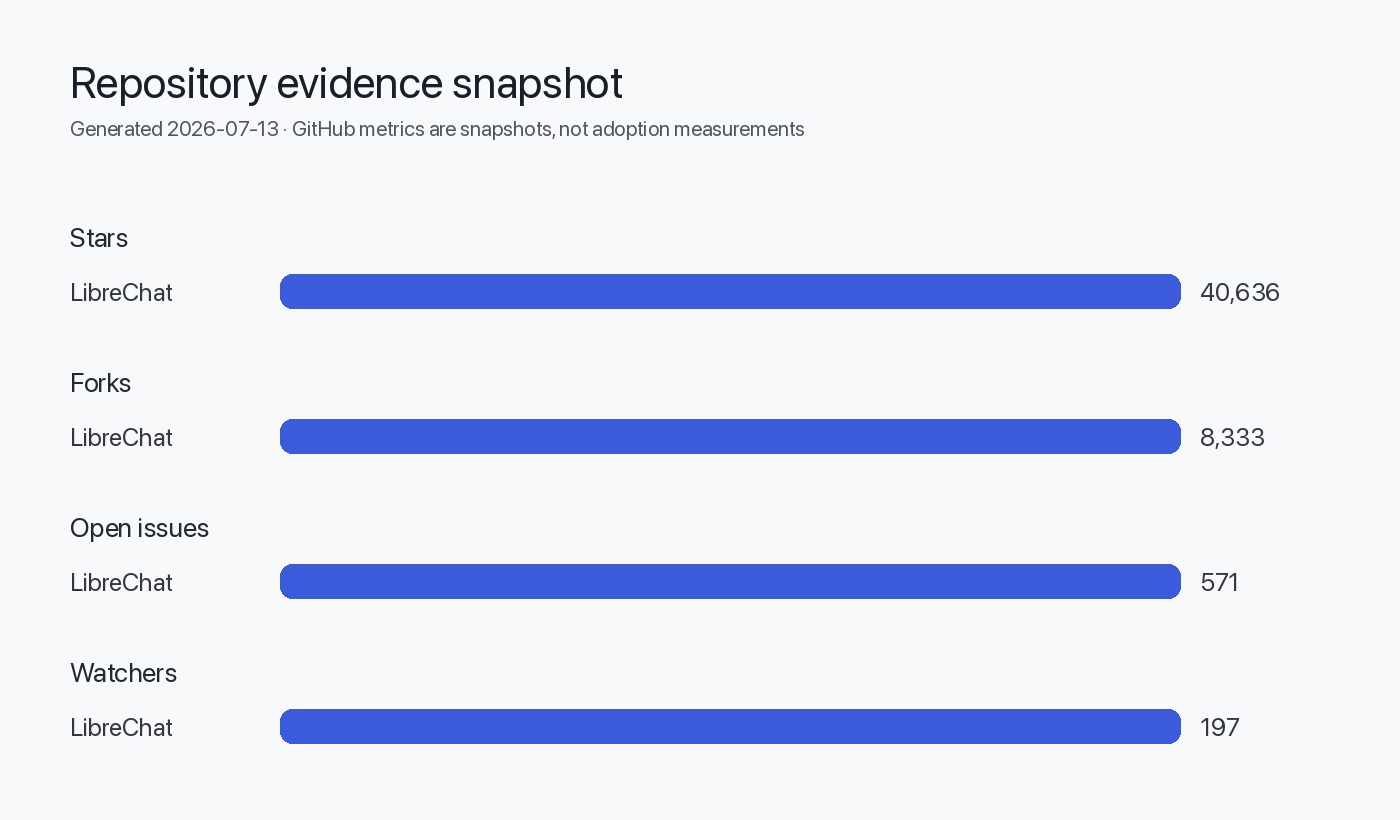
| Stars | 40,636 |
| Forks | 8,333 |
| Watchers | 197 |
| Open issues (count) | 571 |
| Primary language | TypeScript |
| License | MIT |
| Default branch | main |
| Created at | Feb 12, 2023 |
| Last updated (metadata) | Jul 13, 2026 |
| Last push (pushed_at) | Jul 12, 2026 |
| Homepage | https://librechat.ai/ |
| Latest release | null (no release listed in provided metadata) |
Additional high-level features and claims are documented in the repository README and project documentation: multi-provider AI endpoint support (OpenAI, Anthropic, Azure, AWS Bedrock, Google/Vertex, and numerous custom endpoints), agents and skills framework, Model Context Protocol (MCP) support, Code Interpreter functionality, web search integration, image generation, multi-user authentication and admin panel, and multiple deployment options (Docker Compose, cloud templates). These are drawn from the README and project docs cited in the repository metadata [source: README and links in the repository metadata].
What changed — and why there is no release tag
Fact: the repository "latest_release" field in the supplied metadata is null; the repo's default branch received a push at 2026-07-12. There is no evidence in the supplied data of a formal tagged release (for example, a GitHub Release object or release tag). Therefore:
- The most recent deliverable is a branch-head commit rather than an official release artifact (fact: latest_release: null; pushed_at: 2026-07-12). Cite: repository metadata.
- The README and project docs indicate an active, feature-rich project, but they do not substitute for a formal release tag (fact: README features list and "Releases" link provided in README, but latest_release is null). Cite: repository README and metadata.
Why that matters: without a release tag, downstream users cannot safely assume semantic-versioning guarantees or compatibility guarantees tied to a release artifact. Upgrades performed by pulling main/head are inherently higher-risk than switching between tagged releases.
Who should care and why
- Operators running self-hosted LibreChat instances in production (on-prem or cloud): because upgrades that track main/head may introduce behavior changes without a release note or semantic version bump.
- Security and compliance teams: because the project integrates multiple third-party AI provider connections and execution capabilities (Code Interpreter), which increases the blast radius for configuration or behavioral changes after an untagged update.
- Developers building integrations or custom agents: because changes to agent APIs, MCP integrations, or config format could be landed on main without a release tag and therefore impact integration stability.
- Evaluators and architects comparing self-hosted chat platforms: because the repository shows active development and a wide feature set, but reproducible, pinned releases are not present in the supplied metadata.
All of the above statements are derived from the repository metadata and README; they do not assert how any particular deployment will behave after an update.
Upgrade risk assessment and matrix
This matrix synthesizes repository facts (stars, active pushes, large feature surface) into practical risk areas for teams evaluating or performing an upgrade from the repository HEAD.
| Risk area | Evidence from repository | Likelihood (conservative) | Impact | Recommended mitigations |
|---|---|---|---|---|
| API/config breaking changes | Large feature set (agents, MCP, multiple provider configs) and active development; no release tag | Medium | High | Pin configuration backups, run full regression tests, and test provider credential handling in staging |
| Dependency changes (npm/TS) | Language: TypeScript; active commits to main | Medium | Medium | Use package-lock/yarn.lock snapshots; test container builds in CI |
| Data/DB schema changes | Project supports multi-user and admin features (implies stateful backend) | Medium | High | Backup DB and relevant storage before upgrade; test migration paths in staging |
| Provider integrations | README documents many provider types (OpenAI, Anthropic, Bedrock, etc.) | Low–Medium | High | Validate each configured provider in staging; verify secrets are not leaked |
| Runtime environment/deployment differences | Supports Docker Compose and multiple deployment options | Low–Medium | Medium | Recreate production-like environment in staging; validate asset/CDN settings |
| Regression in Code Interpreter or agent tooling | README claims Code Interpreter and agent marketplace | Low–Medium | High | Verify sandboxed execution limits and test common code-run flows in staging |
Notes:
- "Likelihood" and "Impact" above are conservative operational judgements derived from the repository facts (active main, broad feature scope). They are not measurements of defect rates or adoption.
Recommended test plan (pre- and post-upgrade)
This plan is intentionally pragmatic and uses only validated features referenced in the repository metadata and README: Docker Compose deployment, multi-user auth, AI endpoints, agents, Code Interpreter, admin panel, and import/export.
Pre-upgrade checklist (staging first):
- Snapshot and backups
- Backup application state: configuration files, uploaded artifacts, and any database or persistent stores used by the deployment.
- If using S3/CDN or external storage, verify object versioning or copies exist.
- Recreate production environment in staging
- Deploy the same Docker Compose stack or deployment topology the production environment uses (the README references Docker Compose stacks and cloud templates).
- Use test credentials for AI providers; do not reuse production secrets in staging.
- Functional smoke tests (staging)
- UI/Authentication: sign in via configured auth flows (OAuth2/Email/LDAP as applicable) and validate user and admin roles.
- Chat basics: create a conversation, send a prompt, and validate a non-empty model response via any configured provider.
- Agent/Skill: create or run an agent or skill if you use them in production; validate that agent actions complete without error.
- Code Interpreter: run a simple, safe execution (for example, an echo or arithmetic snippet) to validate the execution channel and file upload handling.
- File upload and chat-with-files: upload a small file and ask a question about it; validate parsing/response behavior.
- Image generation/editing: if enabled, request a small image generation or edit via configured provider.
- Integration tests
- Provider failover: simulate a provider failure and verify the UI/behaviour is controlled (graceful error messages). The README documents many provider endpoints; confirm behaviour for the ones you use.
- Multi-device sync: open the same conversation in two sessions (tabs) and verify message sync or resumable streams behavior described in the README works.
- Performance and resource sanity checks
- Start the system and confirm no immediate OOMs, extreme CPU usage, or container restart loops.
Post-upgrade checklist (production dry run then live):
- Re-validate the smoke tests in production in a narrow maintenance window.
- Monitor logs and key metrics (error rates, request latencies, container restarts, provider call failure rates) for a predetermined observation window (for example, first 60–120 minutes after upgrade).
- Validate that the admin panel can edit per-role and per-group permissions and that configuration overrides are accessible without redeploy (feature referenced in the README).
Table: Example test mapping (component -> smoke test -> success criteria)
| Component | Smoke test | Success criteria |
|---|---|---|
| Authentication | Login with a test user and an admin user | Successful logins; admin can access admin panel |
| Chat core | Send a prompt and receive a response | Non-empty model response within expected time window |
| Agents & Skills | Trigger an agent workflow | Agent completes steps without error; subagent delegation works if used |
| Code Interpreter | Execute a small, safe script | Execution completes and output is returned; file upload/download works |
| Provider integrations | Use each configured provider in a test conversation | Provider requests succeed or fail gracefully with clear error messages |
Rollback plan and practical notes
Because the repository does not show a formal release, prefer an upgrade strategy that leaves immediate rollback options:
- Before upgrade: create a consistent snapshot of all state and infrastructure resources (application config, DB backups, file storage backups, and the prior container image or pinned commit hash).
- Deployment approach: use images or pinned commit hashes for the application; deploy them behind a load balancer or with blue/green deployment tools where possible. If you cannot use orchestrated blue/green, use the following simpler rollback plan:
- Stop traffic to the upgraded instance (remove from LB or pause the DNS entry).
- Deploy the previously known-good image or checkout the previously validated commit and rebuild from that commit.
- Restore any DB migrations if a schema change occurred. (Because the README references stateful features, assume DB backups are necessary.)
- Reintroduce traffic and validate the smoke tests.
- If you use a single-host Docker Compose deployment, keep the previous Compose files and a copy of the prior built image or tag so you can docker-compose down and docker-compose up with the previous image.
Architectural inferences (labeled)
The following statements are inferences derived from the README and repository structure; they are explicitly labeled as such per the non-negotiable editorial rules.
- Inference: LibreChat is architected to be provider-agnostic and runs an orchestration layer that routes requests to different AI providers. Evidence: README lists many provider types (OpenAI, Anthropic, Vertex, Bedrock, custom endpoints) and mentions configurable AI endpoints.
- Inference: The platform uses a stateful backend with user and conversation persistence. Evidence: README lists multi-user support, admin panel, conversation import/export, and search features, which imply persistent storage for users, messages, and artifacts.
- Inference: There is an execution sandbox for the Code Interpreter feature (multi-language support). Evidence: README references Code Interpreter with multiple languages and sandboxed execution.
These are architectural conclusions inferred from documentation and repository structure, not direct code-level confirmations.
Multi-provider integration and endpoint support
LibreChat positions itself as a "unified" interface for multiple LLM providers. The README lists direct integrations and a "Custom Endpoints" feature that accepts any OpenAI-compatible API without requiring a proxy.
Documented Provider Support
| Provider | Integration Method | Notes |
|---|---|---|
| OpenAI | Direct API | Includes Responses API |
| Azure OpenAI | Direct API | Separate from standard OpenAI |
| Anthropic (Claude) | Direct API | Multi-model support |
| AWS Bedrock | Direct API | Regional deployment considerations |
| Google (Gemini) | Direct API | Includes Vertex AI |
| Vertex AI | Direct API | Listed separately from Gemini |
| Custom Endpoints | OpenAI-compatible API | No proxy required; configure via YAML |
| Groq | Custom endpoint (inferred) | Not explicitly categorized |
| Mistral AI | Custom endpoint (inferred) | Not explicitly categorized |
| OpenRouter | Custom endpoint (inferred) | Aggregator for multiple models |
| Deepseek | Custom endpoint (inferred) | Reasoning model support |
| Ollama | Local/remote custom endpoint | Self-hosted model serving |
The README references a LibreChat YAML configuration for defining custom endpoints. The documentation link is external and not included in this analysis.
Agents, MCP, and tool execution
LibreChat's agent framework and MCP integration represent a significant architectural layer beyond basic chat interfaces.
Agent Capabilities
- No-code builder: Create custom assistants without writing code.
- Skills: Reusable
SKILL.mdinstruction files that can be applied manually, automatically, or always-on. - Subagents: Delegate tasks to isolated child agent runs with separate context windows.
- Agent marketplace: Community-driven sharing and discovery.
- Collaborative sharing: Restrict agent access to specific users or groups.
- Tool execution: Integrates with MCP servers, file search, and code interpreter.
Model Context Protocol (MCP) Integration
MCP is an open protocol for connecting AI systems to external data sources and tools. LibreChat is listed as an official MCP client. The README states that agents can use "MCP Servers" for tool execution but does not specify:
- How MCP servers are registered or discovered.
- Whether MCP server configuration is per-agent or global.
- Security boundaries for MCP tool execution.
- Rate limiting or cost controls for tool invocations.
Code Interpreter API
The code interpreter feature uses ClickHouse/code-interpreter for sandboxed execution. Supported languages:
- Python
- Node.js (JavaScript/TypeScript)
- Go
- C/C++
- Java
- PHP
- Rust
- Fortran
The README emphasizes "secure, sandboxed execution" and "no privacy concerns" but does not document:
- Resource limits (CPU, memory, execution time).
- Network access policies within the sandbox.
- File system isolation details.
- Whether code execution logs are retained or auditable.
Decision / Action checklist
Evidence, assumptions, and limitations
- Evidence used in this article is limited to the supplied repository metadata and README excerpt from the canonical repository: https://github.com/danny-avila/LibreChat. All repository facts (stars, forks, pushed_at, open issues, language, license, and feature references) are taken from that source.
- Assumptions:
- When recommending tests (for example, verifying admin panel functionality or agent workflows), I assume the referenced features exist and are reachable via the documented UI or APIs because they are described in the README. These are usage-focused test recommendations, not assertions about current implementation correctness.
- Where infrastructure elements (DB, S3, Docker Compose) are mentioned, they are assumed because the README documents features (multi-user, import/export, Docker Compose stacks) which imply persistent storage and standard containerized deployment options.
- Limitations:
- The repository metadata provided does not include a release artifact, release notes, or a change log for a specific release. Therefore, this article cannot analyze changes between formal semantic versions or provide direct mapping of breaking changes introduced in a particular release.
- The article does not inspect the repository diff, individual commits, or CI logs because those artifacts were not supplied. Any suggestion to read specific commits or run specific commands should be executed by the operator against the repository after cloning.
Sources
- LibreChat canonical repository: https://github.com/danny-avila/LibreChat
flowchart LR
  UI[User / Browser UI]
  UI -->|HTTP/WebSocket| Frontend[LibreChat Frontend (TypeScript)]
  Frontend -->|API Calls| Backend[LibreChat Backend / API]
  Backend --> DB[Persistent Storage (users, conversations, artifacts)]
  Backend --> MCP[Model Context Protocol & Tools (inferred)]
  Backend -->|Provider API| AI[AI Providers: OpenAI, Anthropic, Vertex, Bedrock, Custom]
  Backend --> CI[Code Interpreter Sandbox (inferred)]
  CI -->|Run Code| Sandbox[Isolated Execution Environment]
  Backend --> Storage[S3 / CDN (inferred)]
  style MCP stroke-dasharray: 5 5
  style CI stroke-dasharray: 5 5
  classDef inferred stroke:#ff9900,stroke-dasharray:5 5
  class MCP,CI,DB,Storage inferred
FAQs
1) Q: Is there a formal LibreChat release to upgrade to?
A: In the supplied repository metadata the "latest_release" field is null; the most recent push to the default branch is at 2026-07-12. There is no evidence of a tagged release artifact in the provided data [source: repository metadata].
2) Q: Can I safely pull and run main/head in production?
A: Pulling and running main/head is possible, but without a release tag it is higher risk. The article recommends validating commits in staging, creating backups (application state and DB), and having a rollback plan before upgrading production.
3) Q: Which features should I prioritize testing after an upgrade?
A: Prioritize authentication, chat core (model request/response), agent workflows and skills, Code Interpreter sandboxing, provider integrations, and admin panel permission changes. These test areas are based on features documented in the repository README.
4) Q: What are the immediate rollback actions if an upgrade fails?
A: Remove the upgraded instance from traffic, redeploy the prior validated image or commit, and restore DB from the pre-upgrade backup if migrations changed schema. Keep prior images and commit hashes accessible for quick redeploy.
5) Q: Does the repository support multiple AI providers?
A: Yes. The README lists multiple supported providers and custom endpoints; this is a documented project capability in the repository metadata and documentation.
6) Q: Where can I find official docs and changelog?
A: The repository README references docs at https://librechat.ai/docs and a changelog at https://www.librechat.ai/changelog. Use those resources for detailed configurations and any announced breaking changes.
7) Q: What is the retrieval date of the data used for this analysis?
A: The repository metadata and README were used as supplied, with data retrieval/generation date Jul 13, 2026.
FAQ
Is there a formal LibreChat release to upgrade to?
In the supplied repository metadata the "latest_release" field is null; the most recent push to the default branch is at 2026-07-12. There is no evidence of a tagged release artifact in the provided data.
Can I safely pull and run main/head in production?
Pulling and running main/head is possible, but without a release tag it is higher risk. Validate commits in staging, back up application state and DB, and have a rollback plan.
Which features should I prioritize testing after an upgrade?
Prioritize authentication, chat core, agent workflows and skills, the Code Interpreter sandbox, provider integrations, and admin panel functionality — all are referenced in the repository documentation.
What are the immediate rollback actions if an upgrade fails?
Remove the upgraded instance from traffic, redeploy the prior validated image or commit, and restore the DB from the pre-upgrade backup if necessary. Keep prior images and commit hashes accessible.
Does the repository support multiple AI providers?
Yes. The README documents support for many providers (OpenAI, Anthropic, Vertex, Bedrock, custom endpoints), which is a core project capability described in the repository metadata.
Where can I find official docs and changelog?
The repository README lists documentation at https://librechat.ai/docs and a changelog at https://www.librechat.ai/changelog. Consult those links for detailed configuration and any announced breaking changes.
What is the retrieval date of the data used for this analysis?
The repository metadata and README were used as supplied, with data retrieval/generation date Jul 13, 2026.