Ionic Framework: Architecture Analysis and Module Map
A technical architecture analysis of the ionic-team/ionic-framework GitHub repository. Covers packages, extension points, scaling boundaries, operational implications, and explicit repository-based inferences.
open_graph:
title: "Ionic Framework: Architecture Analysis and Module Map"
description: "An evidence-grounded architecture analysis of the ionic-team/ionic-framework repository, mapping packages, extension points, operational trade-offs, and limitations."
url: "https://madewithwhat.net/ionic-framework-architecture";
image: "https://madewithwhat.net/assets/2026/01/13/architecture-analysis-ionic-6-cover.jpg";
Ionic (repository: ionic-team/ionic-framework) is organized as a multi-package TypeScript monorepo that exposes a core Web Components library (@ionic/core) plus first-class framework bindings for Angular, React, and Vue. The published artifacts and README list separate packages for core and framework adapters; repository metadata and topics indicate Web Components, Stencil/stenciljs, and TypeScript as foundational technologies. Source evidence: repository README and package list Ionic canonical repository.
Operationally, Ionic is structured so that UI primitives live in @ionic/core (Web Components) and are consumable via framework-specific wrappers (@ionic/angular, @ionic/react, @ionic/vue). This separation implies a runtime boundary where cross-framework UI is provided by framework-agnostic web components while framework adapters handle integration and developer ergonomics. The latest release data and repository push timestamps provide freshness context for this analysis (data retrieved/generated 2026-07-13) Ionic latest GitHub release.
Repository snapshot
This section summarizes repository metadata pulled directly from the project record. Values and sources are listed in-line and reflected in the following table.
| Field | Value |
|---|---|
| Repository | ionic-team/ionic-framework (source) |
| Primary language | TypeScript |
| License | MIT |
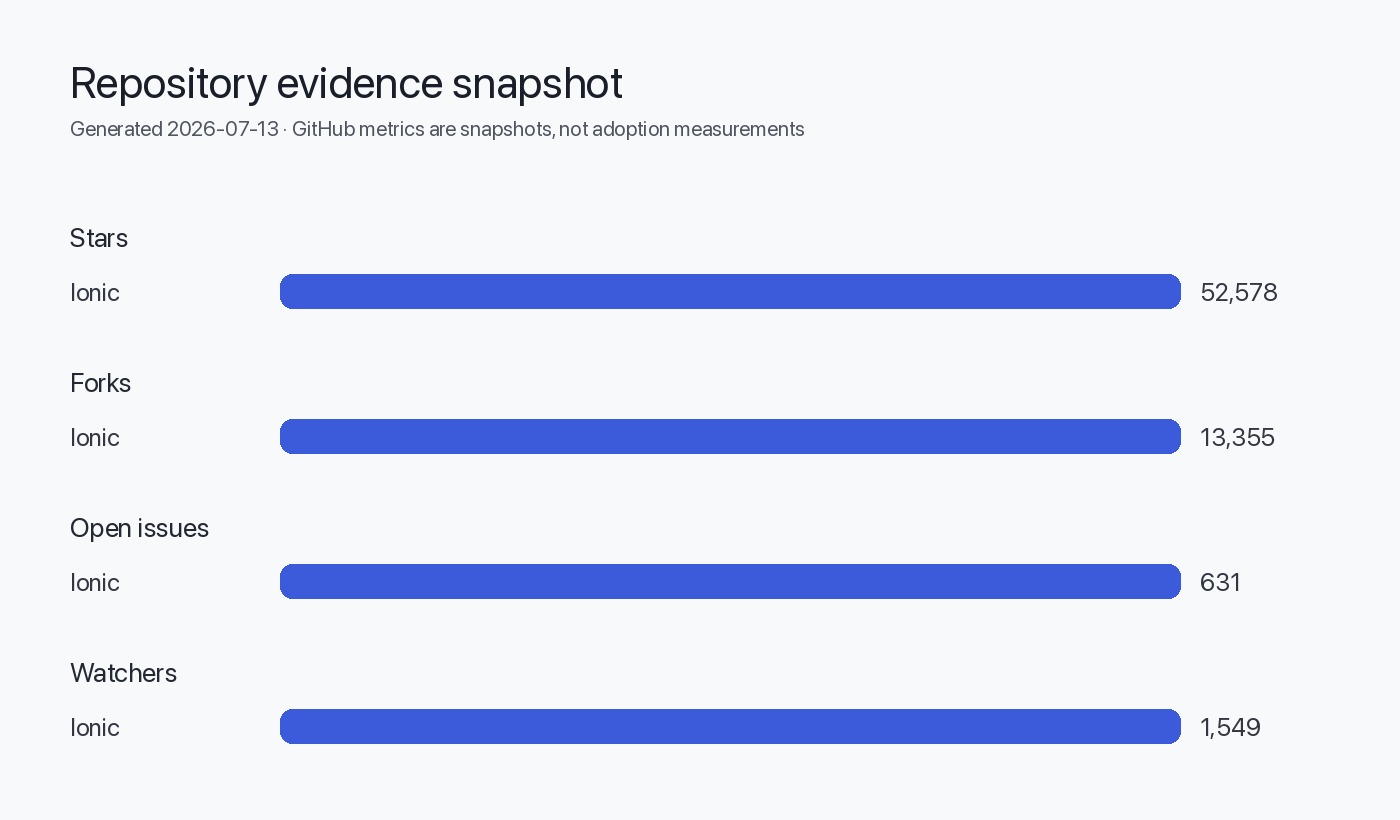
| Stars | 52,578 (GitHub stars; interest signal) |
| Forks | 13,355 |
| Open issues | 631 (open issues — not a defect count) |
| Default branch | main |
| Latest release (tag) | v8.8.13 (published 2026-07-01) (release notes) |
| Last pushed | Jul 10, 2026 |
Sources: repository README, repository metadata and latest release Ionic canonical repository, Ionic latest GitHub release.
Top-level module map and packages
The project explicitly lists a small set of published packages in its README. The README provides a concise packages table (Core, Angular, Vue, React). The presence of these packages is the primary ground-truth for the repository's modular layout.
| Package | Published name | Role / Purpose (from README) | Evidence |
|---|---|---|---|
| Core | @ionic/core | Web Components-based UI primitives intended to be framework-agnostic | README packages table (Ionic canonical repository) |
| Angular adapter | @ionic/angular | Angular bindings and tooling to consume Ionic Web Components in Angular apps | README packages table |
| React adapter | @ionic/react | React bindings and helper components for React apps | README packages table |
| Vue adapter | @ionic/vue | Vue bindings and helper components for Vue apps | README packages table |
Table: selected top-level directories and inferred responsibilities
| Directory / Package (typical monorepo layout) | Observed in repo? | Inferred responsibility | Basis / Evidence |
|---|---|---|---|
| core/ or packages/core | README lists @ionic/core package | Hosts component implementations (Web Components) | README packages table (explicit) |
| packages/angular | README lists @ionic/angular | Framework integration code and Angular-specific wrappers | README packages table (explicit) |
| packages/react | README lists @ionic/react | React wrappers and helpers | README packages table (explicit) |
| packages/vue | README lists @ionic/vue | Vue wrappers and helpers | README packages table (explicit) |
| docs/ | README contains docs links | Documentation / quickstart materials | README links to docs site |
Extension points and integration surface
Concrete extension surfaces visible from repository metadata and the README:
- Core Web Components as the runtime UI primitives (explicit in README: "Ionic is based on Web Components").
- Framework adapters (Angular/React/Vue) that provide developer-friendly wrappers and lifecycle integration.
- Public NPM packages are published separately (README lists package links to npm for each published artifact).
Extension/plug-in points (inferred):
- Component theming and CSS variables: [INFERRED] Ionic's Web Components model typically uses CSS variables for theming. Evidence: the project emphasizes Web Components and cross-framework theming in its docs links (README links to docs). This is an inference from the technology stack (Web Components) and is not a direct repo-file claim.
- Build tooling / Stencil compiler: [INFERRED] Repo topics include stencil and stenciljs, so the component authoring and build pipeline likely relies on Stencil. Evidence: repository topics in metadata list 'stencil' and 'stenciljs' (explicit). The README also describes Web Components as the foundation.
Table: explicit vs. inferred extension surfaces
| Surface | Explicit in repo/README | Inferred (and basis) |
|---|---|---|
| Web Components core | Yes — README claims Ionic is based on Web Components | n/a |
| Framework adapters (Angular/React/Vue) | Yes — README lists package names and links | n/a |
| Stencil-based build pipeline | No direct README statement that "we use Stencil" but repo topics include 'stencil' and 'stenciljs' | [INFERRED] topics metadata indicates Stencil involvement |
| Theming via CSS variables | Not explicitly described in README text provided | [INFERRED] common Web Components approaches and linked docs imply theming support |
Operational implications and runtime boundaries
Runtime boundary: the clearest boundary is between the framework-agnostic UI primitives (@ionic/core) and the framework-specific adapters (@ionic/angular, @ionic/react, @ionic/vue). That boundary yields operational trade-offs:
- Applications that consume @ionic/core via framework adapters will depend on the adapter layer for framework lifecycle integration and idiomatic APIs. The adapters are separate packages per README.
- The core being Web Components implies a single compiled component output that can be consumed in multiple frameworks; this reduces duplication of UI implementation logic but centralizes compatibility concerns into the core build/output.
Operational concerns informed by repository evidence:
- Release cadence: a recent release tag (v8.8.13) and recent pushes (pushed_at 2026-07-10) indicate active maintenance as of generation date 2026-07-13. This is observational metadata, not a stability guarantee.
- Package maintenance surface: multiple published packages mean release management must coordinate cross-package versioning and changelogs (README lists migration guides for major versions). The README includes migration pages linked for several major upgrades, which signals a cross-package upgrade process is documented.
Mermaid diagram: high-level package interaction
flowchart LR
  subgraph BuildTool
    STENCIL[Stencil Compiler] --> CORE_BUILD[@ionic/core (Web Components)]
  end
  CORE_BUILD -->|publish| NPM
  CORE_BUILD -->|consume| ANGULAR[@ionic/angular]
  CORE_BUILD -->|consume| REACT[@ionic/react]
  CORE_BUILD -->|consume| VUE[@ionic/vue]
  ANGULAR --> APP_A[Angular App]
  REACT --> APP_B[React App]
  VUE --> APP_C[Vue App]
  DOCS[Documentation site] -.-> APP_A
  DOCS -.-> APP_B
  DOCS -.-> APP_C
  click STENCIL "https://github.com/ionic-team/ionic-framework" "Repo: topics include 'stencil'"
Note: nodes and the Stencil build step are labeled [INFERRED] where appropriate above; the README explicitly names Web Components and the package list.
Scaling boundaries and maintenance considerations
Key scaling boundaries that emerge from the repository evidence and typical monorepo trade-offs:
- Cross-framework change coordination: changes in @ionic/core can affect all adapter packages. The README's multiple adapter package listings suggest this coordination surface exists.
- Monorepo build complexity: supporting separate adapter packages plus core artifacts implies CI complexity for build, test, and release. The README points to contribution guidelines and migration guides, which implicitly indicate an established contributor process.
Table: scaling signals from repository metadata
| Signal | Evidence | Operational implication |
|---|---|---|
| Multiple published packages | README lists @ionic/core, @ionic/angular, @ionic/react, @ionic/vue | Cross-package compatibility testing required; coordinated releases likely needed |
| Documented migration guides | README lists migration guides across major versions | Breaking changes occur across major versions; migration support is documented |
| Active release activity | Latest release v8.8.13 on 2026-07-01 and recent pushes | Ongoing maintenance; monitor release notes before upgrades |
What cannot be concluded from public metadata
It's important to call out what the repository metadata and README do not reveal (and which cannot be inferred reliably):
- Production usage footprint — GitHub stars and forks are interest signals and do not equate to production deployments, market share, or the number of apps using Ionic. (Non-negotiable: GitHub stars are not usage metrics.)
- Performance characteristics — The README claims modern, fast apps, but performance depends on application code, bundles, and runtime devices. No benchmark data is present in the provided metadata.
- Security posture beyond public issues — Open issue count is not a defect or vulnerability count. There is no authoritative public list of security advisories beyond normal GitHub releases in the supplied metadata.
- Internal CI, testing matrix, and release automation details — The README lists contribution and migration documentation, but details like CI job definitions, test coverage percentages, or release automation pipelines are not included in the provided metadata.
All of the items above require repository file inspection, CI pipelines, or organizational disclosure to confirm.
Decision checklist -- Action checklist
Evidence, assumptions, and limitations
- Repository README and package table listing @ionic/core, @ionic/angular, @ionic/react, @ionic/vue. (Ionic canonical repository)
- Repository metadata: language TypeScript, license MIT, stars/forks/watchers counts, created/pushed/updated timestamps, default branch, and topics including 'stencil' and 'webcomponents'. (See repository metadata in editorial data.)
- Latest release v8.8.13 published 2026-07-01 with release notes indicating bug fixes and component changes. (Ionic latest GitHub release)
- This analysis uses only the README and repository metadata fields provided. It does not inspect the full repository tree, package.json files, source code, or CI configuration, so build-tool specifics, test coverage, and exact implementation details are outside the scope of provable statements.
- Freshness: repository push and release times are included to provide context. This analysis was generated on 2026-07-13 and references a release on 2026-07-01; activity after 2026-07-13 is not considered.
Data snapshot (visual)
FAQ
Does the Ionic repo implement components as Web Components?
Yes — the README explicitly states Ionic is based on Web Components and lists @ionic/core as the core package providing UI primitives (Ionic canonical repository).
Are there first-class adapters for major frameworks?
Yes — the README lists published packages for Angular, React, and Vue: @ionic/angular, @ionic/react, and @ionic/vue. These are explicit package names in the README package table.
Is Stencil definitely used as the compiler for the components?
The repository topics include 'stencil' and 'stenciljs', which strongly indicates Stencil is involved. However, this is an inference based on repository metadata and should be verified by inspecting build configuration files (e.g., package.json, stencil.config.js). [INFERRED]
Can I rely on GitHub stars to estimate Ionic's production usage?
No. GitHub stars are an interest signal only and do not represent production usage, deployments, or market share. (Non-negotiable rule.)
Does the repo show active maintenance?
As of data generation on 2026-07-13, the repository had a recent release (v8.8.13 on 2026-07-01) and pushes as of 2026-07-10, indicating ongoing activity in the repository metadata.
Where should I look to confirm build and test details?
Inspect the repository's build configs (package.json scripts, stencil.config.js), CI definitions (GitHub Actions/other), and the packages' source code. Those files are not part of the supplied metadata used for this analysis.
Sources
- Ionic canonical repository: https://github.com/ionic-team/ionic-framework
- Ionic latest GitHub release (v8.8.13): https://github.com/ionic-team/ionic-framework/releases/tag/v8.8.13