Ghost adoption analysis — signals, risks, and next steps
An adoption-focused technical assessment of the TryGhost/Ghost repository using repository signals, release data, license details, ecosystem indicators, selection risks, and an action checklist for teams considering Ghost.
Ghost (TryGhost/Ghost) shows strong repository activity and a permissive MIT license, with active pushes and a recent release as of 2026-07-10. These repository-level signals support the conclusion that the project is actively maintained, but they are interest and maintenance signals rather than definitive measures of real-world adoption or suitability for any particular project.
For teams evaluating Ghost, the practical next steps are to combine these GitHub signals with runtime evidence: a review of release stability and upgrade paths, dependency and packaging audits, usage telemetry where available (e.g., from hosted Ghost offerings or partner case studies), and a short proof-of-concept (PoC) that exercises your key integration, scaling, and extension points. The rest of this report explains the repository signals, what they mean, what they do not mean, selection risks, and a concrete evidence-collection checklist.
Repository snapshot and data freshness
All repository facts in this report are drawn from the TryGhost/Ghost canonical GitHub repository and its latest release metadata. Data retrieval / generation timestamp: Jul 13, 2026 (UTC). Source links are cited inline where applicable.
Repository: TryGhost/Ghost
Latest release referenced: v6.52.1 release page
Quick repository signals table
| Metric | Value (as of 2026-07-13 UTC) | Source / comment |
|---|---|---|
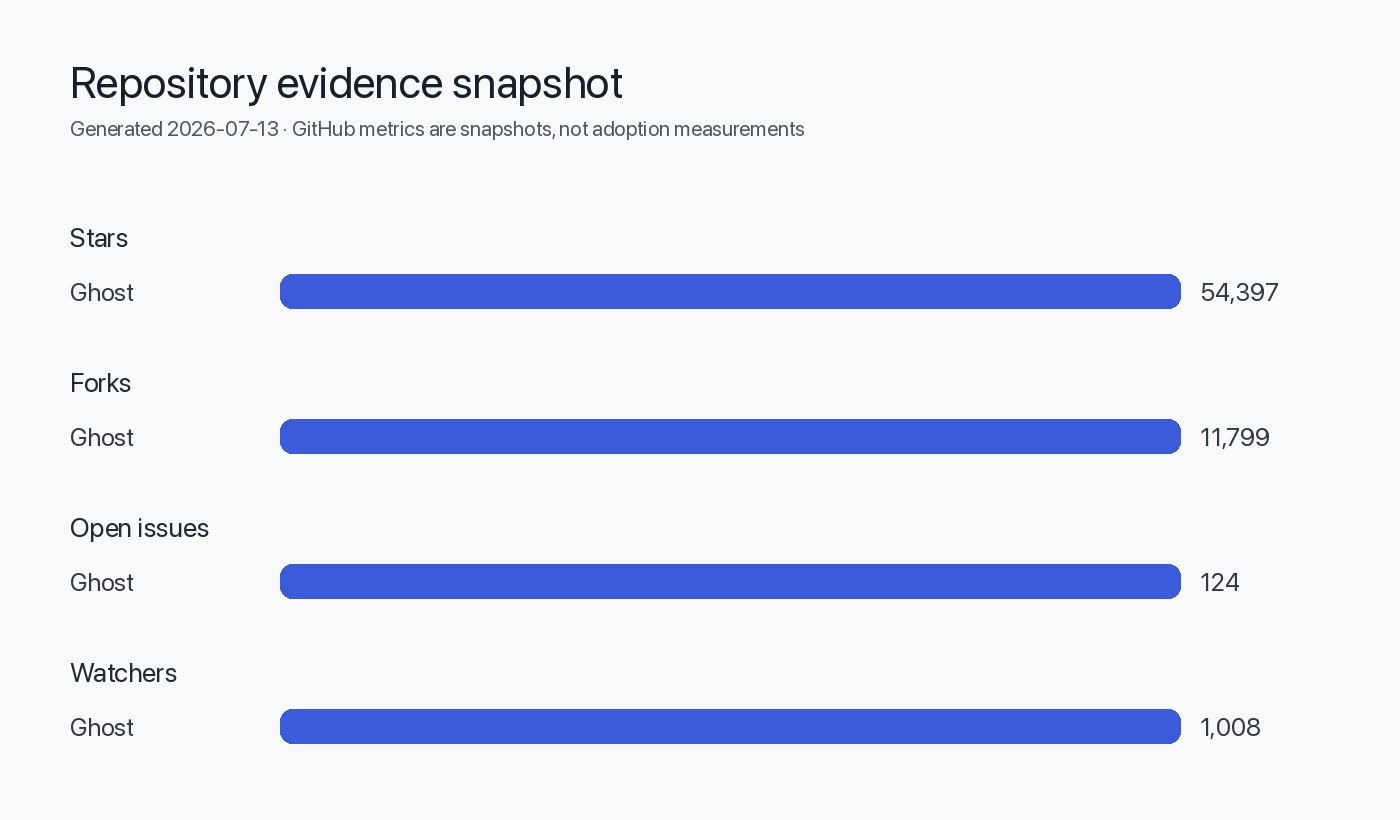
| GitHub stars | 54,397 | Interest and visibility signal — not usage or market share. TryGhost/Ghost |
| Forks | 11,799 | Community activity signal. TryGhost/Ghost |
| Watchers | 1,008 | Notification subscriptions — signal of interest. TryGhost/Ghost |
| Open issues | 124 | Open-issue count; not an absolute defect count. TryGhost/Ghost |
| Primary language | JavaScript | Repository metadata. TryGhost/Ghost |
| License | MIT | Permissive license, relevant to reuse and commercial use. TryGhost/Ghost |
| Created | 2013-05-04 | Repository creation date. TryGhost/Ghost |
| Last push | Jul 12, 2026 | Recent activity on the default branch. TryGhost/Ghost |
| Latest release | v6.52.1 (2026-07-10) | Recent release metadata. v6.52.1 release |
Repository activity and release cadence
This section focuses on measurable repository activity: pushes, releases, and issue/PR flow. These items are evidence of maintenance and prioritization, but not proof of runtime suitability.
Release snapshot
| Field | Value |
|---|---|
| Latest release name / tag | v6.52.1 / v6.52.1 |
| Latest release published at | Jul 10, 2026 |
| Latest release notes (excerpt) | Bug fix for link selection in automations email editor — release body references a single-line fix and links to changelog. release page |
Repository push and branch activity
- The repository
pushed_attimestamp is Jul 12, 2026, indicating recent commits on the default branch. - The default branch is
main.
What these signals mean (and what they don't)
- Active pushes and a recent release indicate that maintainers are committing changes and publishing releases. That supports an assumption of ongoing maintenance for the codebase.
- Open issues = 124. Per the project's metadata, this is the number of currently open issues on GitHub at the retrieval time and should not be equated to the number of defects in production (open issues can include feature requests, questions, and triaged items).
- Stars, forks, and watchers are interest and community signals. They do not equate to deployment counts, revenue, or active instances.
Community, ecosystem, and contribution signals
Ecosystem signals are important for long-term viability and integration options.
Observed signals from repository metadata and README content
- The repository lists topics such as "blogging", "cms", "nodejs", and "publishing" which indicate the project's domain focus. TryGhost/Ghost
- The included README snippet references documentation, a forum, and a managed offering (Ghost(Pro)); these are ecosystem artifacts to verify separately from the repo.
Community and contribution indicators to inspect
| Signal | Why it matters | How to validate |
|---|---|---|
| Number of contributors | More contributors can reduce bus-factor risk | Inspect contributors list and recent PR authors on the repo (GitHub UI) |
| Issues and PR throughput | Indicates responsiveness and backlog health | Measure closed vs opened PRs/issues over a time window (30–90 days) |
| Presence of docs and forum references | Signals available self-help resources | Visit linked docs and forum from the README and evaluate clarity and coverage |
| Official/partner hosting options | Ease of getting to production, vendor lock considerations | Confirm managed offering terms separately (not inferred as product usage) |
Biases and gaps in community signals
- A high number of forks can include forks used for testing, tutorials, or forks that are stale — not all forks indicate active downstream projects.
- The contributors count (visible via GitHub) may show a small core team plus external contributors; to understand bus factor, inspect contribution recency and diversity of committers.
License, legal, and packaging considerations
License summary
- The repository is licensed under MIT. MIT is a permissive license allowing commercial use, modification, and redistribution with few requirements. TryGhost/Ghost
Why license matters for adoption
- Permissive licensing simplifies corporate adoption and packaging for commercial services, but teams still need to verify trademarks and brand policies noted in the README (the README references Ghost as a trademark and links a trademark policy).
Packaging and language ecosystem
- Primary language: JavaScript. For deployment, evaluate Node.js runtime versions supported by the project and third-party dependencies. The repository metadata signals a Node.js/JavaScript codebase, but exact runtime constraints should be derived from package manifests and the project's documentation.
Practical license and packaging checks
- Verify the MIT license file in the repository and any additional files (e.g., CONTRIBUTING, trademark policy) to confirm reuse boundaries.
- Inspect package.json, lockfiles, and build configs to identify Node.js version constraints and transitive dependency surfaces (not inferred in this report; check repository files directly).
Selection risks and red flags
This section lists potential selection risks visible from repository data and the README, and what to look for when validating or mitigating them.
Top selection risks visible from repo-level signals
- Upgrade friction: Even with regular releases, the presence of a managed offering and documented upgrade instructions in README suggests multiple upgrade paths (self-hosted vs managed). Teams should validate the upgrade path with a staging upgrade test.
- Integration surface area: As a JavaScript/Node.js CMS, Ghost uses specific extension points (themes, APIs). If your project depends on particular integrations (e.g., OAuth, external auth providers, complex webhooks), verify those interfaces exist and are stable.
- Dependency and supply-chain risk: Node.js ecosystems can pull many transitive dependencies. An audit of package manifests and lockfiles is required to measure vulnerability exposure.
- Support model mismatch: The README references Ghost(Pro) managed hosting and 24/7 email support for customers there. If you require commercial SLA backing, confirm whether Ghost(Pro) terms meet your needs; the repository itself does not guarantee enterprise SLAs.
What additional evidence your team should collect
Repository signals are a starting point. Before committing to Ghost for production use, collect the following evidence.
Table: Recommended evidence to collect (priority order)
| Priority | Evidence to collect | Why it matters | How to collect |
|---|---|---|---|
| 1 | Upgrade path proof (minor and major) | Confirms how painless or risky future updates are | Run a staged upgrade from current to latest release on a copy of production data; follow docs in repo and document any manual steps |
| 1 | Dependency SBOM/lockfile analysis | Measures supply-chain and vulnerability exposure | Export package-lock.json / yarn.lock, run vulnerability scanners (Snyk, OSV) and inspect major dependency versions |
| 2 | Feature fit PoC for critical integration points | Validates API, webhook, theme extension suitability | Build a minimal integration that exercises your must-have features (authentication, API throughput, export/import) |
| 2 | Performance profile under expected load | Confirms scaling and resource needs | Run load tests against a representative content dataset and caching configuration; measure response times and resource utilization |
| 3 | Community response SLA (issues/PRs) | Helps estimate maintainer responsiveness for critical issues | Open a non-sensitive issue/question and measure response time; review closed PRs for resolution times |
| 3 | Legal/commercial terms (trademark, hosting) | Ensures commercial use complies with policies | Review README-linked trademark policy and hosted product terms; consult legal if needed |
Data collection notes
- For the SBOM and vulnerability scan, use the actual repository lockfiles rather than inferred dependency lists.
- When performing PoC testing, run both the official self-hosted instructions and, if evaluating Ghost(Pro), validate their managed environment behavior under similar workloads.
Action checklist (Decision checklist)
Inferred architecture notes (explicitly labeled)
The repository README content and repository metadata indicate Ghost is a Node.js-based CMS. The following architecture points are inferred from README and repository structure and are explicitly labeled as inferences:
These are inferences and must be validated by inspecting the repository files (package manifests, server entry points, API docs) and official documentation.
Evidence, assumptions, and limitations
- All numeric and textual repository metadata in this report is from the TryGhost/Ghost GitHub repository and the v6.52.1 release page. See the Sources section for the exact links.
- Data retrieval timestamp: Jul 13, 2026 (UTC).
Key assumptions and what is not claimed
- No claims about deployed instance counts, revenue, or market share are made. GitHub stars, forks, and watchers are treated as signals of interest and community engagement only.
- Open issues are not equated to defect counts; they may include feature requests, questions, and enhancement requests.
- Any architectural statements labeled "[Inferred]" are inferences from README or repository metadata and must be validated by code inspection or official docs.
- No security vulnerabilities are claimed or inferred beyond the need to perform a supply-chain and dependency audit. There is no Security Advisory data provided in the supplied sources.
Limitations of repository-only analysis
- Runtime behavior (performance, stability under load) cannot be measured from GitHub metadata and must be tested in a PoC or staging environment.
- Hosted offerings and enterprise SLAs are referenced in README content but must be validated on the service provider's site and legal terms (outside the repository).
- Third-party ecosystem integrations (plugins, themes) may live in other repositories or marketplaces; this report does not enumerate them and recommends a discovery step.
Mermaid: Decision flow for adopting Ghost
flowchart TD
  A[Start: Team evaluates Ghost] --> B{Is permissive licensing acceptable?}
  B -- No --> Z[Reject or seek alternatives]
  B -- Yes --> C[Run dependency SBOM & vuln scan]
  C --> D{High severity vulnerabilities?}
  D -- Yes --> E[Mitigate or fork/patch before production]
  D -- No --> F[Run upgrade test: staging upgrade]
  F --> G{Upgrade friction acceptable?}
  G -- No --> E
  G -- Yes --> H[Build PoC for integration & performance]
  H --> I{PoC passes integration & load tests?}
  I -- No --> Z
  I -- Yes --> J[Decide hosting model: self-host vs Ghost(Pro)]
  J --> K[Prepare deployment runbook & monitoring]
  K --> L[Adopt/Deploy]
Sources
- Ghost canonical repository: https://github.com/TryGhost/Ghost
- Ghost latest GitHub release: https://github.com/TryGhost/Ghost/releases/tag/v6.52.1
FAQ
Are GitHub stars an indicator of Ghost's market share?
No. GitHub stars are interest/visibility signals and do not measure usage, deployments, or market share. They indicate that people have flagged the project in their GitHub accounts.
Does a recent release mean Ghost is safe to deploy in production?
A recent release indicates active maintenance, but safety for production requires additional checks: upgrade testing, dependency vulnerability scanning, and a PoC that exercises your production integration points.
Is the MIT license permissive enough for commercial use?
MIT is a permissive license that generally allows commercial use, modification, and redistribution. Verify any trademark policies or additional legal files in the repository for constraints on branding.
Do open issues mean the project is unreliable?
No. Open-issue counts include feature requests, questions, and active backlog items. Review issue content and resolution timelines to understand maintainer responsiveness.
Should I choose Ghost(Pro) or self-hosted Ghost for production?
That depends on your operational requirements. Ghost(Pro) offers managed hosting and support (mentioned in README), while self-hosting provides more operational control. Compare SLA, compliance, and cost against your needs.
What is the best first technical validation step?
Run a dependency SBOM/vulnerability scan on the chosen release tag and perform a staged upgrade from an earlier release to the target release to validate upgrade steps and migrations.
Where should I look for official docs and community help?
The repository README links to documentation and a community forum. Use those links from the repo to evaluate documentation completeness and community activity.