Fastify (fastify/fastify): Repository Spotlight & Health
A rigorous repository profile of fastify/fastify (Fastify). Covers purpose, maintenance signals, repository health, strengths, limitations, evaluation checklist and an adoption path based on repository evidence.
Fastify (GitHub: fastify/fastify) is an open-source, Node.js web framework whose repository declares a focus on low overhead, extensibility through plugins and a strong developer experience. Evidence from the repository shows active maintenance: a recent release (v5.10.0 published 2026-07-05), recent pushes (pushed_at 2026-07-12), CI badges in the README, and a multi-person core team. The project is licensed MIT and is hosted as the canonical source at the project's GitHub URL.
For teams evaluating Fastify, the repository evidence supports that it is actively developed and has substantial community interest (stars, forks) and formal releases. This profile synthesizes the repository signals, documents strengths and limitations supported by the repository content, and gives a practical evaluation and adoption checklist with a responsible path for trial and production adoption.
Repository at a glance
| Field | Value | Evidence |
|---|---|---|
| Repository | fastify/fastify | GitHub repository |
| Description | Fast and low overhead web framework, for Node.js | Repository metadata |
| Primary language | JavaScript | Repository metadata |
| License | MIT | Repository metadata |
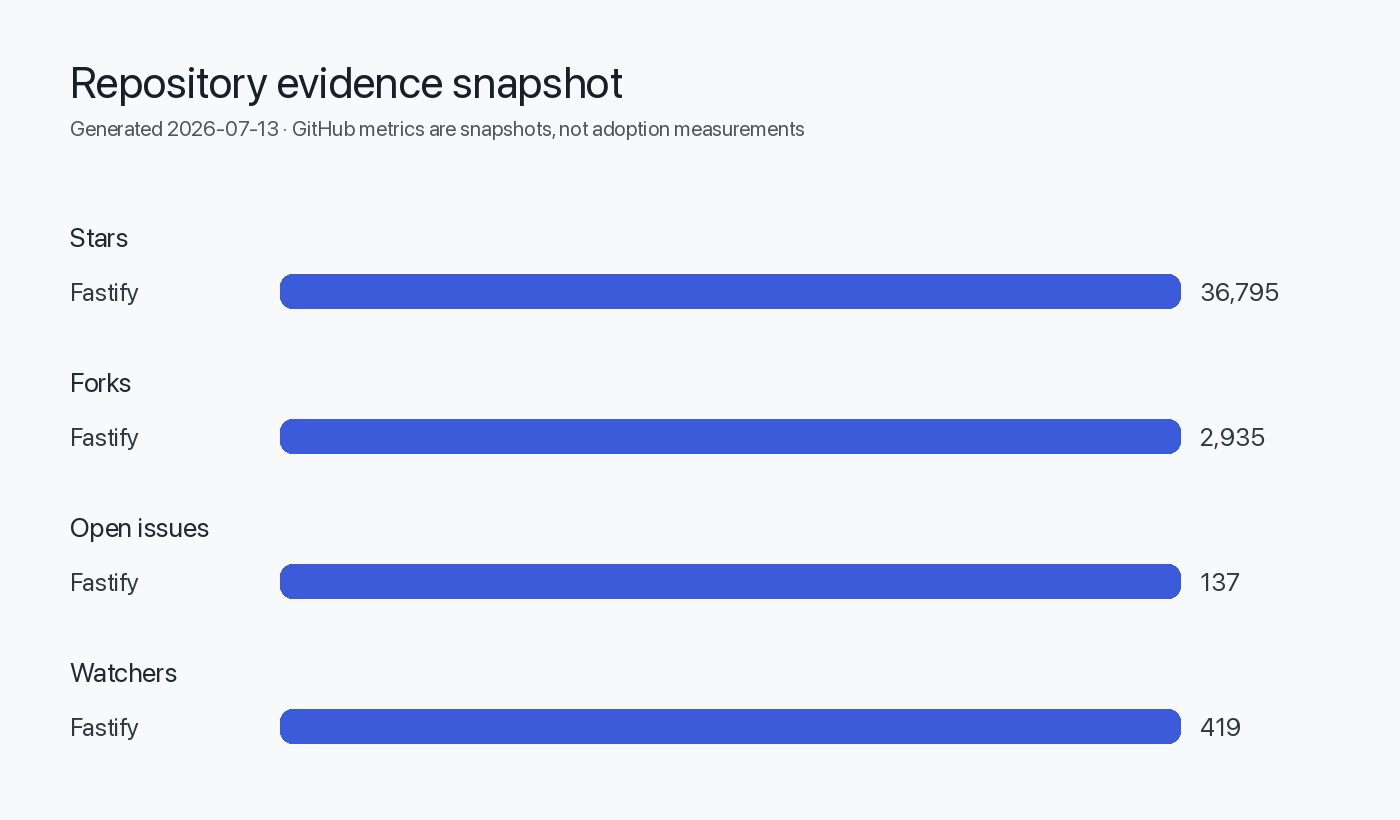
| Stars (interest signal) | 36,795 | Repository metadata (note: signal, not usage) |
| Forks | 2,935 | Repository metadata |
| Watchers | 419 | Repository metadata |
| Open issues | 137 | Repository metadata (note: not defect count) |
| Created | 2016-09-28 | Repository metadata |
| Default branch | main (v5 line) | Repository metadata and README note on v5/main |
| Latest release | v5.10.0 (published 2026-07-05) | Latest release notes |
| Last push | Jul 12, 2026 | Repository metadata |
| Homepage / docs | https://www.fastify.dev | Repository metadata |
Purpose and scope (what the project claims)
The repository README and docs articulate these central claims:
- Fastify is framed as a high-performance Node.js web framework emphasising low overhead and a plugin architecture.
- The project recommends schema-based validation/serialization using JSON Schema and highlights an internal schema compiler for performance.
- The README points to extensibility via hooks, decorators, and a plugins system and documents built-in support for structured logging via Pino.
All above are statements and guidance present in the repository documentation and README; they represent the project's intended scope rather than independently measured guarantees. See the canonical repository for the detailed feature lists and guides: fastify/fastify on GitHub.
Maintenance signals and health indicators
This section compiles repository-provided maintenance signals and explains what each implies.
| Signal | Value / evidence | What it implies |
|---|---|---|
| Latest release | v5.10.0 published 2026-07-05 (release notes) | Active release cadence within the v5 line as of early July 2026. |
| Recent pushes | Last pushed 2026-07-12 | Code was updated after the latest release — ongoing activity. |
| CI and badges | CI, package-manager, website workflows in README | Automated checks and deployment steps are used, indicating some level of continuous integration. |
| Maintainers | Multiple listed Lead Maintainers and Core team in README | Organized team structure with named maintainers. |
| Security disclosure | SECURITY.md referenced in README; security disclosure badge present | The project documents a responsible-disclosure process. |
| Passing best-practices badge | CII Best Practices badge referenced in README | Participation in a recognized best-practices program. |
Maintenance context notes:
- The repository declares v5 on
mainand documents v4 in a branch; the README explicitly references v5 and links to the 4.x branch. This indicates a maintained major-line (v5) with older major versions retained separately. - Open issues are listed as 137 in the metadata; repository data does not equate open issues to code quality. Use issue triage status, time-to-close on resolved issues, and contributor responsiveness to assess support quality.
Evidence-backed strengths and limitations
This section synthesizes strengths and limitations grounded in repository data and documentation.
Strengths (repository-evidenced)
- Active releases and recent commits: a published v5.10.0 (2026-07-05) and a push on 2026-07-12 indicate ongoing maintenance and bug fixes as of July 2026 (release notes).
- Organized governance and named maintainers: the README lists Lead Maintainers, a Core team and Plugins team, which is a sign of explicit caretaking roles.
- Focused documentation: the README links to extensive docs (Guides, Reference) and a dedicated website (https://www.fastify.dev) for further reading.
- Ecosystem and plugin emphasis: the README outlines a core vs community plugin model and provides guides for creating plugins and examples — useful for extensibility.
- CI and security hygiene: CI workflow badges, a security disclosure process and a CII Best Practices badge are present in the README.
Limitations and practical cautions (repository-evidenced)
- Interest signals, not usage: the star count (36,795) is an attention metric. Do not treat it as a measurement of production usage across your specific domain or scale.
- Single primary language: JavaScript is the declared primary language; TypeScript support and typing guidance are documented, but if a team requires first-class TypeScript in-source types you should validate the type-provider story for your use case.
- Benchmarks are synthetic: the README contains a synthetic "hello world" benchmark table. The document explicitly cautions that per-application overhead will vary and recommends benchmarking real workloads. Treat the numbers as a framework-overhead indicator, not an app-level guaranteed throughput.
- Open issues count: the repository metadata lists 137 open issues; that is a snapshot and not a direct defect metric. Investigate issue labels and backlog triage rather than relying on raw open-issue counts.
Architecture and ecosystem (inferred and stated)
Stated architecture elements (from README/docs)
- Plugin architecture: the README repeatedly references plugins and includes a Plugins Guide. The project promotes encapsulation and modularity through plugins.
- Schema-based validation: the README recommends JSON Schema for route validation and serialization, with mention of an internal schema compiler for performance.
- Logging: Fastify documents Pino as the logging solution of choice and integrates logging into the framework's design.
- Inference: Fastify appears to implement a layered request lifecycle with hook points and per-route configurations. This is inferred from the README references to hooks, decorators, lifecycle docs and route-specific logging examples in the release notes.
- Inference: The plugin system supports dependency ordering and encapsulation. This inference is based on the README emphasis on encapsulation, the Plugins Guide, and the common plugin-based patterns described in the docs.
Mermaid diagram — simplified architecture and adoption flow
flowchart LR
  A[Client Requests]
  B[Fastify Core Router & Lifecycle]
  C[Route Schemas (JSON Schema)]
  D[Plugins & Decorators]
  E[Logging (Pino)]
  F[Response Serialization]
  G[Application code]

  A --> B
  B --> C
  B --> D
  D --> G
  B --> E
  C --> F
  F --> A
  G --> F
Benchmarks and performance context (repo-provided)
The repository README includes a synthetic benchmark table for a "hello world" workload (autocannon) intended to compare framework overhead. The README also explicitly cautions that these are synthetic tests and that you should benchmark your own application if performance matters.
Reproduced from the repository's README (evidence):
| Framework | Version | Router? | Requests/sec |
|---|---|---|---|
| Express | 4.17.3 | ✓ | 14,200 |
| hapi | 20.2.1 | ✓ | 42,284 |
| Restify | 8.6.1 | ✓ | 50,363 |
| Koa | 2.13.0 | ✗ | 54,272 |
| Fastify | 4.0.0 | ✓ | 77,193 |
| http.Server | 16.14.2 | ✗ | 74,513 |
Source: fastify/fastify README benchmark table (see repository). The README includes the machine specification and the benchmark method (autocannon -c 100 -d 40 -p 10 localhost:3000) used to generate the numbers.
Interpretation notes (repository-sourced guidance):
- The README explicitly states that the benchmark is synthetic and aimed at measuring framework overhead in a very simple route. The project recommends you perform your own benchmarks for realistic workloads.
Plugin ecosystem and extensibility model
The README distinguishes between Core plugins maintained by the Fastify team and Community plugins supported by third parties. The existence of a separate Fastify Plugins team (12 members) alongside the Core team (13 members) reflects organizational investment in ecosystem quality.
The fastify/fastify-cli and fastify/create-fastify projects provide scaffolding via npm init fastify, generating a development-ready project structure. The plugin architecture enforces encapsulation by default—plugins cannot access parent context decorators unless explicitly wrapped with fastify-plugin, a design choice that prevents implicit coupling.
Key plugin categories inferred from documentation structure:
- Authentication: Session management, JWT, OAuth flows
- Validation: Schema compilation, custom validators
- Database: Connection pooling, ORM integration
- Serialization: Custom encoders, streaming responses
- Observability: Metrics exporters, tracing integrations
- Transport: WebSocket, HTTP/2, gRPC adapters
The presence of a "How to write a good plugin" guide and a Plugins Guide in the documentation suggests the project actively cultivates third-party extension development, reducing core maintenance burden while expanding capability surface area.
Version 5 evolution and stability signals
The main branch represents Fastify v5, with the README directing users to the 4.x branch for the previous major version. Release v5.11.3 includes eight pull requests addressing:
- Trailer header state management: Clearing internal state when all trailers removed
- Security documentation: Clarifying that percent-decoded route params are untrusted input
- Type system fixes: Recognizing constructor-assigned built-in properties as decorators
- RegExp parser edge cases: Resetting
lastIndexfor global/sticky content-type parsers - Error handler consistency: Passing
nullinstead ofundefinedtorequestCompletedon success
These changes reflect production-grade refinement rather than feature churn. The presence of three first-time contributors in this release (minirang, lazerg, zelinewang) indicates sustained community engagement beyond the core team.
Support lifecycle and commercial backing
The README explicitly states versions 3 and lower are EOL and will not receive security or bug fixes. The project documents a partnership with HeroDevs for commercial extended support of unsupported versions, suggesting a clear monetization path that does not restrict the open-source codebase. NearForm and Platformatic are listed as sponsoring companies, both with business models aligned to Node.js consulting and platform services.
Decision checklist (quick evaluator)
Use this checklist before doing a trial implementation.
Action checklist — recommended adoption steps
A practical, evidence-grounded path to trial and adopt Fastify.
- Pilot project
- Create a small microservice that mirrors your expected request/response shapes and middleware (auth, body parsing, logging). Use the
npm init fastifypath suggested in the README to bootstrap.
- Reproduce performance tests
- Reuse the README's benchmarking approach but with your payloads and concurrency to measure real overhead.
- Validate TypeScript story
- If you require TypeScript-first development, exercise the documented TypeScript and type-provider guides and confirm typing ergonomics for your team.
- Test plugins and ecosystem
- Evaluate core plugins and community plugins relevant to your stack. The README offers a separation between core and community plugins — exercise both types to confirm maturity.
- Security review
- Review SECURITY.md and the project's release notes for relevant fixes. Run dependency scans and SCA tools on the project and your dependency tree.
- Production readiness
- Validate CI/CD integration using the repository's example workflows and confirm observability (logging via Pino, metrics) in your environment.
- Contribute or vendor fixes
- If you encounter issues, use the repository's CONTRIBUTING guide and issue process. For long-lived forks or vendor support, the README references commercial support links for unsupported versions.
Responsible adoption path and recommended testing plan
A responsible adoption plan follows development, testing, and ops validation steps that map to repository evidence.
Phase 1 — Exploratory (1–2 weeks)
- Goals: confirm fit and developer ergonomics.
- Tasks: bootstrap sample app, run linter and test suites, read server and routes reference docs, test plugin registration and encapsulation.
Phase 2 — Performance and compatibility (2–4 weeks)
- Goals: measure real-world performance and validate middleware/plugin compatibility.
- Tasks: reproduce synthetic and representative benchmarks (autocannon or similar), validate JSON Schema validation performance, check logging and error handling integration.
Phase 3 — Security and compliance (1–3 weeks)
- Goals: ensure dependencies and configuration meet your security requirements.
- Tasks: run SCA, check for relevant CVEs, review SECURITY.md process, run threat modeling for listen/bind interfaces.
Phase 4 — Pilot in staging and gradual rollout (2–8 weeks)
- Goals: production-like stress and operational readiness.
- Tasks: deploy to staging with realistic traffic, validate observability and incident response, test graceful shutdown and resource usage, perform chaos/latency injection if needed.
Phase 5 — Production adoption and contribution
- Goals: full production rollout with ongoing maintenance plan.
- Tasks: finalize monitoring, service-level objectives, and consider contributing back fixes or docs based on your findings.
Evidence, assumptions, and limitations
- Repository metadata provided in the editorial dataset (stars, forks, watchers, open_issues, language, license, created_at, pushed_at, default_branch, homepage).
- README content and included artifacts (CI badges, benchmark table, description, docs listing) as supplied in the editorial data.
- Latest release notes for v5.10.0 (published 2026-07-05) supplied in the editorial data.
- When I infer architectural layout (request lifecycle, plugin dependency ordering), these are labeled as "Inference" and are based on README references to hooks, decorators, plugins and encapsulation. The repository content suggests these patterns but the exact runtime architecture should be verified by reading source code and documentation.
- Benchmarks reproduced here are those present in the README. The README itself warns they are synthetic; I assume no external measurements beyond the README were available.
- This profile does not include results of running the repository's CI, executing test suites, or performing live installs. Readers should run these checks themselves before deployment.
- External signals such as production adoption by specific companies, runtime usage statistics, or security advisories outside the repository were not used (no external sources provided). Do not infer market-share or production prevalence from stars or forks.
Data freshness
- Data and repository timestamps are based on the editorial payload and were current as of the generated_at timestamp: Jul 13, 2026. The latest release in the repository data is v5.10.0 published 2026-07-05.
FAQ
Is Fastify actively maintained?
The repository shows recent activity and a recent release (v5.10.0 published 2026-07-05) and a last push on 2026-07-12, indicating ongoing maintenance as of July 2026. See the release notes in the repository for details: https://github.com/fastify/fastify/releases/tag/v5.10.0.
Can I rely on Fastify for high-throughput services?
The README contains synthetic benchmark results demonstrating low framework overhead in simple tests and documents performance as a goal. The README also explicitly recommends benchmarking with representative workloads before deciding.
Does Fastify provide TypeScript support?
The README references TypeScript and type-provider documentation. The repository includes TypeScript guidance in its docs; you should exercise the TypeScript/type-provider path for your codebase to confirm ergonomics.
Are security practices documented?
The repository README references a SECURITY.md and shows a security disclosure badge, which indicates a documented responsible-disclosure process. Run your own SCA and security scans before production use.
What is the licensing model for Fastify?
The project is licensed under the MIT license as indicated in the repository metadata.
How should I evaluate Fastify plugins?
Fastify's README separates core plugins from community plugins and provides guides for writing plugins. For production use, validate plugin maintenance, CI status, compatibility with your Fastify major version, and test plugins in a staging environment.
Do open issues indicate poor quality?
Open issue counts are a snapshot and not a direct defect metric. Inspect issue triage, labels, and resolution times to assess project responsiveness and support quality.