Medusa vs Magento: headless vs classic commerce comparison
A focused, evidence-grounded comparison of Medusa (TypeScript, modular commerce) and Magento (PHP, Adobe-maintained) to help architects pick the right platform for their project needs.
Medusa and Magento address online commerce from different technical foundations. Medusa's canonical repository indicates a TypeScript / Node.js stack, an MIT license, and explicit positioning as "building blocks for digital commerce" with modular integrations and a cloud offering referenced in the README. Magento's repository shows a long-established PHP codebase maintained under the OSL-3.0 license and provides a full-featured open-source product with extensive installation and system-requirements documentation maintained by Adobe.
For practical project decisions: choose Medusa when you need a JavaScript/TypeScript-first, modular, API-driven commerce foundation that aligns with headless storefronts and modern JS toolchains (evidence: repository language, topics, and README references). Choose Magento when your project needs the breadth of features and ecosystem typical of a mature, PHP-based, full-stack commerce product and when Adobe's broader product ecosystem or compatibility with traditional Magento workflows matters (evidence: Magento README content and repository size signals). These are not absolute winners—below you'll find a decision matrix, trade-offs, migration guidance, and recommendations tailored to four concrete project profiles.
At-a-glance facts
| Property | Medusa (medusajs/medusa) | Magento (magento/magento2) |
|---|---|---|
| Repository URL | github.com/medusajs/medusa | github.com/magento/magento2 |
| Primary language (repo) | TypeScript | PHP |
| Topics / signals | commerce, e-commerce, framework, nodejs, typescript, react | ecommerce, ecommerce-platform, magento2, php |
| License | MIT | OSL-3.0 (Magento Open Source) |
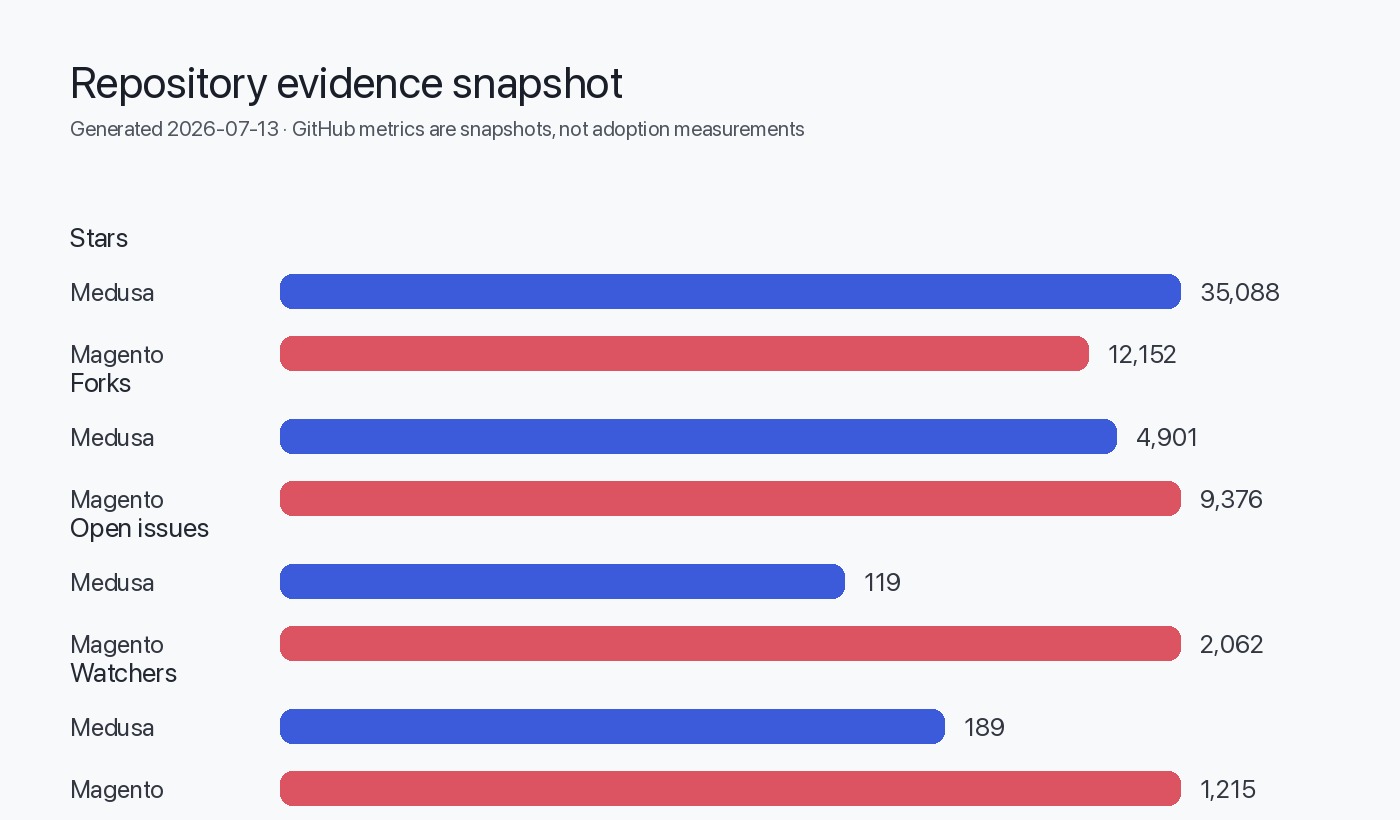
| GitHub stars (signal) | 35,088 | 12,152 |
| Forks | 4,901 | 9,376 |
| Open issues (repo) | 119 | 2,062 |
| Default branch | develop | 2.4-develop |
| Latest release (as supplied) | v2.17.2 — published 2026-07-01 (release notes) | 2.4.9 — published 2026-05-12 ([release])(https://github.com/magento/magento2/releases/tag/2.4.9) |
| Homepage / Docs referenced | https://medusajs.com, https://docs.medusajs.com | http://www.magento.com, Experience League docs |
Decision matrix (criteria-based)
This matrix maps high-level decision criteria to repository-backed evidence. Entries summarize whether the evidence from the supplied repos and READMEs favors one platform, both, or is inconclusive.
| Criterion | Evidence from supplied data | Which platform this evidence indicates |
|---|---|---|
| Language & ecosystem alignment | Medusa repo language: TypeScript; topics include nodejs, javascript, react, typescript. Magento repo language: PHP; topics include magento2, php. | Medusa for JS/TS stacks; Magento for PHP-based environments. |
| Licensing | Medusa: MIT (per repo metadata and README). Magento: OSL-3.0 and Adobe-managed licensing notes in README. | Medusa for permissive license; Magento subject to OSL-3.0 and Adobe terms (read README). |
| Modularity & headless design signal | Medusa README describes "building blocks for digital commerce" and links to architecture and commerce modules; latest release notes reference admin SDK and JS SDK. (INFERRED: modular, API-centric). | Magento README presents a full-featured open-source product and links to installation/system requirements; typical Magento messaging (INFERRED: feature-rich, more monolithic product). See "Architectural inferences" section for labeling. |
| Admin & platform features | Medusa latest release notes (v2.17.2) list admin dashboard improvements (Layout Composer), async payment support, tiered pricing for price lists — evidence of active feature development and admin customization features. | Magento README and release references show full product releases maintained by Adobe and large contributor base; release 2.4.9 indicates continued maintenance. |
| Community signals & project activity | Medusa: 35k stars, recent release (2026-07-01), 119 open issues. Magento: 12k stars, release 2026-05-12, 2,062 open issues. | Both active; Medusa shows higher star count as a community interest signal; Magento has more open issues (not defect counts). |
| Upgrade & maintenance guidance | Medusa README points to Release Notes and integrations; Magento README lists system requirements and installation docs and points to Adobe's support channels. | Both provide upgrade guidance; Magento points to formal Adobe documentation channels. |
Trade-off table
The table below summarizes practical trade-offs you should expect when choosing one repository-backed platform over the other. All rows are grounded in the supplied repository metadata and README content; when an architectural conclusion is inferred from README/repo structure, it is explicitly labeled.
| Trade-off | Medusa (evidence) | Magento (evidence) | Practical implication |
|---|---|---|---|
| Modern JS stack vs. PHP ecosystem | Language: TypeScript; topics include nodejs, react, typescript; README references JS SDK and modular integrations. | Language: PHP; README is Adobe-hosted and references Composer-based installs and system requirements. | Choose Medusa when your team prefers JS/TS end-to-end; choose Magento when your environment or hosting stack aligns with PHP/Composer and Adobe ecosystem. |
| License and code reuse | MIT license (Medusa) — permissive. | OSL-3.0 + Adobe contributor/licensing notes. | MIT generally has fewer redistribution constraints; Magento's license and Adobe relationship require reading README and license terms for enterprise uses. |
| Admin UX & customization | Medusa release notes list admin Layout Composer and other admin features — evidence of admin customization. | Magento README lists extensive admin docs and system guidance — evidence of a full-featured admin experience supported by Adobe. | Both platforms support admin capabilities; the integration pattern and extension model will differ by platform and team skills. |
| Complexity of installation | Medusa README points to Medusa Cloud for fast start and docs for local setup. | Magento README highlights system requirements and multiple installation options and points to Experience League docs. | Medusa Cloud can reduce ops overhead; Magento installations often require platform and infrastructure planning per Adobe docs. |
| Community size & contributions | Medusa: higher stars (35k) with active release cadence (release dated 2026-07-01). Magento: long-lived repository with many forks and a large contributor base; release dated 2026-05-12. | Community signals differ: interest vs. historical contributor magnitude. | Evaluate community channels (Discord, GitHub Discussions, Adobe support) when you need ecosystem plugins or vendor support. |
Workload fit analysis (project profiles and recommendations)
Below are four realistic project profiles. Each includes a recommendation anchored in repository facts and labeled inferences where applicable.
Profile A — Small DTC headless storefront
Context: A startup wants a fast-to-launch, JavaScript-first storefront using Next.js or React SPA, with modest catalog size and a small engineering team (JS expertise preferred).
Recommendation (evidence-grounded): Medusa is a natural fit because the repo is TypeScript-based, lists nodejs/react topics, references a JS SDK and Medusa Cloud for quick starts. These facts indicate alignment with JS/TS storefronts and managed deployment options (Medusa repo README).
Considerations:
- If your team must operate within a PHP hosting provider or requires Magento-specific platform features, evaluate Magento instead (evidence: Magento repo language PHP and Adobe docs). (INFERRED: switching to Magento implies aligning with PHP-based workflows.)
Profile B — Enterprise multi-store / omnichannel
Context: An enterprise needs multi-store capability, complex shipping/taxation integrations, and formal vendor support. They have a mix of PHP and Java teams and existing investments in Magento or Adobe Commerce.
Recommendation (evidence-grounded): Magento’s repository and README show a mature, Adobe-backed product with documentation for installations and system requirements, suggesting a platform that integrates into larger enterprise processes (Magento README). If your organization already uses Magento or needs Adobe's commercial offerings, Magento is a defensible choice. Medusa can be used for modular headless setups, but evaluate operational fit against Adobe-managed workflows.
Profile C — B2B wholesale with complex pricing
Context: B2B wholesale with tiered pricing, price lists, and asynchronous payment flows.
Recommendation (evidence-grounded): Medusa's latest release notes (v2.17.2) explicitly mention tiered pricing for price lists and async payment methods support in the Payment module and Stripe provider — evidence that these specific commerce capabilities are present in the repository's active development (v2.17.2 release notes). That makes Medusa an attractive option for B2B scenarios where those features are required and where a JS/TS stack is acceptable.
Magento can also be adapted for B2B use, but confirm feature coverage against Adobe's Commerce offerings and read Magento's docs for enterprise-specific functionality. (INFERRED: Magento's full-featured positioning suggests B2B capabilities, but verify specific modules in Adobe's documentation.)
Profile D — Marketplace / multi-vendor platform
Context: Building a marketplace with vendor onboarding, commissions, and multi-party payouts.
Recommendation (evidence-grounded): Neither repository's README explicitly advertises a marketplace module in the supplied README snippets. Medusa's modular architecture language ("commerce modules", "building blocks") suggests it may be extended for marketplace features (INFERRED from the README and repo topics). Magento's ecosystem and long history (and Adobe's Commerce product lines) historically include marketplace extensions in the broader ecosystem (INFERRED from README references to product tiers). For either platform, expect development work to implement marketplace primitives or to integrate third-party marketplace extensions; evaluate available community plugins and commercial extensions specific to marketplaces.
Migration considerations
All migration guidance below is conservative and based on evidence or repository-readme inferences.
- Data model differences: Medusa and Magento use different primary languages and extension models (TypeScript/Node vs PHP/Composer). Expect data model transformation work when migrating between platforms (INFERRED due to language and architecture differences in READMEs).
- Operational model: Medusa references Medusa Cloud for managed deployments, which can simplify rollout for JS-first stores. Magento’s README points to formal installation guides and system requirements maintained by Adobe, which implies more platform and infrastructure configuration for self-hosting. Use these resources when planning migration: Medusa docs and Magento Experience League (Medusa repo, Magento repo).
- Feature parity: Compare specific commerce features (payments, pricing, promotions) to avoid functional regressions. Medusa release notes explicitly mention async payments and tiered price list pricing in v2.17.2; use those documented features as a baseline for parity checks. For Magento, consult Adobe's product and module documentation referenced in the Magento README.
- Extension & plugin availability: Both ecosystems rely on third-party modules and integrations. Catalogue existing extensions in your source platform and find replacements or rebuild plans for the target platform.
Workload & team fit analysis
Map engineering/team traits to platform fit using only evidence from the supplied repository metadata and READMEs.
| Team trait | Platform fit (evidence) | Notes |
|---|---|---|
| JavaScript/TypeScript frontend engineers, preferring end-to-end JS | Medusa — repo language TypeScript; topics include nodejs, react, typescript; JS SDK referenced in release notes. | Medusa reduces cross-language friction. |
| PHP/Composer operations teams or existing Magento expertise | Magento — repo language PHP; README references Composer-based install docs and Adobe product documentation. | Magento integrates into existing PHP tooling. |
| Need for permissive license for redistribution | Medusa — MIT license stated in repo metadata and README. | MIT is permissive; Magento uses OSL-3.0 plus Adobe licensing notes that must be reviewed. |
| Desire for managed/cloud offering for fast starts | Medusa — README mentions Medusa Cloud as fastest way to get started. | Medusa Cloud can lower ops overhead per README. Magento README points to installation guides and system requirements. |
Mermaid: decision flow
flowchart TD
  A[Start: Project Requirements] --> B{Primary language preference?}
  B -- "JavaScript/TypeScript" --> C[Consider Medusa]
  B -- "PHP / Adobe ecosystem" --> D[Consider Magento]
  B -- "No strong preference" --> E{Feature & operations priorities}
  E -- "Headless + modern JS" --> C
  E -- "Enterprise features + Adobe support" --> D
  C --> F{Need advanced B2B & tiered pricing?}
  F -- "Yes" --> C1[Medusa: v2.17.2 lists tiered price-list pricing and async payments (see release notes)]
  F -- "No" --> G[Medusa: good fit for JS-driven storefronts]
  D --> H{Has in-house PHP ops or existing Magento install?}
  H -- "Yes" --> I[Magento: aligns with Adobe docs and Composer workflows]
  H -- "No" --> J[Evaluate staffing & migration costs]
Decision checklist / Action checklist
- Inventory your current stack and list non-negotiable constraints (language, hosting, vendor contracts).
- Map required commerce features (payments, pricing tiers, tax/shipping integrations) to the feature notes in the supplied releases and READMEs. For example, confirm Medusa's async payments and tiered price-list support by reviewing v2.17.2 release notes (Medusa release v2.17.2).
- Evaluate license implications: MIT (Medusa) vs OSL-3.0 + Adobe terms (Magento). Get legal review if redistribution or embedding is planned.
- Check operational requirements: if you need managed hosting, review Medusa Cloud offerings referenced in Medusa's README and compare with your enterprise hosting model and Magento Experience League docs.
- Prototype core flows (checkout, payments, import/export) on both platforms using small POCs and the official docs linked from each repo.
- For migrations, draft ETL for products, customers, orders; confirm data model differences and plan for transformation.
Architectural inferences, evidence, assumptions, and limitations
Evidence (from supplied sources):
- Medusa repo metadata: language=TypeScript, license=MIT, topics include nodejs/react/typescript, latest release v2.17.2 (published 2026-07-01), README references Medusa Cloud, docs, architecture pages, integrations, and an admin SDK (Medusa canonical repository, v2.17.2 release).
- Magento repo metadata: language=PHP, license=OSL-3.0, README references Adobe Contributor License Agreement, installation/system requirements, Experience League docs, and a release 2.4.9 (published 2026-05-12) (Magento canonical repository).
Inferences (explicitly labeled):
- Inferred: Medusa is designed to be modular and API-first / headless. This inference is based on README phrasing such as "building blocks for digital commerce," repository topics (nodejs, typescript, react), and references to a JS SDK and modular integrations in the release notes. These repository signals are consistent with an API-driven approach but are an inference and should be confirmed by reviewing the architecture docs linked in the Medusa README.
- Inferred: Magento represents a larger, more feature-complete, and traditionally monolithic PHP-based commerce product that integrates into Adobe's ecosystem. This inference is based on README content that emphasizes installation options, system requirements, Adobe's involvement, and the project's long history. Verify Magento's specific architectural model and available modules in Adobe's official docs.
- All facts in this article are drawn from the supplied repository metadata, READMEs, and the Medusa release notes provided in the editorial data. No external benchmarks, usage metrics, or un-cited claims are included.
- GitHub stars and forks are used only as community interest signals, not as adoption or market-share metrics. Open issue counts are presented as repository metadata and are not equated to defect counts.
- Where I have drawn architectural conclusions from README language or repository structure, those are explicitly labeled as "Inferred." Those inferences should be validated by reading the projects' architecture documentation and testing the platforms.
- Release dates and versions are cited from the supplied data; check upstream repositories for any newer releases beyond the supplied snapshot.
Visual data (supplied)
Sources
- Medusa canonical repository: https://github.com/medusajs/medusa
- Medusa latest GitHub release: https://github.com/medusajs/medusa/releases/tag/v2.17.2
- Magento canonical repository: https://github.com/magento/magento2
FAQ
Which platform is better for a React-based storefront?
Based on repository evidence, Medusa aligns with TypeScript/React stacks (repo language TypeScript; topics include react). Magento is PHP-based; it can serve headless storefronts via APIs, but Medusa is the clearer fit from a language/ecosystem perspective.
Are there built-in tiered pricing features?
Medusa's v2.17.2 release notes explicitly mention tiered pricing for price lists. For Magento, consult Adobe's product docs to confirm comparable modules; Magento's README points to Experience League documentation.
What are the licensing differences?
Medusa is released under the MIT license per repository metadata. Magento Open Source is under OSL-3.0 and includes Adobe contributor/licensing notes in its README. Review those licenses for redistribution or modification obligations.
Do GitHub stars indicate production usage?
No. Stars are interest signals; they do not measure installations or market share. Use them as one of many signals when evaluating community interest.
Which platform is easier to get started with operationally?
Medusa's README points to Medusa Cloud as the fastest way to start, which can reduce initial ops work. Magento's README emphasizes system requirements and installation docs, suggesting more platform setup for self-hosted deployments.
Are both projects actively maintained?
Both repositories show recent releases in the supplied data: Medusa v2.17.2 published 2026-07-01 and Magento 2.4.9 published 2026-05-12. These release dates are supplied and indicate recent activity as of the snapshot.
How should I validate which platform to pick?
Use the decision checklist: inventory constraints, map required features to repository evidence (e.g., Medusa release notes for tiered pricing), prototype critical flows, and confirm license/operational implications.