Bagisto + SuiteCRM: An eCommerce + CRM Stack Guide
Technical guidance for integrating Bagisto (Laravel-based eCommerce) with SuiteCRM to form a production-ready commerce + CRM stack, including architecture, data flow, deployment topology, observability, security boundaries, and a staged implementation plan.
Bagisto + SuiteCRM: an implementation and integration stack guide
Bagisto (an open-source Laravel eCommerce platform) and SuiteCRM (an open-source PHP CRM) can be combined into a cohesive commerce + CRM stack where Bagisto operates the storefront, catalog, checkout and order lifecycle, and SuiteCRM becomes the canonical system for customer records, sales pipelines, service cases and marketing activities. Integration is typically one-way or bidirectional sync of customer, order and product metadata using HTTP APIs, webhooks, or message-broker patterns; this guide lays out architecture, request/data flow, integration boundaries, deployment topology, observability, security boundaries, and a staged rollout plan.
This article is evidence-grounded on each project's canonical repositories and releases (see Sources). Where repository structure or README content implies architecture or integration points, those statements are explicitly labeled as inferences. Data retrieval/generation date: 2026-07-13 (see "Evidence, assumptions, and limitations").
Why integrate Bagisto and SuiteCRM?
- Bagisto provides a Laravel-based eCommerce platform with storefront, cart, checkout, multichannel, multivendor and headless options. See the Bagisto repository for project facts and release notes: bagisto/bagisto and the latest release details at v2.4.8 release.
- SuiteCRM provides an open-source CRM used to manage customers, leads, opportunities, cases and marketing workflows. See the SuiteCRM repository for project facts: SuiteCRM/SuiteCRM.
Combining them keeps eCommerce concerns (catalog, pricing, checkout) inside Bagisto while SuiteCRM centralizes customer lifecycle management, support cases and sales operations—reducing duplicate business logic and aligning CRM workflows with back-office systems.
Technology snapshot (quick facts)
| Aspect | Bagisto | SuiteCRM |
|---|---|---|
| Canonical repo | bagisto/bagisto | SuiteCRM/SuiteCRM |
| Primary language | PHP (Laravel) | PHP |
| Default branch | 2.4 | hotfix |
| Latest notable release (repo) | v2.4.8 (published 2026-07-08) | 7.15.1 (published 2026-03-19) |
| License | MIT | AGPL-3.0 |
| Topics / capabilities | eCommerce, headless, multi-vendor (see repo topics) | CRM, leads, opportunities, cases, reports |
| Repo stars (signal) | 27,690 | 5,571 |
| Open issues (signal) | 39 | 1,414 |
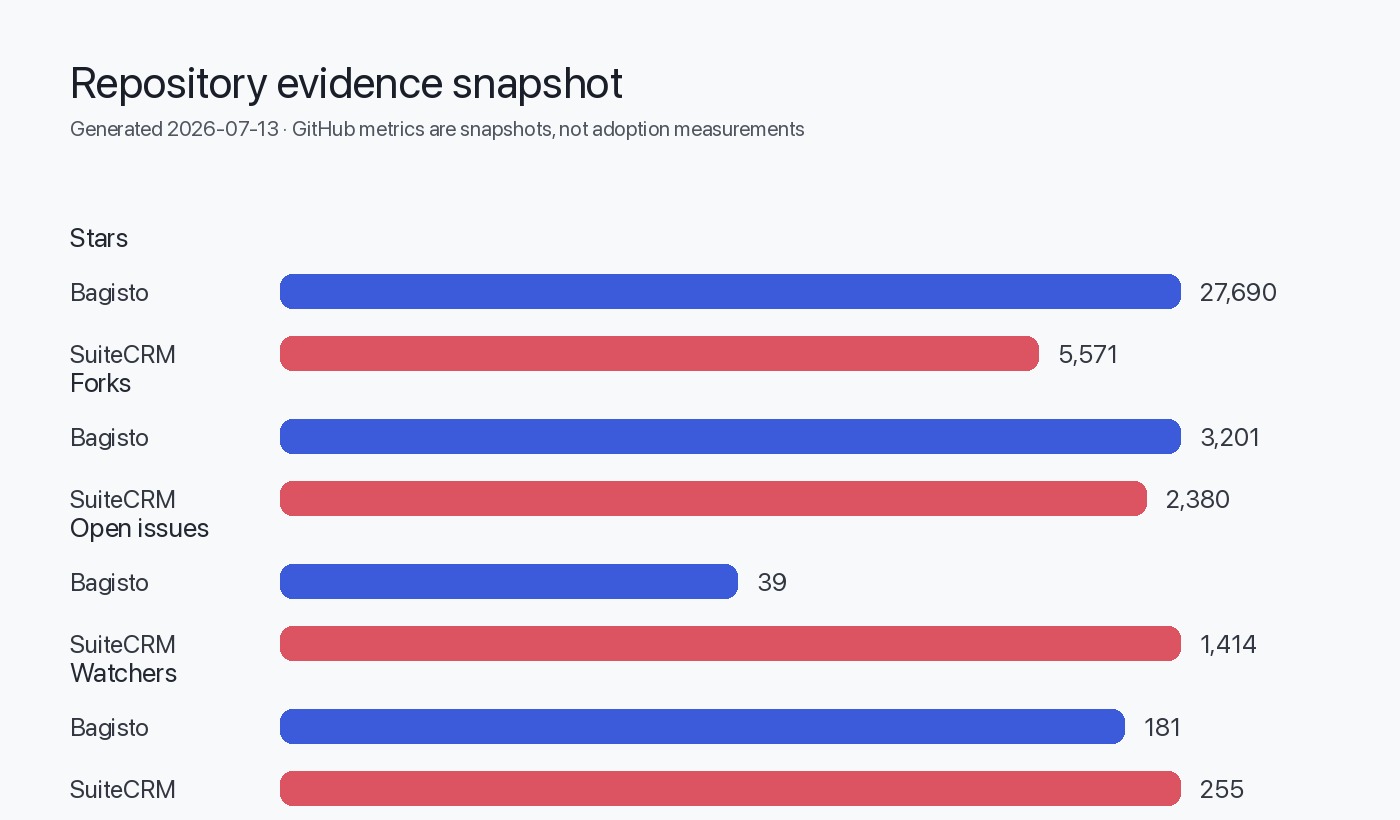
High-level architecture and integration patterns
This section describes three practical patterns to connect Bagisto and SuiteCRM. Choose a pattern based on latency tolerance, volume, and operational complexity.
- Synchronous HTTP API + webhooks: Bagisto emits webhooks for order and customer events; SuiteCRM exposes inbound API endpoints to receive these events. Suitable for low-to-moderate volume and when near-real-time visibility in CRM is required.
- Asynchronous message bus (recommended for scale): Bagisto publishes events to a queue (RabbitMQ, Amazon SQS, Kafka); an integration service consumes events and performs writes to SuiteCRM via its API or database adapter. This decouples systems and improves resilience.
- Data replication / ETL: Nightly batch export/import of orders and customers into SuiteCRM for reporting and analytics—suitable when CRM needs a near-daily snapshot only.
Architectural inference: Bagisto is Laravel-based and provides headless capabilities and a plugin extension model. SuiteCRM follows a PHP/Apache compatible stack and exposes REST-style endpoints and a module system. These are inferred from each project's README and repository structure (bagisto/bagisto, SuiteCRM/SuiteCRM).
Mermaid: component diagram
flowchart LR
  subgraph storefront
    Browser[Browser / Mobile App]
    NextJS[Optional Headless Frontend]
    Browser -->|HTTP| NextJS
    NextJS -->|GraphQL/REST| API_GW[API Gateway / CDN]
    Browser -->|HTTP| API_GW
  end

  subgraph ecommerce
    API_GW --> BagistoApp[Bagisto (Laravel)]
    BagistoApp --> BagistoDB[(MySQL/MariaDB)]
    BagistoApp -->|publish events| MQ[(Message broker)]
    BagistoApp -->|webhooks| SuiteCRMAPI[SuiteCRM API]
  end

  subgraph integration
    MQ --> IntegrationSvc[Integration service / worker]
    IntegrationSvc --> SuiteCRMAPI
    IntegrationSvc --> SuiteCRMDB[(SuiteCRM DB) - optional]
  end

  subgraph crm
    SuiteCRMAPI --> SuiteCRMApp[SuiteCRM]
    SuiteCRMApp --> SuiteCRMDB
  end

  Admin[Admin Dashboard] --> BagistoApp
  Admin --> SuiteCRMApp
Request and data flow (detailed)
Below are typical request flows and recommended guarantees.
- Customer registration (preferred authoritative system: SuiteCRM or Bagisto?)
- Option A: Bagisto as authoritative for authentication and storefront profiles. On successful registration, Bagisto emits a "customer.created" webhook and/or message to the queue. Integration service creates or updates the contact/account in SuiteCRM.
- Option B: If marketing automations and lead capture are handled primarily in SuiteCRM (common in B2B), inbound leads in SuiteCRM may be synced to Bagisto as guest customers or converted into accounts via API.
- Order lifecycle
- Bagisto handles cart, checkout, payment, and order status. On order created/paid/fulfilled events Bagisto should emit message(s) to MQ or call SuiteCRM webhook endpoints with a compact order payload (order id, customer id, total, status, items metadata).
- The integration service enriches payloads if required (e.g. map Bagisto product SKUs to CRM product records) and creates an invoice/opportunity/case in SuiteCRM according to your sales workflow.
- Customer service and cases
- SuiteCRM remains the system for creating cases. For case-resolution actions that affect orders (refunds, returns, cancellations), SuiteCRM can call Bagisto APIs (authenticated) to change order status or initiate refunds.
- Product and inventory
- Product master data typically stays in Bagisto. If SuiteCRM requires product lists for quoting, the integration service exports a lightweight product list or exposes an on-demand API endpoint to SuiteCRM.
- Marketing and campaigns
- Customer segments (from Bagisto events and order history) can be synced into SuiteCRM. Frequent sync options: real-time via events, or batch hourly/daily depending on volume and campaign freshness needs.
Latency and consistency recommendations
- Use event-driven, idempotent handlers: each event should include a stable business key (customer UUID, order number) and a monotonically increasing timestamp to avoid duplication.
- For critical operations that must be synchronous (e.g., a Cart->Create Lead step used in checkout fraud checks), implement a best-effort synchronous API with a fallback to the event pipeline.
Integration boundaries and mapping tables
The table below maps common objects and recommended integration strategy.
| Business object | Source of truth | Direction | Recommended transport | Notes |
|---|---|---|---|---|
| Customer (profile) | Bagisto by default for storefront profile; CRM for long-lived contact records in B2B | Bagisto -> SuiteCRM (create/update) | Webhook or MQ message -> Integration service -> SuiteCRM API | Use unique identifier mapping (Bagisto customer_id -> SuiteCRM contact.external_id) |
| Order | Bagisto | Bagisto -> SuiteCRM | Event-driven (MQ) or webhook | Create order record or opportunity in CRM; include payment status and fulfillment status |
| Product catalog | Bagisto | Bagisto -> SuiteCRM (optional read-only sync) | Batch export or API on-demand | Only sync SKU, name, price, and tax class to CRM quoting modules |
| Cases / Support tickets | SuiteCRM | SuiteCRM -> Bagisto (if action on order needed) | SuiteCRM outbound webhook or API call to Bagisto | Keep case data in CRM; only change order status when necessary |
| Marketing segment | SuiteCRM (derived) | Bidirectional (for dynamic storefront overlays) | Batch sync or real-time events | Keep PII handling policy consistent with privacy rules |
Another useful table: API and integration endpoints (inferred)
| System | Typical inbound integration endpoint | Authentication model (suggested) | Inference/source |
|---|---|---|---|
| Bagisto | REST API endpoints (orders, customers); webhooks via extension | Token-based / OAuth 2.0 recommended at gateway | Bagisto is Laravel-based and commonly exposes REST endpoints; inference from repository and headless projects (bagisto/bagisto) |
| SuiteCRM | REST API endpoints (Contacts, Leads, Cases, Module APIs) | SuiteCRM supports REST API and module endpoints; recommend API tokens/HTTPS | SuiteCRM README documents web/API usage and LAMP compatibility (SuiteCRM/SuiteCRM) |
Important: label of inference above — the specific endpoint names and auth schemes should be verified in each project's documentation. The statements about available REST endpoints are inferred from README content and common PHP application patterns.
Deployment topology and runtime considerations
Recommended production topology (minimum for medium-traffic sites):
- Bagisto application cluster (Laravel PHP-FPM) behind a load balancer or CDN. Shared database (MySQL/MariaDB) with read replicas if needed.
- SuiteCRM application cluster (PHP/Apache or PHP-FPM) with its own database (MySQL/MariaDB). Keep the CRM DB separate from Bagisto DB to respect data ownership and license boundaries.
- Message broker service (RabbitMQ/SQS/Kafka) for event routing and to buffer spikes between Bagisto and SuiteCRM.
- Integration service(s) running as stateless workers or serverless functions to consume messages and call SuiteCRM APIs. Workers should be idempotent and horizontally scalable.
- API Gateway that mediates external webhooks and enforces TLS, authentication, rate limiting and WAF rules.
- Optional shared cache layer (Redis) for sessions, rate limiting, and short-lived data.
- Backups for each database, and a disaster recovery plan that includes restoring cross-system integrity (e.g. re-running events to rehydrate CRM).
Network topology guidance
- Place Bagisto and SuiteCRM in private subnets; expose only the load balancer/API gateway publicly.
- Encrypt in transit with TLS; protect inter-service communication using mTLS or strong API tokens.
- Keep separate monitoring and alerting for each platform but centralize logs and metrics to a single observability stack for correlation.
- Automate deployment with IaC (Terraform/CloudFormation) and CI/CD pipelines that test integration endpoints in staging before production deploys.
Observability and operational practices
Monitoring and logging recommendations (vendor-agnostic):
- Metrics: instrument request rates, error rates, latencies for Bagisto and SuiteCRM; track queue depths and worker success/failure counts for the integration service.
- Tracing: add distributed tracing across the request path (frontend -> Bagisto -> MQ -> Integration -> SuiteCRM) using OpenTelemetry-compatible tracers.
- Logging: centralize logs (structured JSON) from all services to a log store (ELK/EFK, Datadog, or similar) with correlation IDs passed through events.
- Alerting: SLO-based alerts (e.g., CRM synchronization lag > X minutes, message queue depth > threshold, failed webhook rate > Y%).
Security boundaries and hardening checklist
- Data ownership: Keep customer PII handling policy aligned across both systems. Determine which system is the source of truth for PII (recommended: Bagisto for storefront authentication data, SuiteCRM for business contacts).
- Network: place internal services (databases and worker APIs) on private networks; use firewalls and security groups to restrict access between Bagisto, SuiteCRM, and the integration layer.
- Authentication: enforce TLS for all endpoints; prefer OAuth2 or short-lived API tokens for inter-service API calls. Rotate keys regularly.
- Authorization: apply least privilege to API tokens. SuiteCRM modules and Bagisto admin panels should use role-based access controls (verify each project's admin capabilities before production rollout).
- Data integrity: use idempotency keys on event messages and write operations to prevent duplicates.
- Backups & secrets: store DB backups encrypted and keep secrets in a secrets manager (Vault, cloud provider secrets). Do not store secrets in code repositories.
Security note (repository facts): Both projects provide security contact guidance in their READMEs. Follow maintainers' advisories for reporting vulnerabilities (see Sources for Bagisto/SuiteCRM repos).
Staged implementation plan (milestones and tests)
Phase 0 — Discovery & compliance (2–4 weeks)
- Inventory required business objects and determine source-of-truth for each (customer, order, product, case).
- Verify PHP, DB and platform compatibility against Bagisto and SuiteCRM (consult repo docs linked in Sources).
- Confirm licensing constraints (Bagisto MIT, SuiteCRM AGPL-3.0) and hosting model.
Phase 1 — Prototype (2–4 weeks)
- Deploy Bagisto and SuiteCRM in a dev environment (local docker or cloud dev). Use sample data.
- Implement minimal integration: Bagisto -> SuiteCRM for customer.created and order.created events via a simple webhook receiver in SuiteCRM or a small middleware service.
- Tests: end-to-end tests for registration -> CRM contact creation; order -> CRM order record.
Phase 2 — Harden and scale (4–8 weeks)
- Replace webhooks with message-broker pattern if volume testing shows need for buffering.
- Add idempotency, retry/backoff logic, dead-letter queue processing and monitoring for integration workers.
- Add authentication, TLS, and a gateway with rate limits.
Phase 3 — Staging and UAT (2–4 weeks)
- Deploy to staging with production-like data (anonymized) and run manual and automated UAT for sales, support and marketing teams.
- Verify data reconciliation: run scripts to compare Bagisto and SuiteCRM datasets and reconcile differences.
Phase 4 — Production rollout and monitoring (1–2 weeks + ongoing)
- Perform a phased rollout (canary or feature-flagged) and monitor key metrics (sync lag, error rates, queue depth).
- Maintain the ability to rollback integrations or pause event consumers.
Testing checklist (prior to production):
- Idempotency test: duplicate events should not create duplicate CRM records.
- Failure recovery: simulate SuiteCRM downtime—messages should queue and be processed on recovery.
- Data reconciliation: run end-to-end reconciliation scripts for customers and orders.
- Security audit: validate TLS, API auth and secrets handling.
Decision checklist / Action checklist
- Decide source of truth per object: Bagisto or SuiteCRM?
- Choose integration transport: webhooks only, message broker, or batch ETL?
- Select authentication scheme and secrets management approach.
- Define idempotency key format and retention policy for events.
- Establish observability stack: metrics, logs, tracing, and alerting owners.
- Build integration tests and a replay mechanism for events.
- Draft rollback and incident response runbooks that cover cross-system inconsistency scenarios.
Evidence, assumptions, and limitations
- Bagisto canonical repository: https://github.com/bagisto/bagisto
- Bagisto latest release referenced: v2.4.8 release notes
- SuiteCRM canonical repository: https://github.com/SuiteCRM/SuiteCRM
- Inference: statements about Bagisto being Laravel-based, headless-capable, and exposing REST APIs are inferred from the Bagisto README and repository structure. See the canonical repo for confirmation. (Labeled as inference where used.)
- Inference: statements about SuiteCRM offering REST/module APIs and fitting a LAMP-compatible stack are inferred from SuiteCRM documentation and README. Confirm API feature set in SuiteCRM's docs for your chosen release.
Limitations:
- This guide does not enumerate every endpoint, plugin or configuration option—use the projects' official documentation for API schemas and compatibility matrices.
- Repository signals (stars, open issues) are presented as factual counts at the time of data generation and are not indicators of production suitability on their own. Data retrieval/generation date: 2026-07-13.
FAQ
Can I run Bagisto and SuiteCRM on the same database server?
Technically possible if using separate schemas, but recommended practice is to use distinct database instances for separation of concerns, backups, scaling, and license/data ownership boundaries.
Which system should own customer authentication?
For typical storefront flows, Bagisto owns authentication; SuiteCRM stores contact records and CRM-specific fields. If you need single-sign-on (SSO), implement a shared identity provider or SSO layer.
Does SuiteCRM have a ready-made Bagisto connector?
The repositories in Sources are the canonical project sources; the presence of an off-the-shelf connector is not asserted here. If you require a connector, check community modules or implement a small middleware service.
How do I handle GDPR/PII across both systems?
Define a single data-retention policy and implement deletion/erasure workflows that propagate across systems. Log and test erasure between Bagisto and SuiteCRM during UAT.
Is asynchronous messaging necessary?
Not strictly, but recommended when you expect higher throughput, need decoupling, or want resiliency against transient downstream outages.
Can I use Bagisto in a headless configuration with SuiteCRM?
Yes. Bagisto supports headless storefronts (e.g., Next.js commerce projects referenced in its ecosystem). You can still integrate Bagisto with SuiteCRM in the same patterns described here.
Sources
- Bagisto canonical repository: https://github.com/bagisto/bagisto
- Bagisto latest GitHub release (v2.4.8): https://github.com/bagisto/bagisto/releases/tag/v2.4.8
- SuiteCRM canonical repository: https://github.com/SuiteCRM/SuiteCRM