vLLM Ecosystem Guide — Serving, Integrations, Maintenance
A technical ecosystem guide for vLLM that maps the core repository, project categories, integration patterns, evaluation criteria, maintenance signals, licensing considerations, and a practical discovery workflow.
Executive answer
vLLM is a purpose-built inference and serving engine for large language models that emphasizes throughput and memory efficiency. The project's canonical repository (vllm-project/vllm) and its release artifacts show a project organized around advanced attention management, multiple hardware backends, quantization support, speculative decoding approaches, and a production-oriented API surface (vLLM canonical repository, release metadata vLLM latest GitHub release). The repo is licensed under Apache-2.0 and is primarily Python-based; at the time this article was prepared the repository metadata and latest release details were retrieved on Sep 6, 2026.
This guide maps the vLLM ecosystem for architects and teams considering adoption or integration: it documents the core repo facts, organizes adjacent project categories, describes common integration patterns (with inference-labeled architecture notes), provides objective evaluation criteria and maintenance signals to watch, calls out licensing considerations, and gives a practical discovery workflow to validate suitability for your stack. All repository facts and release information cited here are drawn from the project's public repository and release pages cited above.
Core repository snapshot
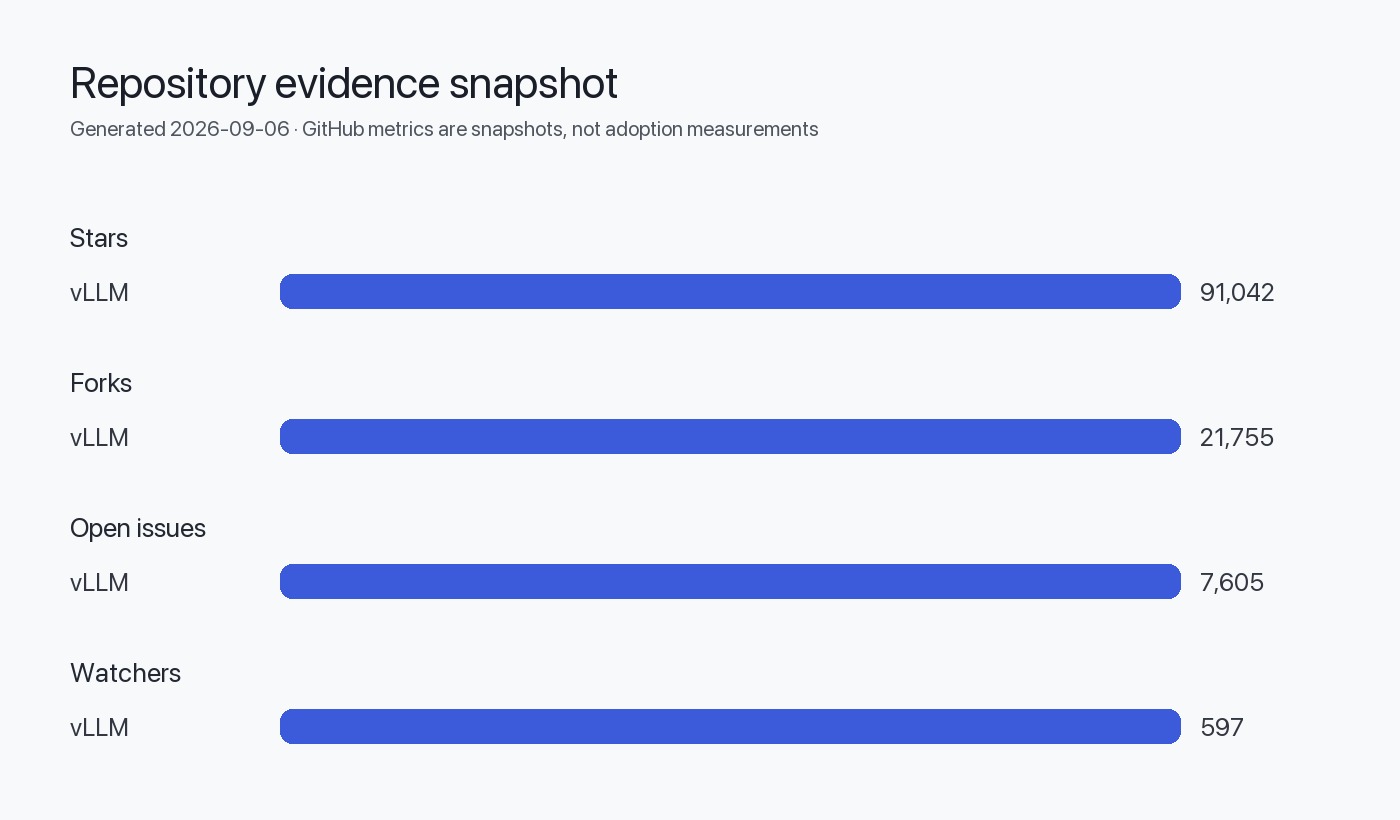
This table summarizes repository metadata and a concise summary of the most relevant release information. All values are taken from the repository metadata and the v0.28.0 release page cited below.
| Field | Value |
|---|---|
| GitHub repository | vllm-project/vllm (repo link) |
| Short description (repo) | A high-throughput and memory-efficient inference and serving engine for LLMs |
| Primary language | Python |
| License | Apache-2.0 |
| Stars (signal) | 91,042 (GitHub stars are an interest signal, not usage) |
| Forks | 21,755 |
| Open issues (repo) | 7,605 (open-issue count is a signal, not a defect count) |
| Latest release (tag) | v0.28.0 — published 2026-08-26 (see release notes) (release link) |
Project categories in the vLLM ecosystem
Below are the logical project and artifact categories you will encounter when evaluating or integrating vLLM. Each category maps to code, artifacts, or documentation referenced in the canonical repo and release assets.
| Category | What you'll find (examples from repo/release) |
|---|---|
| Core engine | The main Python code implementing serving, attention management (PagedAttention), and scheduling behaviors (see repo README and Engine Core sections in the release notes) (repo). |
| Model runners & plugins | Model runner components, hardware-specific runners, and out-of-tree plugins referenced in release notes (e.g., model runner V2; plugin architecture notes). |
| Hardware backends | CUDA, ROCm, Intel/XPU, CPU-specific wheels and Docker images published with releases (release artifacts list). |
| Quantization & kernels | Multiple quantization formats and kernel references (FP8, INT8/4, GGUF, GPTQ/AWQ, MXFP formats) described across the docs and release notes. |
| Frontends & APIs | OpenAI-compatible HTTP server, Anthropic Messages API, gRPC surfaces, Rust frontend and connectors described in the release notes. |
| Tooling & CI artifacts | Pre-built wheels, Docker images, and per-platform packages enumerated in the release's Assets section. |
Integration patterns and architecture (inferred and explicit)
This section describes common integration patterns you will see when deploying vLLM. Architectural conclusions explicitly inferred from the repository structure or README are labeled as "(inferred)".
Common integration patterns
- Sidecar API server: run vLLM as an OpenAI-compatible or gRPC server colocated with an application component. The repo documents an HTTP API surface and Docker images in releases that enable this pattern (release).
- Disaggregated runner architecture (inferred): the release and release-notes reference E/P/D disaggregation and a Model Runner V2; from that structure one can infer an architecture where encoding, prefill, and decoding responsibilities can be disaggregated across processes or nodes (inferred from release notes referencing E/P/D disaggregation). Label any inference as such in your design notes.
- Hardware-specific deployment: choose wheels or Docker images matching your GPU/ROCm/CPU/XPU stack — the release provides per-platform artifacts (CUDA, ROCm, CPU, XPU) to support this approach.
- KV offload tiering: the release documents KV cache offloading and tiering connectors; integration patterns include local-memory-first with disk or remote secondary tiers (explicit in release notes).
Mermaid diagram (high-level integration map)
flowchart LR
  A[Application] -->|HTTP/gRPC| B[vLLM API Server]
  B --> C{Model Runner}
  C --> D[GPU Backend (CUDA / ROCm / XPU)]
  C --> E[CPU Backend]
  C --> F[Quantization Plugins]
  B --> G[KV Offload / Tiering]
  G --> H[Disk / Remote Tier]
  C -. inferred .-> I[Speculative Decoding Engine]
  style I stroke-dasharray: 5 5
click B "https://github.com/vllm-project/vllm" "Repo"Evaluation criteria: how to decide if vLLM fits your use case
Use the checklist below to evaluate suitability. These criteria are derived from explicit repository facts (supported models, release artifacts, API surfaces) and general best-practice evaluation signals.
| Criterion | What to check in repo/release | Why it matters |
|---|---|---|
| Platform artifact availability | Does the release publish wheels/Docker images for your hardware (CUDA/ROCm/CPU/XPU)? Check the release Assets. | Without a matching artifact you may need to build from source. |
| API compatibility | Does vLLM provide the API surface you need (OpenAI-compatible, gRPC, Anthropic)? See README and API notes. | Simplifies integration if your client expects a particular protocol. |
| Model support | Are the target model architectures listed in the supported_models doc? (released model lists referenced in docs) | Confirms you can load the models you intend to serve. |
| Quantization & precision | Are required quantization formats supported (e.g., GPTQ, AWQ, NVFP4, MXFP)? Check release docs and feature lists. | Determines memory footprint and inference speed tradeoffs. |
| KV cache & offload | Does the release describe KV offloading, tiering connectors, or disk offload? | Important for very long contexts or multi-tenant serving. |
| Operational tooling | Are Docker images, monitoring hooks, and connectors present in release assets or docs? | Production deployments rely on these artifacts. |
| License compatibility | Is Apache-2.0 compatible with your licensing and redistribution policies? | Legal/redistribution constraint check. |
| Maintenance signals | Are commits and releases recent (see pushed_at, published_at), and are release notes and contributor counts available? | Indicates activity and responsiveness — combine with issue/PR reviews. |
Maintenance signals and what they mean
The repository exposes a set of observable signals. Below are practical interpretations you can apply; quote the raw values from the repo when you present findings to stakeholders.
- Recent commits and release cadence: the repository metadata includes pushed_at and updated_at timestamps; the v0.28.0 release was published on 2026-08-26 (release link). Frequent releases and release notes with detailed change lists are operational positives.
- Contributor base and release metadata: the v0.28.0 release notes state a broad contributor set for that release; use the release's contributor count as a signal of community involvement (release notes list commit/contributor counts). Do not conflate contributor counts with commercial support guarantees.
- Issue and PR activity: the repo shows an open issue count (7,605) in its metadata. Open-issue counts indicate workload and discussion volume, not a defect backlog count — examine issue age, response patterns, and labels to assess triage quality.
- Artifact freshness: release assets (wheels, Docker images) and the presence of platform-specific artifacts (CUDA/ROCm/CPU/XPU) are practical maintenance signals. If a needed artifact is missing for several releases, factor that into risk.
Licensing considerations
vLLM is distributed under the Apache-2.0 license (repo metadata). Apache-2.0 is a permissive license that includes patent grants and requires preservation of notices; verify compatibility with any proprietary components you plan to incorporate and consult legal counsel if you redistribute modified binaries. The repository and release pages should be used as the authoritative license source (repo license metadata).
Practical discovery workflow (step-by-step)
A reproducible workflow to validate vLLM for a specific environment. All steps reference artifacts or features described in the repository and release metadata.
- Confirm platform artifacts
- Inspect the release Assets for pre-built wheels or Docker images that match your target (CUDA/ROCm/CPU/XPU) on the release page (v0.28.0 release).
- Validate API surface
- Review the README and API notes in the repository for OpenAI-compatible, Anthropic, and gRPC server support. Identify which protocol your application requires.
- Short smoke test
- If a Docker image matching your platform is available, run the official image in an isolated environment and confirm the server responds to a simple request (the release lists Docker images for multiple platforms). If no image exists, consider a local wheel install or building from source.
- Load a representative model
- Use a model listed in the project's supported models documentation (link referenced in README) to confirm loading and inference behavior on your hardware.
- Measure operational behavior (non-benchmarked)
- Observe memory usage, whether KV offload triggers, and whether the API produces streaming outputs as needed. Record logs, startup behavior, and any connector interactions.
- Review maintenance signals
- Check pushed_at, latest release date, and open issue patterns in the repository to assess activity. Review release notes for breaking changes that could affect you (release notes list breaking changes in v0.28.0).
- Security & dependency check
- Review upstream dependencies in repository manifests and observe whether the project uses a security advisories mechanism (the repo points to GitHub Security Advisories for disclosures in its contact list). Confirm internal policy on dependency scanning.
Decision checklist (Action checklist)
Evidence, assumptions, and limitations
Evidence
- Repository metadata, README content, and the v0.28.0 release notes are the primary evidence sources cited in this article (vLLM canonical repository, vLLM latest GitHub release).
- Release assets referenced in the release notes (wheels, Docker images, platform artifacts) are taken as described in the v0.28.0 release page.
Assumptions
- Any architectural statements labeled "(inferred)" are deductions based on repository structure, release notes, and component names; they should be validated against specific code paths or maintainers if they are material to your design.
- Observations about maintenance signals assume the reader will inspect timestamps, open-issue patterns, and release notes in situ to derive current status.
Limitations
- This guide does not present micro-benchmarks, throughput numbers, or security vulnerability claims. The repository and release notes contain functional feature lists and changelogs but do not constitute measured performance guarantees here.
- Open-issue counts and GitHub star counts are presented only as metadata signals; they are not proxies for usage, market share, or defect density. The repository's metadata was retrieved on Sep 6, 2026 and may have changed since.
Sources
- vLLM canonical repository: https://github.com/vllm-project/vllm
- vLLM latest GitHub release (v0.28.0): https://github.com/vllm-project/vllm/releases/tag/v0.28.0
FAQ
What is vLLM and where is the canonical source?
vLLM is an inference and serving engine for large language models; the canonical source is the GitHub repository vllm-project/vllm (repo link).
What license does vLLM use and what does that imply?
vLLM is distributed under the Apache-2.0 license (as stated in the repository metadata). Apache-2.0 is permissive and includes a patent grant; validate redistribution and integration implications with your legal team.
Are there pre-built artifacts for production platforms?
The v0.28.0 release publishes platform-specific release artifacts (wheels and Docker images) for multiple targets (CUDA, ROCm, CPU, XPU) as noted on the release page. Check the release Assets for the artifact that matches your platform (v0.28.0 release).
How should I interpret the repository's stars and open issues?
GitHub stars are interest signals and not a measure of usage or market share. Open-issue counts are not defect counts; they indicate activity and discussion volume. Evaluate issue age, labels, and maintainers' responses for a fuller picture.
Does vLLM support quantized models and KV offloading?
The repository and release notes document support for multiple quantization formats (several formats referenced in the docs and release) and KV offloading/tiering connectors are described in the release notes. For specifics, consult the supported models and quantization documentation in the repo.
Where can I report security issues or ask operational questions?
The repository directs security disclosures to GitHub Security Advisories and lists a forum and Slack for user discussions in its contact section. See the repository contact information for the exact channels (repo).