vLLM Ecosystem Guide: Projects, Plugins & Integration Map
A technical map of the vLLM high-throughput LLM serving ecosystem, covering model support, hardware backends, quantization, distributed serving, and integration patterns for production deployments.
Executive answer
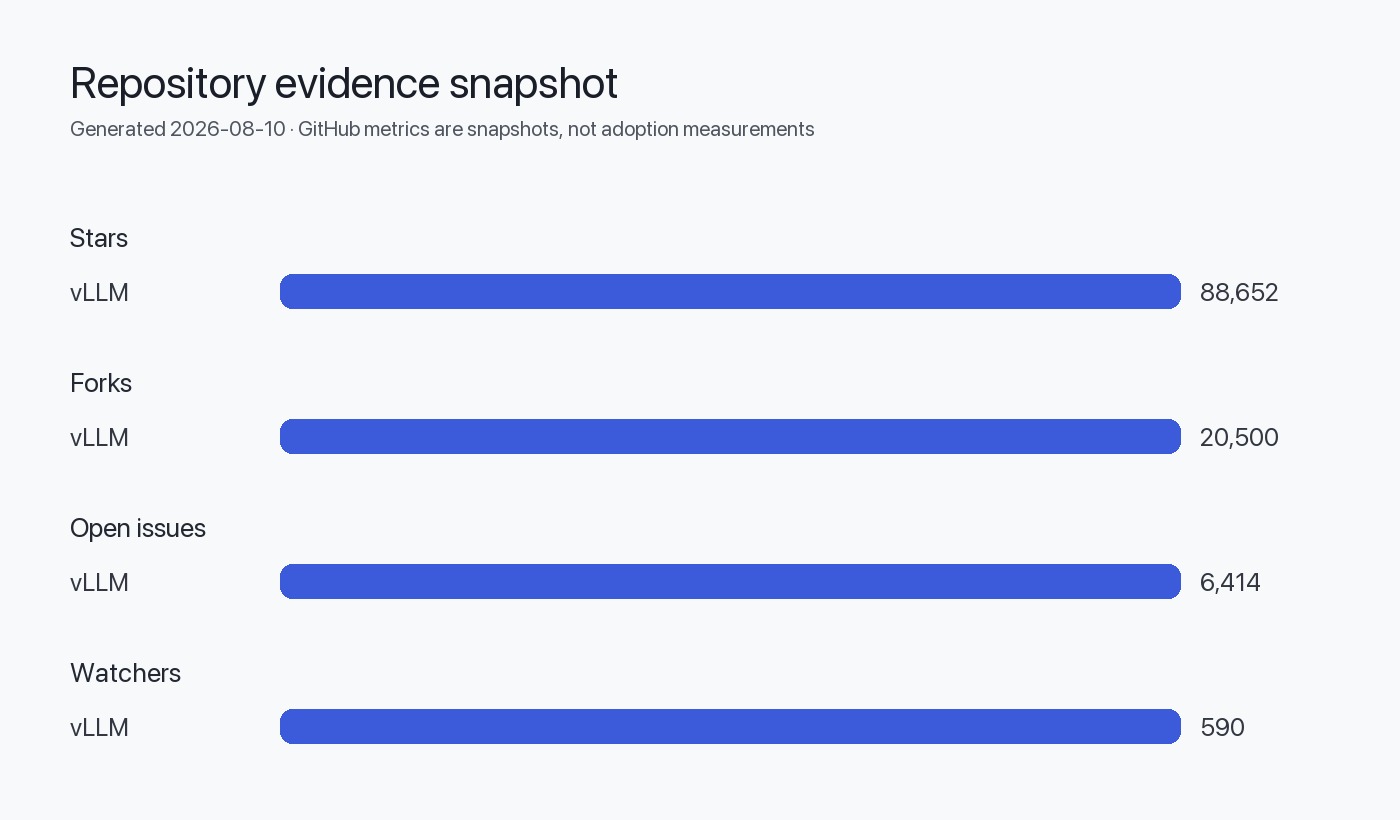
The core value proposition centers on memory efficiency through paged attention, continuous batching, and flexible parallelism strategies (tensor, pipeline, data, expert, and context parallelism). The ecosystem is licensed under Apache-2.0, with active development cadence visible in the v0.26.0 release (July 2026) featuring 411 commits from 212 contributors. Integration points include OpenAI-compatible REST APIs, Anthropic Messages API, gRPC endpoints, and native Python libraries. The repository signals strong maintenance health with daily commits, though 6,414 open issues (as of August 2026) indicate substantial community engagement and diverse deployment scenarios requiring support.
Core architecture and components
vLLM's architecture separates into five primary subsystems inferred from the repository structure and release notes:
Inference engine core manages request scheduling, memory allocation via PagedAttention, and continuous batching. The engine supports chunked prefill, prefix caching with partial hit support for hybrid models, and automatic CUDA graph generation through torch.compile. Memory profiling results can persist across restarts (opt-in) to reduce cold-start overhead.
Attention backend layer provides pluggable kernels including FlashAttention, FlashInfer, TRTLLM-GEN, FlashMLA, and Triton. As of v0.26.0, attention backends can be selected per KV-cache group, enabling hybrid models that mix sliding-window and full attention patterns within a single request.
Model executor subsystem handles model loading, weight distribution across devices, and execution. It supports InstantTensor loading for faster startup, automatic fallback to ViT data parallelism when tensor parallelism is unavailable for vision encoders, and flexible head_dtype configuration (e.g., fp32 lm_head for generation models).
KV-cache management implements tiered storage with CPU offloading, object-store secondary tiers supporting workload identity, and data-parallel replica-aware tiering. Offloading metrics expose read/write cache usage and tiering-lookup latency split into synchronous and asynchronous histograms.
Serving frontend offers OpenAI-compatible REST endpoints, Anthropic Messages API, gRPC, and a native Rust frontend. The Rust layer added multimodal video/audio support and native benchmarking tools in v0.26.0.
graph TB
    A[Client Request] --> B[API Layer]
    B --> C[Request Scheduler]
    C --> D[Continuous Batcher]
    D --> E[Memory Manager / PagedAttention]
    E --> F[Attention Backend]
    F --> G[Model Executor]
    G --> H[Hardware Backend]
    H --> I[GPU/TPU/CPU/NPU]
    E --> J[KV Cache Tier]
    J --> K[Local GPU Memory]
    J --> L[CPU Offload]
    J --> M[Object Store]
    G --> N[Quantization Layer]
    N --> O[FP8/INT4/GPTQ/AWQ/GGUF]
    B --> P[OpenAI API]
    B --> Q[Anthropic API]
    B --> R[gRPC]
    B --> S[Rust Frontend]
Model architecture support categories
vLLM documentation claims support for 200+ model architectures on Hugging Face. The repository topics and v0.26.0 release notes identify six major categories:
| Category | Supported Families | Integration Notes |
|---|---|---|
| Decoder-only LLMs | Llama, Qwen, Gemma, Mistral, DeepSeek-V3/V4, GPT-OSS, Olmo/Olmo2 | Core use case; Olmo/Olmo2 migrated to Transformers backend in v0.26.0 |
| Mixture-of-Experts | Mixtral, DeepSeek-V3/V4, Qwen-MoE, GPT-OSS, MiniMax-M3 | Specialized routing kernels for DeepSeek-V4 (+2.94% TPOT); FlashInfer MoE LoRA for BF16 |
| Hybrid attention/state-space | Mamba, Qwen3.5, models with sliding-window + full attention | Sliding-window now explicit backend capability; DFlash hybrid drafters |
| Multi-modal | LLaVA, Qwen-VL, Pixtral, HunyuanVL, LlavaNextVideo, Cosmos3 | Automatic ViT data-parallel fallback; LoRA support for vision towers/connectors |
| Embedding/retrieval | E5-Mistral, GTE, ColBERT | Preprocessing-computation overlap for pooling models in offline inference |
| Reward/classification | Qwen-Math, BertForMaskedLM, RobertaForTokenClassification | Added BertForMaskedLM and token-classification models in v0.26.0 |
The "Inkling" model family introduced in v0.26.0 demonstrates full-stack support: base modeling, piecewise CUDA graph, Hopper FlashAttention 4 relative attention, speculative decoding (MTP=1), LoRA, and NVFP4 quantization.
Hardware backend ecosystem
vLLM supports seven major hardware platforms with varying maturity levels inferred from release activity:
NVIDIA CUDA (primary platform): Full feature set including Blackwell (SM10x/SM110) support, CUTLASS and CuTeDSL optimized kernels, FlashAttention 3 (pinned to torch stable-ABI commit), and TensorRT-LLM GEN kernels. v0.26.0 added specialized DeepSeek-V4 routing kernels, FP32 router GEMV, and BF16x3 router GEMM.
AMD ROCm: Production-grade support with DeepSeek-V4 two-stage compressor kernel for HCA prefill, sparse decode/prefill optimizations, MXFP8 GEMM for MiniMax-M3, and HybridW4A16 linear kernel. ROCm-specific optimizations include MLA KV-split heuristics for DeepSeek-V3.2 and AITER sparse paged attention.
Intel XPU/Gaudi: Batch-invariant kernels, HND KV layout support, DSpark speculative decoding for DeepSeek-V4, INT2 weight-only quantization. Nightly and release images published as of v0.26.0.
Google TPU: Supported via tpu-inference v0.24.0 dependency. Repository topics list "tpu" but release notes contain limited TPU-specific optimization detail.
Apple Silicon / x86 CPU: Native macOS arm64 CPU wheel builds, s390x NUMA topology support, IBM Power VSX math function optimization, and Docker builds for IBM Power using prebuilt wheels. DFlash speculative decoding for GDN models on CPU.
Specialized NPUs: Repository README mentions Huawei Ascend, Rebellions NPU, IBM Spyre, and MetaX GPU through "diverse hardware plugins." Integration depth varies; no detailed release-note coverage in v0.26.0.
Quantization and compression methods
vLLM implements quantization through a pluggable layer supporting multiple frameworks:
| Method | Precision | Maturity Signal | Hardware Scope |
|---|---|---|---|
| NVFP4/MXFP4 | 4-bit floating-point | Online MoE quantization (v0.26.0); CuTe-DSL FlashInfer integration | NVIDIA (Hopper+) |
| FP8 | 8-bit floating-point | Core production feature; MXFP8 GEMM for AMD | NVIDIA, AMD |
| INT8/INT4 | Integer quantization | XPU weight-only INT2 (v0.26.0); emulation MoE backend INT4 | Cross-platform |
| GPTQ/AWQ | Weight-only | Long-standing support; integrated via Transformers | NVIDIA-primary |
| GGUF | Llama.cpp format | Import support | CPU, cross-platform |
| ModelOpt | NVIDIA toolkit | Standard stack for Inkling NVFP4 | NVIDIA |
| TorchAO | PyTorch native | Listed in core features | Cross-platform |
| compressed-tensors | Humming w[2-7]a[4,8] | Added in v0.26.0 for weight-only inference | NVIDIA |
Performance improvements in v0.26.0 include bounded peak memory when repacking FP4 MoE weights for Marlin and NVFP4 MoE weight loading. The kv_cache_dtype can be configured separately for speculative decoding as of v0.26.0, and MLA models support kv_cache_dtype_skip_layers to selectively apply quantization.
Distributed serving and disaggregation patterns
vLLM supports five parallelism strategies and multiple disaggregation modes:
Parallelism strategies:
- Tensor parallelism: Splits model layers across devices within a node; primary scaling method for large models.
- Pipeline parallelism: Partitions layers across devices/nodes; NIXL 1.3.1 enables pipeline-parallel prefill in push mode (NIXL pipeline as of v0.26.0).
- Data parallelism: Replicates model across devices; used for throughput scaling; tiered KV storage is DP-replica-aware.
- Expert parallelism: Distributes MoE experts; FlashInfer MoE LoRA support added for BF16.
- Context parallelism (Decode Context Parallel, DCP): Splits sequence dimension; hybrid attention support and DCP + Eagle for Tokenspeed MLA backends added in v0.26.0.
Disaggregation modes:
- Prefill-decode separation: Disaggregated prefill and decode workers share KV cache.
- Encoder-cache connectors: Transfer parameters and CPU-offloading connector for encoder outputs (v0.26.0).
- Tiered KV storage: Primary GPU memory, CPU offload tier, and object-store tier with workload identity and S3-compatible backends.
P2P communication for KV offloading gained default host/port environment variables in v0.26.0. The prefill-decode disaggregation pattern is listed in core features but lacks detailed v0.26.0 release coverage.
API compatibility and integration layers
vLLM offers four primary API surfaces:
OpenAI-compatible REST API: /v1/completions, /v1/chat/completions, /v1/embeddings. v0.26.0 added bad_words parameter support in completions, exposed logprob_token_ids on Python endpoints, and populated num_cache_creation_tokens on responses. The include_reasoning parameter extends to non-Harmony models.
Anthropic Messages API: Compatible with Claude client SDKs; listed in core features.
gRPC endpoints: High-performance binary protocol; endpoint plugins framework introduced in v0.26.0.
Rust native frontend: Multimodal video and audio support, Seed-OSS tool parser, native vllm-bench benchmarking tool, and continue_final_message handling with renderer sentinel (all v0.26.0).
The RLHF development API includes /abort_requests and stateful trainer-send abstractions. An endpoint plugins framework in v0.26.0 enables custom serving logic without forking the core.
Speculative decoding and acceleration techniques
vLLM implements multiple speculative decoding strategies:
- n-gram matching: LongCat-Flash-Lite n-gram embedding support.
- Suffix matching: Listed in core features.
- EAGLE: Tokenspeed MLA backend integration with DCP.
- DFlash: Hybrid (sliding-window + full attention) drafters; GDN model support on CPU.
- DSpark: Gemma4-12B drafts, DeepSeek-V4 on AMD ROCm and Intel XPU.
Runtime draft weight updates were added in v0.26.0, allowing dynamic model switching. Separate kv_cache_dtype configuration for speculative_config enables mixed-precision drafting. Optimizations for thinking-budget TPOT when combined with speculative decoding improve reasoning-model performance.
Maintenance and community health signals
As of August 10, 2026:
- Commit activity: Last push August 10, 2026; 411 commits in v0.26.0 (released July 27, 2026).
- Contributor growth: 212 contributors in v0.26.0 (61 new), over 2,000 cumulative.
- Issue volume: 6,414 open issues. This is not a defect count but indicates high community engagement across diverse deployment scenarios.
- Release cadence: v0.26.0 released July 27, 2026. Release body shows structured feature categorization.
- Stars/forks: 88,652 stars, 20,500 forks; interest signals, not usage metrics.
- Licensing: Apache-2.0; commercial-friendly.
- Governance: Originally UC Berkeley, now community-maintained. README lists contact channels (GitHub Issues, forum, Slack, security advisories).
The repository is not archived. Security practices include replacing diskcache to eliminate pickle deserialization, resource-bounds validation, and file-path sanitization.
Discovery workflow for integration projects
Step 1: Determine hardware compatibility
- Identify your deployment hardware (NVIDIA, AMD, Intel, TPU, CPU).
- Cross-reference the installation documentation for backend-specific build instructions.
- Check v0.26.0 release notes for recent backend optimizations relevant to your hardware.
Step 2: Validate model architecture support
- Consult the supported models list.
- For models not explicitly listed, review recent issues and pull requests mentioning the architecture name.
- Test with a small model first; architecture support does not guarantee all features (LoRA, quantization) work identically.
Step 3: Assess quantization requirements
- Choose quantization method based on hardware (NVFP4 for Hopper, FP8 for AMD/NVIDIA, INT4 for CPU).
- Review quantization documentation for format compatibility.
- Validate accuracy on a held-out set; quantization impacts vary by model family.
Step 4: Select parallelism strategy
- Single GPU: No parallelism configuration needed.
- Multi-GPU single node: Tensor parallelism first; data parallelism if throughput-limited.
- Multi-node: Combine tensor, pipeline, and data parallelism; review KV-cache tiering if memory-constrained.
- Long-context or disaggregated: Evaluate context parallelism and prefill-decode separation.
Step 5: Choose API layer
- Python library: Offline inference or custom scheduling.
- OpenAI-compatible REST: Drop-in replacement for OpenAI SDK.
- Rust frontend: Multimodal workloads, custom tooling, or native performance requirements.
- gRPC: Low-latency, high-throughput microservice integration.
Step 6: Monitor and tune
- Enable offloading metrics (
--enable-metrics) to track cache usage. - Use prefix-cache metrics in full report mode.
- Profile with CUDA graphs enabled; disable for debugging.
- Review FlashInfer/FlashAttention backend selection per KV-cache group for hybrid models.
Decision checklist
Licensing and contribution considerations
vLLM is licensed under Apache-2.0, permitting commercial use, modification, and distribution with attribution. The contributing guide outlines development setup. Key policies inferred from release notes:
- Model architecture contributions require test coverage and documentation.
- Hardware backend plugins should include CI coverage and maintainer contact.
- Security issues must use GitHub Security Advisories, not public issues.
- The project maintains media kit assets for logo usage; see the media kit repo.
The project removed TeleChat, Persimmon, and Fuyu models in v0.26.0, signaling willingness to prune architectures lacking active maintenance or adoption.
Evidence, assumptions, and limitations
Evidence base: This guide synthesizes the vLLM repository README, v0.26.0 release notes (411 commits, 212 contributors), repository metadata (stars, forks, issues, topics), and documentation references. All feature claims and architectural descriptions derive from these sources.
Architectural inferences: The five-subsystem breakdown (inference engine, attention backend, model executor, KV-cache, serving frontend) is inferred from release-note structure, repository topics, and README organization. The official architecture may differ.
Limitations:
- Performance claims (e.g., "2.94% E2E TPOT improvement") are copied from release notes; we have not reproduced benchmarks.
- Model support for "200+ architectures" is a project claim; the supported-models documentation link is provided but not enumerated here.
- Hardware backend maturity is inferred from release-note coverage density; less-discussed backends (TPU, specialized NPUs) may have production deployments not reflected in public release notes.
- Open-issue count (6,414) is a snapshot from August 2026; it reflects engagement volume, not defect severity.
- Quantization accuracy impacts are workload-dependent; stated compatibility does not guarantee acceptable quality for your use case.
Data retrieval date: August 10, 2026.
Sources
FAQ
What is PagedAttention and why does it matter?
PagedAttention is a memory-management algorithm that stores attention key-value (KV) caches in non-contiguous "pages" rather than contiguous tensors. This reduces fragmentation, enables dynamic memory allocation per request, and allows KV-cache sharing across sequences (prefix caching). The technique is detailed in the 2023 SOSP paper cited in the repository. It matters because KV-cache memory is often the bottleneck in LLM serving; paged allocation increases effective batch size and throughput.
Can vLLM replace OpenAI API servers without code changes?
vLLM provides OpenAI-compatible /v1/completions and /v1/chat/completions endpoints. Many OpenAI SDK calls work unchanged, but not all features match exactly (e.g., bad_words was added in v0.26.0). Test your specific SDK usage pattern; gaps may require workarounds or feature requests.
Which hardware backend should I choose for production?
NVIDIA CUDA offers the broadest feature set, optimization depth, and community support. AMD ROCm is production-ready for MoE and sparse-attention workloads (DeepSeek, MiniMax families). Intel XPU is suitable if you have Gaudi accelerators and can validate model compatibility. TPU and CPU backends are viable for specific cost or edge-deployment constraints. Apple Silicon and specialized NPUs remain niche; verify recent release coverage before committing.
How do I estimate memory requirements for a model?
vLLM includes a memory profiler that runs before serving. Enable --enable-memory-profiling and optionally --memory-profile-cache-path to persist results. Memory needs depend on model size, batch size, sequence length, KV-cache dtype, and quantization. For rough estimates: model weights + (batch_size × max_seq_len × hidden_dim × num_layers × 2 bytes/element for FP16 KV cache). Use tiered storage (CPU offload, object store) if GPU memory is constrained.
What does 6,414 open issues indicate about project health?
Open-issue counts in large inference projects reflect community size, deployment diversity, and feature-request velocity, not defect density. vLLM supports 200+ model architectures across seven hardware backends; each combination generates unique questions. Review recent issue close rates, maintainer response times, and issue labels (bug vs. feature vs. question) for a clearer picture. High engagement is typical for active infrastructure projects.
Can I use vLLM for fine-tuning or only inference?
vLLM is an inference and serving engine, not a training framework. However, it supports multi-LoRA inference (loading multiple LoRA adapters on a base model), LoRA towers/connectors for multimodal models, and RLHF stateful trainer-send abstractions introduced in v0.26.0. For training, use frameworks like PyTorch FSDP, DeepSpeed, or Megatron-LM, then serve the resulting model with vLLM.
How stable is the API between releases?
vLLM follows semantic versioning for major/minor/patch releases. The v0.26.0 release removed three model families (TeleChat, Persimmon, Fuyu), indicating willingness to break compatibility for maintenance reasons. The OpenAI-compatible API surface is more stable; internal Python APIs may shift. Pin versions in production and review release notes before upgrading. The FlashAttention 3 dependency is pinned to a stable-ABI commit, reducing breakage risk for attention backends.