Security Alert: Unauthenticated Shutdown in @typespec/spector
A high-severity (CVSS 7.5) advisory shows @typespec/spector exposes an unauthenticated POST /.admin/stop endpoint that exits the process. This briefing explains facts, impact, dependency-chain relevance, verification guidance, and remediation steps for maintainers and operators.
Executive answer
A GitHub Security Advisory (GHSA-7q9c-hpx7-9cwm) documents a high-severity (CVSS 7.5) missing-authentication issue in the development/testing package @typespec/spector. The package registers an unauthenticated HTTP route POST /.admin/stop which calls process.exit(0), and the server binds to 0.0.0.0 by default, allowing any network-reachable client to trigger a one-request denial-of-service (DoS). The advisory identifies the vulnerable range as <= 0.1.0-alpha.26 and lists 0.1.0-alpha.27 as the patched version. Source: the GitHub advisory GHSA-7q9c-hpx7-9cwm (published 2026-09-04; advisory metadata used here was generated at 2026-09-06).
This alert is not saying SvelteKit itself is vulnerable. The advisory names @typespec/spector (an npm package in the TypeSpec/microsoft/typespec repository); SvelteKit (sveltejs/kit) is not referenced in the advisory. If you maintain SvelteKit, a SvelteKit-based project, or build systems that may include @typespec/spector in CI or developer tooling, read the dependency and exposure guidance below. For direct evidence and the call chain, see the linked advisory and the reproduced facts that follow GHSA-7q9c-hpx7-9cwm.
Facts from the advisory (what is known)
- Advisory identifier: GHSA-7q9c-hpx7-9cwm. Source: GitHub Security Advisory page: GHSA-7q9c-hpx7-9cwm (published 2026-09-04, advisory metadata used here generated at 2026-09-06).
- Package named in the advisory: @typespec/spector (ecosystem: npm).
- Vulnerability summary in the advisory: @typespec/spector registers a POST /.admin/stop route that performs process.exit(0) without any authentication, Origin check, or IP-source restriction. The server binds to 0.0.0.0 by default, which exposes the route to network-reachable clients. The advisory labels this a Missing Authentication for Critical Function (CWE-306) and assigns a CVSS v3.1 score of 7.5 (High).
- Reproduced call chain in the advisory (paraphrased from the advisory text):
- CLI command
tsp-spector serve <scenariosPaths..>starts the server on the default port (3000) with no host option. - Server construction calls start() without a host argument.
- Router registration mounts the admin routes under
/including /.admin/stop. - The POST /.admin/stop handler calls process.exit(0) after returning HTTP 202.
- The server listen() call omits a host, causing Node/Express to bind to 0.0.0.0.
- Proof-of-concept (PoC) and reproduction artifacts are included in the advisory and show that a single unauthenticated POST to /.admin/stop will cause the process to exit and the container or process to stop. The advisory provides example curl and Python PoC usage.
- Affected version range (as reported): <= 0.1.0-alpha.26. Patched in 0.1.0-alpha.27 (advisory metadata).
Is SvelteKit directly affected?
Short answer: No direct evidence in the advisory names SvelteKit (sveltejs/kit) or indicates that SvelteKit packages are vulnerable. The advisory explicitly targets the @typespec/spector package in the TypeSpec repository.
Why we say this:
- The advisory's package field and text reference @typespec/spector and code paths inside the TypeSpec repository; it does not mention SvelteKit or the sveltejs/kit repository. The SvelteKit canonical repository is: https://github.com/sveltejs/kit [source].
Dependency-chain relevance and exposure scenarios
Fact: The advisory identifies a development/testing tool that runs an HTTP server and exposes a shutdown endpoint by default. Development tools and test mock servers are often run locally, in CI, or inside containers.
Architectural inference (explicitly labeled): From the advisory's description and the repository paths it cites, one can infer that @typespec/spector is a mock server used by TypeSpec projects and is started with a CLI command tsp-spector serve. This is an architectural conclusion drawn from the advisory's file paths and CLI references, not from the SvelteKit repository.
Exposure scenarios where this advisory matters to SvelteKit users or other maintainers:
- A developer or automation job running
tsp-spector serveon a host or container that is reachable from untrusted networks (shared CI runners, public cloud instances with exposed ports, ephemeral dev containers accessible to other tenants). The advisory explicitly notes the default bind to 0.0.0.0 and lack of host/allowlist options. - A build or test container image that includes @typespec/spector and runs the server during pipeline steps with ports exposed to other services or workers.
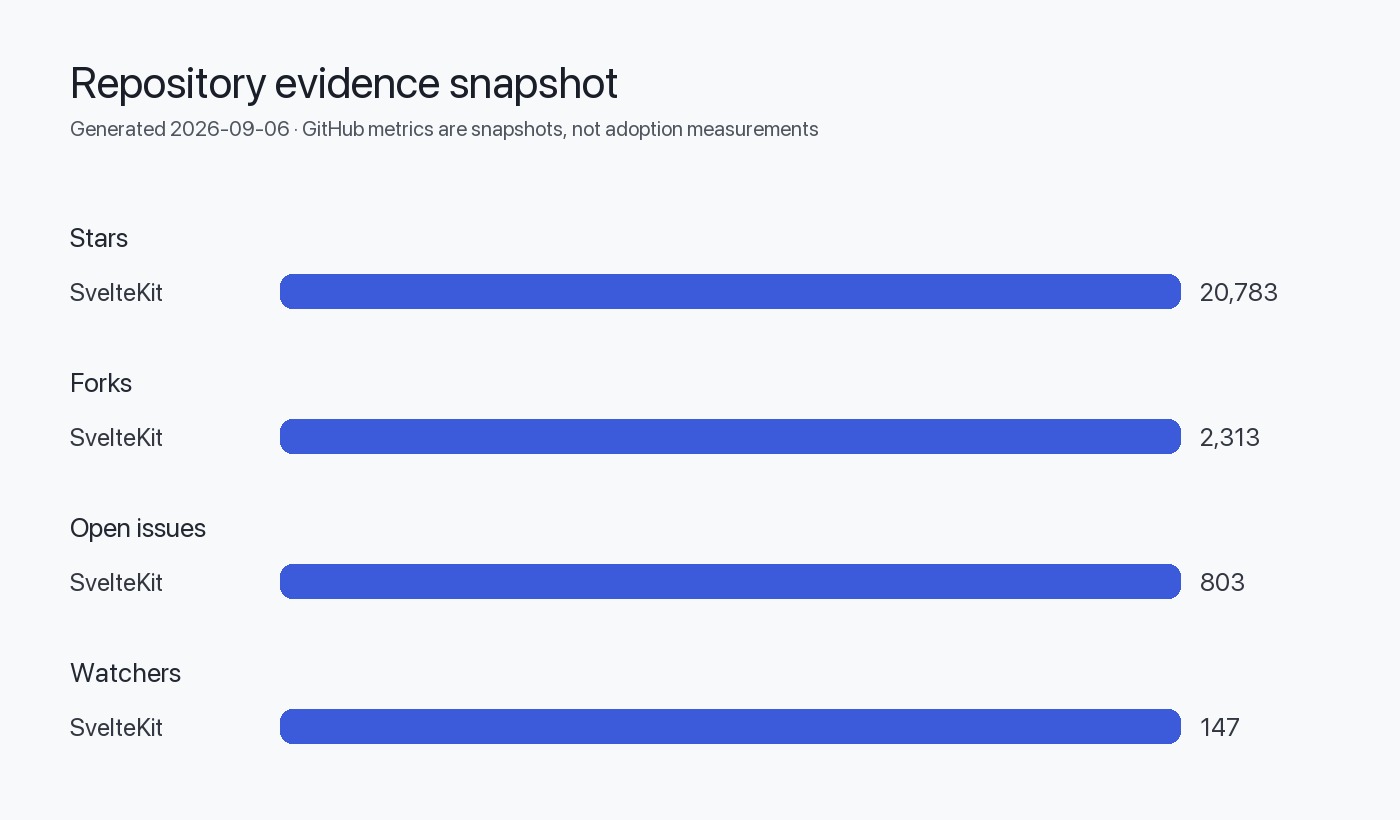
Data image (relevant to dependency/visibility discussion):
How to check if your codebase or CI installs the package (safe verification)
These commands are examples only and are generic, commonly used package-inspection steps. They do not exploit the vulnerability; do NOT send POST requests to the /.admin/stop endpoint as that will trigger the shutdown described in the advisory.
- Check project dependencies locally (npm):
- npm:
npm ls @typespec/spector— lists package occurrences in the current node_modules tree. - pnpm:
pnpm why @typespec/spector— explains why the package is present in a pnpm workspace. - yarn:
yarn why @typespec/spector
- Search repository files for references (safe string search):
git grep "@typespec/spector"orrg "@typespec/spector"in the repo root.
- Check CI images or running containers that may expose ports:
docker ps --format "{{.Names}} {{.Image}} {{.Ports}}"and inspect images used in pipeline steps.
Affected range and severity
Severity (from advisory): High — CVSS v3.1 base score 7.5 (advisory reported classification: Missing Authentication for Critical Function, CWE-306).
| Field | Value |
|---|---|
| GHSA ID | GHSA-7q9c-hpx7-9cwm (advisory link) |
| Package | @typespec/spector (npm) |
| Vulnerable range | <= 0.1.0-alpha.26 |
| Patched in | 0.1.0-alpha.27 |
| CVE | Not assigned (advisory shows null) |
| Severity | High (CVSS 7.5) |
Table: Affected versions and recommended immediate action
| Version(s) | Action |
|---|---|
| <= 0.1.0-alpha.26 | Treat as vulnerable: avoid running network-exposed instances; apply patches to 0.1.0-alpha.27 when available; implement network restrictions and CI isolation. |
| 0.1.0-alpha.27 and later | Advisory lists 0.1.0-alpha.27 as patched. Verify repository's release/changelog and upgrade. |
Verification commands (examples, safe-by-default)
The advisory includes a PoC that demonstrates the real exploit using an actual POST. We provide only safe, non-mutating checks here.
- Verify package presence in a local project (safe):
- npm:
npm ls @typespec/spector(exit code 0 shows presence). - pnpm:
pnpm why @typespec/spector(explains the dependency tree).
- Inspect build/CI images and container ports (safe):
docker ps --format "{{.Names}} {{.Image}} {{.Ports}}"— look for containers exposing ports 3000 or similar.ss -tuln | grep :3000ornetstat -tuln | grep :3000— check listening sockets on a host (requires privileges).
- Probe the admin path without invoking the POST shutdown (safe):
curl -sI http://<host>:<port>/.admin/stop` — issue an HTTP HEAD; this should not trigger the POST handler. If it responds 200/202 on HEAD, do not proceed with POST unless you intend to stop the service.
If a safe probe indicates the admin path exists and you cannot ascertain the process identity, isolate the host/container and follow the incident-response checklist below.
Incident-response checklist
Follow these steps if you detect exposure or an unexpected outage that may be caused by the reported issue.
- Contain
- Immediately isolate the affected host or container from untrusted networks (stop exposing ports; remove public network routes).
- If the process is down unexpectedly and you suspect an unauthorized POST caused it, preserve container logs for analysis (docker logs, systemd/journal logs).
- Identify
- Determine whether @typespec/spector is installed:
npm ls @typespec/spectoror inspect the runtime command line fortsp-spector serve. - Check Docker images used by CI jobs that may include the package and inspect startup commands for
tsp-spector.
- Eradicate
- If running a vulnerable version, stop running the exposed server and replace it with the patched version (0.1.0-alpha.27) or remove the package from images and CI steps.
- For ephemeral shared runners, mark the runner as untrusted until the image is rebuilt with the fix.
- Recover and harden
- Rebuild containers/images with patched dependencies and redeploy.
- Employ network policies or firewall rules to ensure development mock servers bind only to localhost or internal interfaces; do not expose dev servers directly to public networks.
- Post-incident
- Rotate any credentials or tokens if you determine sensitive actions were performed (advisory describes process exit only, but follow your organization's post-incident steps).
- Update documentation and CI templates to avoid running dev-only servers on publicly reachable interfaces.
Actions maintainers should take (decision & action checklist)
The following actions are split for two audiences: (A) maintainers/operators of projects that may run @typespec/spector and (B) maintainers of third-party tooling or images.
Decision checklist (quick triage)
- Is @typespec/spector present in your repo or build images? (Yes/No)
- Are you running
tsp-spector servein CI or on hosts reachable by untrusted networks? (Yes/No) - Can you restrict the bind address or network exposure with existing firewall or orchestration controls? (Yes/No)
Action checklist (recommended immediate steps)
- If the package is present and you run the server publicly:
- Stop exposing the service to untrusted networks; restrict traffic to localhost or internal CIDRs.
- Upgrade @typespec/spector to 0.1.0-alpha.27 or later as soon as the package release is confirmed. (Advisory lists 0.1.0-alpha.27 as patched.)
- For CI runners and shared environments, rebuild images without running the server, or run it with network isolation.
- If the package is present but not used in networked mode:
- Audit how the package is invoked in scripts and remove or sandbox server invocations that bind to 0.0.0.0.
- Add checks in CI to prevent running dev servers on shared runners without explicit allowlists.
- For maintainers building base images or distribution packages:
- Remove the default behavior that exposes the admin route in images, or ensure the server defaults to binding to localhost.
- Add authentication/allowlist or remove destructive admin endpoints in production builds.
- For SRE/Platform teams:
- Block external access to known dev-tool ports at network edge (e.g., block common dev-tool ports in firewall rules for CI networks).
- Scan images for the package (
npm ls,pnpm why) and update image build pipelines.
Recommended mitigations (table)
| Category | Mitigation | Rationale |
|---|---|---|
| Immediate | Do not run tsp-spector serve on hosts with public network exposure; restrict to localhost or private networks. | Prevents attacker access to the admin endpoint regardless of package code. |
| Short-term | Upgrade to @typespec/spector 0.1.0-alpha.27 (patched) where available. | Removes the vulnerability per advisory. |
| Medium-term | Add authentication or IP allowlist to any admin/shutdown endpoints; default to binding to localhost. | Defense in depth; reduces risk even if misconfiguration occurs. |
| Platform | Harden CI/runner images: run tests in network-isolated sandboxes and avoid exposing dev servers. | Shared runners are a common exposure vector noted in the advisory. |
Attack chain (mermaid visualization)
flowchart TD
  A[Operator runs `tsp-spector serve` on host/container] --> B[Server listens on 0.0.0.0:3000]
  B --> C[Router mounts admin routes at /.admin/stop]
  D[Attacker (network-reachable)] -->|HTTP POST /.admin/stop| C
  C --> E[Handler logs and responds 202, then calls process.exit(0)]
  E --> F[Server process exits -> denial of service]
  style A fill:#f9f,stroke:#333,stroke-width:1px
  style D fill:#fee,stroke:#900,stroke-width:1px
  style F fill:#fcc,stroke:#900,stroke-width:2px
Evidence, assumptions, and limitations
- Evidence: This briefing is based solely on the GitHub Security Advisory GHSA-7q9c-hpx7-9cwm and the SvelteKit repository metadata listed in the supplied editorial data. All advisory facts and code-path citations in the call chain are summarized from the advisory text and reproduced PoC materials. Source: GHSA-7q9c-hpx7-9cwm. SvelteKit repository data referenced for clarification: https://github.com/sveltejs/kit.
- Assumptions (explicitly stated):
- We assume the advisory's statement that the server binds to 0.0.0.0 by default is accurate; this is taken from the advisory's reproduced call chain and PoC. The advisory also reports the lack of a CLI
--hostoption. Those are direct advisory statements. - We assume that organizations running
tsp-spector servemay do so in CI or shared environments; the advisory lists such scenarios as examples of exposure. We do not assume any additional unknown attack vectors beyond the network-reachable POST described.
- Limitations:
- The advisory covers @typespec/spector only. There is no evidence in the advisory that SvelteKit (sveltejs/kit) or its packages exhibit the same behavior. This briefing does not and cannot assert code-level vulnerabilities in SvelteKit unless future advisories name it.
- Patch availability and release notes should be confirmed against the TypeSpec project's releases and changelog before upgrading; advisory metadata lists 0.1.0-alpha.27 as the patched version.
Sources
- SvelteKit canonical repository: https://github.com/sveltejs/kit
- SvelteKit latest GitHub release referenced in editorial data: https://github.com/sveltejs/kit/releases/tag/%40sveltejs/kit%402.70.3
- GitHub Security Advisory GHSA-7q9c-hpx7-9cwm: https://github.com/advisories/GHSA-7q9c-hpx7-9cwm
FAQ
What exactly is vulnerable?
The advisory identifies @typespec/spector as registering an unauthenticated POST /.admin/stop handler that calls process.exit(0). If you run a vulnerable version and the server is reachable over the network, a single POST will terminate the process. Source: GHSA-7q9c-hpx7-9cwm.
Is SvelteKit itself vulnerable?
No. The advisory names @typespec/spector only. There is no mention of SvelteKit (sveltejs/kit) in the advisory. If you rely on SvelteKit, the relevant question is whether your project or CI installs or runs @typespec/spector.
Which versions are affected and which fix it?
Affected range listed in the advisory: <= 0.1.0-alpha.26. The advisory lists 0.1.0-alpha.27 as the patched version. Confirm the patch by checking the TypeSpec repository or npm registry before upgrading: https://github.com/advisories/GHSA-7q9c-hpx7-9cwm.
How can I safely verify if my environment is exposed?
Search for the package in your project (npm ls @typespec/spector, pnpm why @typespec/spector), inspect images and CI steps, and check listening sockets on hosts/containers. For HTTP probing, use non-mutating requests (HEAD or OPTIONS). Do not POST to /.admin/stop unless you intend to stop the service.
What immediate mitigations should I apply?
If you find an exposed instance, restrict network access to the host/container, stop the server, and upgrade to the patched package when available. For CI/shared runners, rebuild images without running network-exposed dev servers.
Should I block ports at my network edge?
Yes — blocking or firewalling access to ports used by development tooling across untrusted networks is a practical mitigation. Apply network policies to prevent accidental exposure of dev/test servers.
Where can I find the original advisory and PoC artifacts?
The GitHub Security Advisory is here: https://github.com/advisories/GHSA-7q9c-hpx7-9cwm. The advisory includes PoC instructions and reproduction artifacts.