Medusa vs Magento: Choosing a Commerce Platform
Compare Medusa (TypeScript open-core) and Magento (PHP/Adobe) with a decision matrix, workload-fit analysis, migration guidance, and recommendations for four project profiles.
Executive answer
Medusa and Magento are both mature open-source foundations for building e-commerce, but they target different engineering models and operational expectations. Medusa is a modern TypeScript/Node.js commerce framework with an open-core approach and first-class headless patterns; Magento (Magento Open Source) is a large, PHP-based monolith maintained under Adobe, with a broad ecosystem, long-running extensions, and a conventional full-stack commerce architecture. The choice between them should be based on team skills, expected scale and complexity, extension and hosting preferences, and the need for out-of-the-box enterprise capabilities.
Below you'll find an evidence-grounded decision matrix, trade-off table, workload-fit analysis, migration considerations (with a visual migration plan), and explicit recommendations for four project profiles: a DTC startup, an enterprise omnichannel retailer, a multi-vendor marketplace, and a B2B custom-order platform. Data referenced here was generated from the project repositories and releases on 2026-09-06; links to the sources are cited inline where relevant.
Quick data snapshot (repo-level evidence)
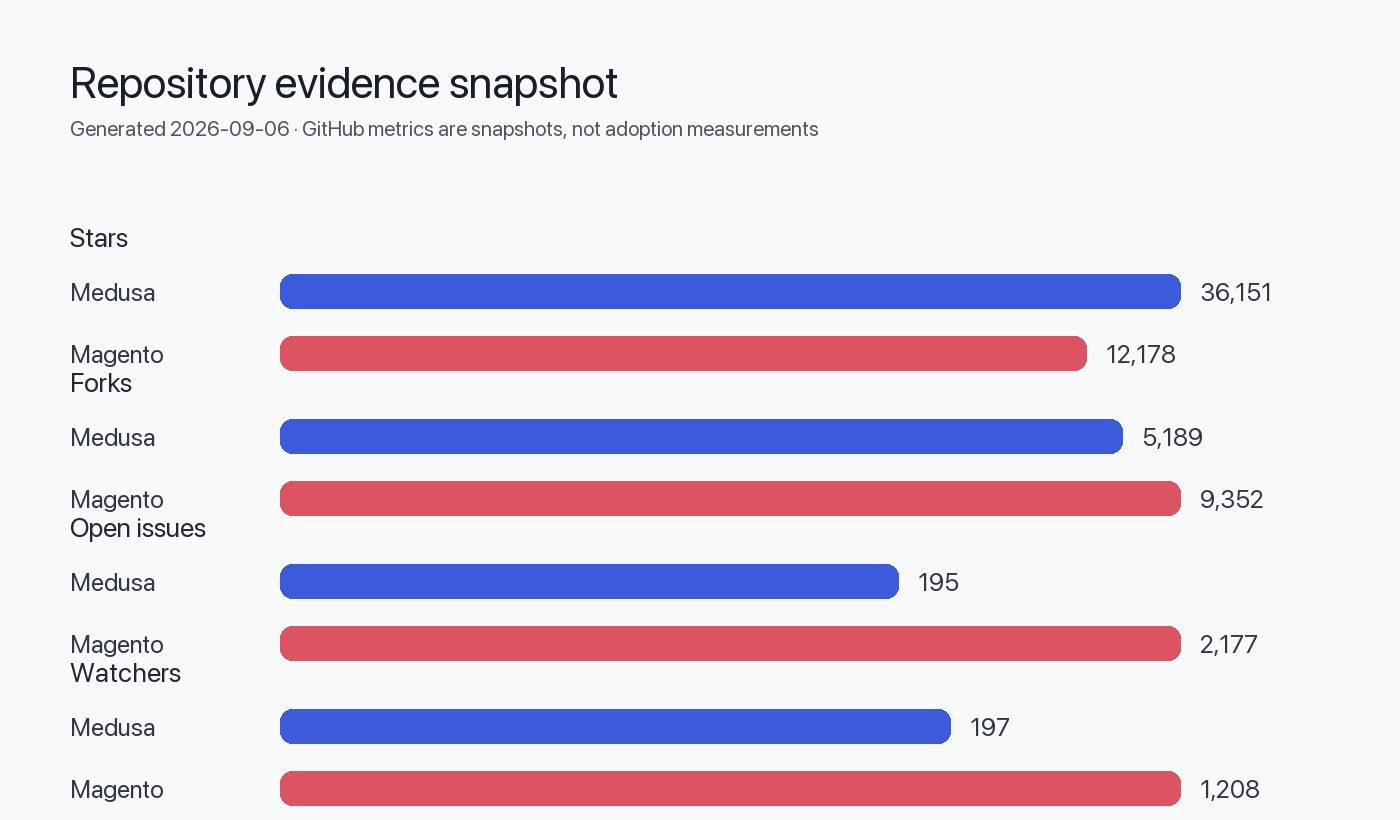
| Attribute | Medusa (evidence) | Magento (evidence) |
|---|---|---|
| Primary language | TypeScript (medusajs/medusa) | PHP (magento/magento2) |
| GitHub stars (interest signal) | 36,151 ([source]) | 12,178 ([source]) |
| Forks | 5,189 ([source]) | 9,352 ([source]) |
| Open issues (repo) | 195 ([source]) | 2,177 ([source]) |
| License model | Open-core; core MIT, Enterprise features commercial (inferred from README) ([source]) | OSL-3.0 (Adobe/Magento) ([source]) |
| Latest release (tag & date) | v2.20.1 — 2026-09-03 ([release]) | 2.4.9 — 2026-05-12 ([repo]) |
Notes: GitHub star and fork counts are interest signals and do not equal adoption or market share; open-issue counts are repository state snapshots, not defect totals. Data generated 2026-09-06 from the repositories linked below.
Sources: Medusa repository, Medusa release v2.20.1, Magento repository.
Decision matrix (practical criteria for platform selection)
- How to use: score each criterion qualitatively for your project. The matrix below synthesizes repo-level facts and product positioning.
| Criterion | Why it matters | Medusa | Magento |
|---|---|---|---|
| Language & stack | Matches team skills, runtime and deployment choices | TypeScript/Node.js — fits JS/React stacks, easier to integrate with modern Jamstack frontends (medusajs/medusa) | PHP — fits legacy LAMP ecosystems and many enterprise PHP teams (magento/magento2) |
| Architecture & extensibility | How straightforward it is to customize commerce flows | Modular, composable services and plugins oriented to headless use; open-core for core features (README indicates open-core model) (medusajs/medusa) | Large monolith with extension points and a vast extension marketplace; customization often requires deep knowledge of Magento internals (magento/magento2) |
| Ecosystem & integrations | Extensions, partners, third-party integrations | Growing integrations and first-party cloud offering (Medusa Cloud referenced in README) (medusajs/medusa) | Extensive ecosystem, many merchants, plug-ins, and enterprise partners under Adobe umbrella (magento/magento2) |
| Operational model | Hosting, managed options, maintenance burden | Designed for cloud-native/node deployments; Medusa Cloud referenced as a managed option (README) (medusajs/medusa) | Often deployed on PHP-optimized platforms; Adobe offers commerce cloud options and enterprise services (magento/magento2) |
| Security & release cadence | Patching, security responsiveness | Active releases; recent v2.20.1 includes a field-filter security fix (see release notes) (Medusa release) | Large project with regular releases; enterprise security processes maintained via Adobe channels (repo and release tag 2.4.9) (magento/magento2) |
| Licensing & commercial features | Cost and vendor lock-in potential | Open-core: core MIT license; Enterprise Edition flagged in README as requiring commercial agreement (medusajs/medusa) | OSL-3.0 for Open Source; Adobe/Adobe Commerce commercial tiers exist and are mentioned in project materials (magento/magento2) |
Decision guidance: prefer Medusa when your team is JavaScript-first, you need headless flexibility, and you want an open-core framework you can iterate on quickly. Prefer Magento when you need a lot of out-of-the-box commerce features, have PHP/Adobe operational expertise, or require deep enterprise integrations that Adobe partners provide.
Trade-off table (concrete pros and cons)
| Trade | When Medusa is better | When Magento is better |
|---|---|---|
| Time-to-custom-feature | Faster for teams that can ship Node.js microservices and frontends (headless) | Faster if the required feature is already implemented by an existing Magento extension or vendor solution |
| Total implementation complexity | Lower for greenfield headless projects with JS stacks | Lower for stores that rely heavily on PHP tools, legacy extensions, or require enterprise features tied to Adobe |
| Operational surface | Smaller if you standardize on Node.js tooling and managed DBs | Larger if running full Magento stack and PHP dependencies, but enterprise tooling and hosting are available |
| Long-term maintainability | Easier for JS-centric teams; core is MIT so you can fork and adapt | Easier for organizations with dedicated Magento/Adobe teams and partner support |
Workload-fit analysis (what projects map well to each)
Below are four concrete project profiles with recommendations and short rationales. These profiles are representative—apply the decision matrix above to your exact constraints.
1) DTC startup (single brand, fast iterations, React storefront)
- Recommendation: Medusa (strong preference)
- Why: If your team is JavaScript-first and plans a React/Next.js storefront, Medusa’s TypeScript core and headless patterns reduce friction integrating frontends and microservices. The open-core MIT license for the core allows rapid customization without licensing negotiation (medusajs/medusa).
- When to consider Magento: If you expect to need many pre-built enterprise integrations immediately (payments, fraud, catalog syncs from third parties available as Magento extensions) and have PHP resources.
2) Enterprise omnichannel retailer (POS, ERP integrations, inventory distribution)
- Recommendation: Magento (strong preference) or Medusa with enterprise architecture
- Why: Magento’s long presence in enterprise commerce and Adobe’s ecosystem provide pre-built connectors and partner services that shorten integrations to ERPs, POS systems, or merchandising platforms (magento/magento2).
- When to choose Medusa: If you have an API-first architecture and can build bespoke connectors, Medusa can be used as a composable commerce layer but will require more integration engineering.
3) Multi-vendor marketplace (complex vendor flows, revenue share)
- Recommendation: Depends on marketplace complexity. Consider Medusa if you want a headless, composable approach to vendor microservices; consider Magento if you want marketplace features supported by extensions or vendors.
- Why: Medusa’s modularity makes it straightforward to implement custom fulfillment and commission logic as services. Magento’s ecosystem may offer ready-made marketplace extensions that reduce initial development time but can introduce coupling to their extension models.
4) B2B platform (custom catalogs, complex pricing, procurement flows)
- Recommendation: Magento (preference) or Medusa with heavy customization
- Why: Magento has a history of B2B features and enterprise deployments; many B2B patterns are supported either in core or through enterprise tooling. Medusa can implement these patterns but they are more likely to require custom engineering.
Migration considerations and plan
Key migration decisions differ depending on direction:
- Migrating from Magento to Medusa: common when moving to a headless, JS-first stack or when replacing a legacy PHP monolith with a modular architecture.
- Migrating from Medusa to Magento: less common, typically when adopting larger enterprise capabilities tied to Adobe, or integrating into an existing Adobe Commerce ecosystem.
Core migration concerns (applies to both directions):
- Data model mapping: customers, products, catalogs, orders, promotions, and tax rules must be mapped between schemas. Expect to build mapping utilities or ETL jobs.
- Integrations: payments, shipping, tax providers, and ERPs will need to be reattached to the new platform.
- Extensions & custom code: Magento extensions don't translate directly to Medusa plugins; custom features must be reimplemented.
- Operational changes: runtime stack differences (Node.js vs PHP) affect hosting, observability, and CI/CD.
Mermaid migration flow (phased plan):
flowchart LR
  A[Assess & inventory current system] --> B[Design target data model]
  B --> C[Build mapping & ETL pipelines]
  C --> D[Implement core integrations (payments, shipping)]
  D --> E[Parallel run & reconciliation]
  E --> F[Cutover & decommission legacy components]
  E --> G[Post-cutover monitoring & rollback window]
Migration practical notes:
- Start with a read-only sync of products and customers to validate the target model before exporting orders.
- Use a reconciliation run (parallel operation) to compare transactions and ensure parity.
- Keep rollback and audit logs; do not delete legacy data until operations are stable.
Workload cost & engineering effort (qualitative workload-fit)
| Project profile | Typical engineering effort to launch MVP | Typical ops complexity | Special considerations |
|---|---|---|---|
| DTC startup (Medusa) | Low–medium for JS teams | Low with managed services/Medusa Cloud | Fast frontend iteration; fewer PHP ops needed (medusajs/medusa) |
| Enterprise omnichannel (Magento) | Medium–high; many integrations | High; enterprise hosting and compliance | Strong partner ecosystem and enterprise SLAs (magento/magento2) |
| Multi-vendor marketplace | Medium–high | Medium–high | Complex vendor flows benefit from composable services; evaluate extension availability |
| B2B custom platform | High | High | Custom pricing and procurement flows often need deeper platform customization; prefer platform with proven B2B features |
Action checklist (decision & migration)
- Assess your team's primary language and runtime expertise (JS/Node vs PHP).
- Inventory required integrations and check for existing extensions or partners on each platform.
- Score each criterion in the decision matrix with stakeholders; prioritize the top three must-haves (e.g., ERP integration, headless storefront, compliance).
- Prototype a minimal end-to-end flow (product → cart → checkout) on the shortlisted platform before committing.
- If migrating, build a mapping document for data models and plan a parallel reconciliation period.
- Plan for security patches and upgrades: subscribe to vendor security alerts for Magento; track Medusa releases for important fixes (e.g., v2.20.1 field-filter fix) (Medusa release).
Evidence, assumptions, and limitations
- Evidence sources: facts and repository metadata are drawn from the Medusa canonical repository and release pages and from the Magento canonical repository linked below. Citations are: Medusa repository, Medusa latest release v2.20.1, Magento repository. Data was generated 2026-09-06.
- Assumptions: this article assumes readers will treat GitHub stars as interest signals (not usage or market share) and open-issue counts as repository state snapshots. Any architectural statements that are not explicit in code comments are labeled as "inferred".
Inferred architectural conclusions (explicitly labeled):
- Inferred: Medusa’s codebase and README emphasize a modular, headless-first approach and an open-core model where the core is MIT and enterprise features are commercially licensed. This is derived from the repository README and release notes (medusajs/medusa).
- Inferred: Magento is positioned as a full-featured open-source commerce product with enterprise commercial tiers and Adobe integration points; its repository and readme materials describe OSL-3.0 licensing and links to Adobe Commerce offerings (magento/magento2).
Limitations:
- This comparison uses repository metadata, READMEs, and published release notes only. It does not include external marketplace data, independent performance benchmarks, or customer case studies beyond what the repositories provide.
- Do not treat repository open-issue counts as a measure of software quality without deeper triage.
FAQ
What are the primary technical differences at a glance?
Medusa is TypeScript/Node.js with a headless, modular approach and an open-core model; Magento is a PHP-based, feature-rich platform maintained under Adobe with a broad extension ecosystem. (Sources: Medusa and Magento repositories.)
Are Medusa and Magento interoperable with the same frontends?
Both can be used with headless frontends, but Medusa is designed with headless integrations in mind; Magento can be used headlessly but often has more coupled frontend patterns historically. Evaluate integrations individually.
Does Medusa have an enterprise offering?
Yes. The Medusa README indicates an open-core model: the core is MIT-licensed while certain Enterprise Edition materials require a commercial agreement (inferred from README). See the Medusa repository for details.
Is Magento still actively maintained?
Yes. The Magento Open Source repository shows ongoing maintenance and releases (latest referenced tag 2.4.9). See the Magento repository for release details.
How do GitHub stars and forks affect my decision?
Treat stars and forks as interest signals and indicators of community activity; they are not reliable measures of production usage or market share. Use them alongside ecosystem and partner availability when making decisions.
Which platform requires more ops work?
Magento deployments typically involve more operational surface area (PHP ecosystem, scaling monolith concerns) compared to a Node.js headless service like Medusa — but real ops effort depends on scale, integrations, and whether you use managed hosting.
Sources
- Medusa canonical repository: https://github.com/medusajs/medusa
- Medusa latest GitHub release (v2.20.1): https://github.com/medusajs/medusa/releases/tag/v2.20.1
- Magento canonical repository: https://github.com/magento/magento2