LlamaIndex vs Ollama: Choosing for Real LLM Projects
A practical comparison of LlamaIndex (document-agent / data framework) and Ollama (local & hosted model runtime) with decision matrices, migration notes, and role-based recommendations.
Executive answer
LlamaIndex and Ollama address different layers of an LLM application stack and are often complementary rather than direct substitutes. LlamaIndex (Python) is a data-framework and document-agent platform focused on ingestion, parsing, indexing, and retrieval-augmented workflows; Ollama (Go) is a model runtime / local-first model manager and API surface for running and serving models. Use LlamaIndex when your core problem is document ingestion, structured extraction, and query/index pipelines. Use Ollama when you need to run, host, or orchestrate LLM models locally or on self-managed infrastructure with a simple CLI/REST surface and broad model support.
This article (data snapshot generated Sep 6, 2026) compares both projects using only the supplied repository and release data. It includes a decision matrix, explicit trade-offs, workload-fit recommendations for four project profiles, migration considerations, an action checklist, and an evidence/assumptions section listing the exact sources used.
Quick comparison at a glance
- Primary language and ecosystem
- LlamaIndex: Python library and modular ecosystem focused on data ingestion, indices, retrievers, and agent workflows. Evidence: run-llama/llama_index README and repository metadata.
- Ollama: Go-based runtime/CLI for running models locally or on servers; exposes a REST API and CLI and provides SDKs/libraries across languages. Evidence: ollama/ollama README and repository metadata.
- Focus
- LlamaIndex: Document agents, OCR/parsing (LlamaParse), integrations with over 300 connectors, and query engines. Evidence: LlamaIndex README and release notes referencing LlamaParse and many integrations.
- Ollama: Model hosting, model import, local-first inference, REST and CLI interfaces, and language SDKs. Evidence: Ollama README showing CLI install, REST API, and listed SDKs.
- Governance and health (repo metadata snapshot)
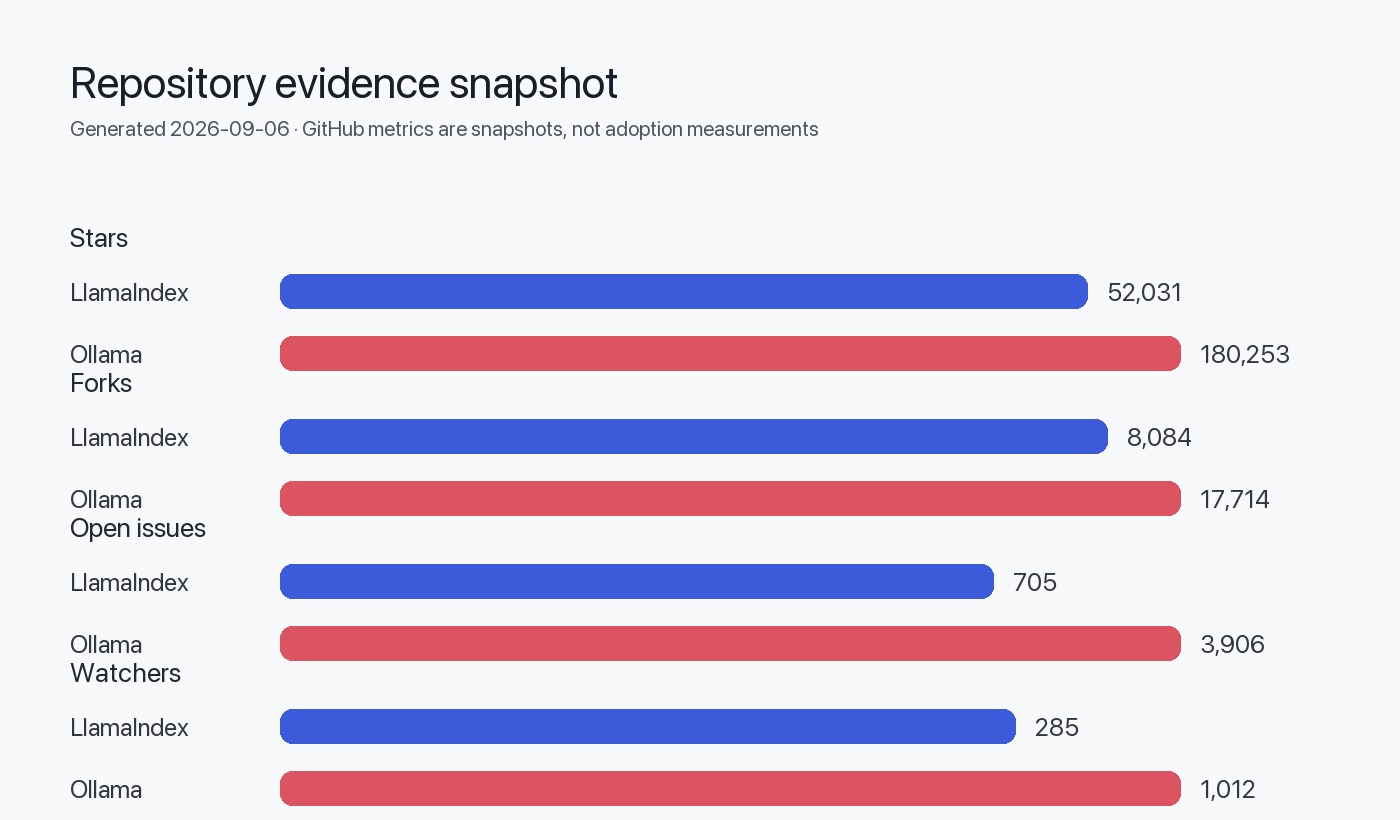
- LlamaIndex: MIT license, 52,031 stars, active releases (latest v0.14.24 published 2026-08-19). See LlamaIndex repo and release v0.14.24.
- Ollama: MIT license, 180,253 stars, active releases (latest v0.33.3 published 2026-09-02). See Ollama repo and release v0.33.3.
Decision matrix
| Decision criteria | LlamaIndex — evidence | Ollama — evidence | Practical implication |
|---|---|---|---|
| Primary role | Data framework & document agents; LlamaParse OCR/parse/extract/index features referenced in README | Model runtime, CLI, REST API, multi-language SDKs | Choose the one matching your primary engineering problem (data pipelines vs model hosting) (LlamaIndex README, Ollama README). |
| Language / SDKs | Python ecosystem; core package and integration packages; >300 integrations referenced in README | Go core runtime with REST API; SDKs and client libs listed (Python, JS, Java, etc.) | Pick LlamaIndex for Python-first data workflows; pick Ollama for polyglot runtimes or when using the CLI/REST API. |
| Integration with models | LlamaIndex offers integration packages for many LLM providers and explicit example of using Ollama as an LLM backend | Ollama exposes local model hosting and a REST API, plus client libraries, enabling it to act as a backend for frameworks like LlamaIndex | LlamaIndex can use Ollama as an LLM provider; Ollama can serve models to frameworks (LlamaIndex README example using Ollama). |
| Deployment targets | Library used inside Python applications or services (in-memory by default, persistence via storage_context) | Local-first CLI, Docker image, system installs for macOS/Windows/Linux, REST API for programmatic access | Ollama is oriented toward installing/running a local or server runtime; LlamaIndex is embedded in Python services. |
| Extensibility | Plugin/integration package model, many vector-store and reader integrations (release notes and README reference dozens of components) | Model import, modelfiles, and community integrations; many web/desktop/mobile clients referenced | Use LlamaIndex for richer data pipeline customization; use Ollama to bring models into existing app stacks. |
| Release activity (snapshot) | Latest release v0.14.24 on 2026-08-19; many fixes/features in release notes | Latest release v0.33.3 on 2026-09-02; churn and engine updates noted in changelog | Both projects are actively maintained as of the data snapshot (2026-09-06). |
Trade-off table: when to pick which
| Situation | Prefer LlamaIndex | Prefer Ollama | Why (evidence-based) |
|---|---|---|---|
| Building an OCR-backed document agent with structured extraction | ✅ LlamaIndex (LlamaParse, Extract, Index in README) | LlamaIndex README and product notes call out LlamaParse and document parsing as core features. | |
| Running models in isolated local environments or desktops | ✅ Ollama (CLI, local install scripts, Docker image in README) | Ollama README documents install scripts for macOS/Windows/Linux and a Docker image; REST API example shows how to run models locally. | |
| Needing a Python-native retrieval + index pipeline for RAG | ✅ LlamaIndex | Possible with Ollama as backend but requires integration | LlamaIndex presents index, retriever, and storage persistence APIs; examples show in-Python usage. |
| Multi-language app or embedding Ollama into non-Python stacks | ✅ Ollama (SDKs, REST API) | Ollama lists Python, JS, Java, Go SDKs and a REST API example in README. | |
| Wanting a high-level data pipeline with many connectors (SQL, GitHub, GCS, PDFs) | ✅ LlamaIndex | LlamaIndex README references many reader and connector packages and over 300 integrations. |
Workload-fit analysis (four project profiles)
For each profile below we (a) state the profile, (b) recommend fit(s) using only the supplied evidence, (c) list migration/implementation notes, and (d) provide an estimated engineering focus.
1) Enterprise document-processing and search (OCR, extraction, compliance)
- Fit recommendation: Primary: LlamaIndex (document-agent and LlamaParse features). Ollama as optional model runtime if you want local hosting for the LLM used by LlamaIndex.
- Evidence: LlamaIndex README explicitly highlights LlamaParse, agentic OCR and structured extraction and Index/Extract components. LlamaIndex README
- Migration/implementation notes:
- Start by ingesting documents using LlamaIndex readers and pipelines (LlamaIndex provides many readers and a StorageContext for persistence per the README).
- If you require the LLM call to be local/on-prem, configure LlamaIndex to use an Ollama LLM integration (the README includes an Ollama example showing Settings.llm = Ollama(...)).
- Engineering focus: Data connectors, index tuning, extraction schemas, and integrating storage persistence. If adding Ollama, add operational work to install/manage the Ollama runtime.
2) Self-hosted / on-device model serving for privacy-sensitive inference
- Fit recommendation: Primary: Ollama (local CLI, REST API, Docker). Secondary: Use LlamaIndex within Python services to manage RAG/indexing and point LlamaIndex at Ollama as the LLM when needed.
- Evidence: Ollama README documents install scripts per platform, a Docker image, REST API example, and mentions SDKs and model import. Ollama README
- Migration/implementation notes:
- Deploy Ollama runtime on the target host (or Docker). Use Ollama REST API or SDKs to serve model calls.
- If your application needs document retrieval and indexing, run LlamaIndex in a Python service and set the LLM to use Ollama (README shows example usage).
- Engineering focus: Ops for runtime and model imports, SDK integration, and test harnesses for local inference latency.
3) SaaS RAG chatbot (cloud-hosted web app) with multi-provider models
- Fit recommendation: LlamaIndex as the data and retrieval layer; Ollama can be an optional backend if you want to include local/self-hosted models; otherwise configure LlamaIndex integrations to cloud LLMs as available.
- Evidence: LlamaIndex offers connectors, storage context, and query engines suitable for RAG; Ollama can act as an LLM backend (LlamaIndex README shows Ollama usage). LlamaIndex README
- Migration/implementation notes:
- Build ingestion and index pipelines in LlamaIndex.
- Decide model hosting: cloud provider (use LlamaIndex integration packages) vs self-hosted Ollama. The README shows both approaches exist within the LlamaIndex ecosystem.
- Engineering focus: Scalability of vector store, retriever tuning, user session handling, and model hosting trade-offs.
4) Research prototyping with many open models and fast iteration
- Fit recommendation: Ollama for quickly running multiple open models locally and testing variants; LlamaIndex if the experiment requires structured data ingestion and retrieval-augmented prompting.
- Evidence: Ollama README lists many models in its library and shows quick run/launch commands; LlamaIndex README focuses on data handling and indexing. Ollama README, LlamaIndex README
- Migration/implementation notes:
- Use Ollama CLI/REST to test models quickly; when experiments require document-driven retrieval, add LlamaIndex to manage ingestion and retrieval.
- Engineering focus: Experiment orchestration, reproducible modelfiles/versions, and storage of datasets.
Migration considerations and integration patterns
- LlamaIndex -> Ollama: The LlamaIndex README includes an example configuring Ollama as the LLM provider (Settings.llm = Ollama(...)). That implies a straightforward integration pattern where LlamaIndex handles ingestion and retrieval while Ollama handles inference. (This is an architectural conclusion inferred from the README example.)
- Ollama -> LlamaIndex: If an existing application uses Ollama through its REST API, you can introduce LlamaIndex as an independent Python service that queries the same Ollama endpoint; no repository-level migration is required—this is a cross-service integration.
- Persisted storage and operational concerns: LlamaIndex documents a StorageContext and persistence APIs (readme examples show persist and reload). Ollama offers install scripts, Docker, and a REST API—operational work differs: LlamaIndex needs a Python runtime and persistent storage for indices; Ollama needs runtime management for the model server and model files.
Operational, licensing, and security notes (evidence-limited)
- Licenses: Both repositories list MIT in their metadata, which the supplied data shows. Check the repositories directly for precise license text before using in proprietary workflows (LlamaIndex repo, Ollama repo).
- Release cadence: Both projects had releases within weeks of the data snapshot (LlamaIndex v0.14.24 published 2026-08-19; Ollama v0.33.3 published 2026-09-02). This indicates active maintenance in the provided timeframe. See release links in Sources.
- Security: No security advisories were supplied. When assessing security, treat any local model runtime (Ollama) as an operational surface needing usual hardening; treat document ingestion (LlamaIndex) as sensitive to PII and content governance. (These are general operational considerations—not claims about specific advisories; consult each project's security pages for advisories.)
Decision checklist (actionable)
- If you need document ingestion, OCR, or index-backed query: evaluate LlamaIndex first.
- If you need a local-first runtime, CLI, or REST API to host models or run many open models: evaluate Ollama first.
- If you need both: prototype with LlamaIndex for ingestion and configure Ollama as the LLM backend (the LlamaIndex README shows an Ollama example).
- Check the exact release tags and license text in each repo before production deployment (links in Sources). Data snapshot used: Sep 6, 2026.
Action checklist
Mermaid diagram: integration flow (LlamaIndex + Ollama)
flowchart LR
  A[Document sources: PDFs, GCS, SQL] -->|readers| B[LlamaIndex ingest]
  B --> C[Index + Retriever]
  C --> D[Query Engine]
  D -->|LLM calls| E[Ollama REST/CLI runtime]
  E --> F[Model inference]
  F --> D
  style B fill:#F3F4F6,stroke:#333
  style E fill:#EEF2FF,stroke:#333
Evidence, assumptions, and limitations
- Evidence used (data retrieval/generation timestamp): the article uses only the supplied repository metadata, README content, and latest release notes. Data snapshot generated at Sep 6, 2026. Sources are provided exactly in the Sources section below.
- Assumptions explicitly stated:
- When the README shows an example connecting LlamaIndex to Ollama, we infer an integration architecture: LlamaIndex handles data and retrieval while Ollama acts as an LLM backend. This is an architectural conclusion inferred from README examples and repository structure.
- Operational and security recommendations are general best-practice guidance; they are not derived from any reported advisories in the supplied sources.
- Limitations:
- This comparison deliberately does not include benchmarks, adoption statistics, or unreferenced feature claims because those data were not supplied.
- The supplied release notes and README content were used verbatim for feature signals; any features or integrations not mentioned in these supplied artifacts were not assumed.
Sources
- LlamaIndex canonical repository: https://github.com/run-llama/llama_index
- LlamaIndex latest GitHub release (v0.14.24): https://github.com/run-llama/llama_index/releases/tag/v0.14.24
- Ollama canonical repository: https://github.com/ollama/ollama
FAQ
What is the single best way to combine LlamaIndex and Ollama?
Use LlamaIndex as the ingestion/indexing/query layer and configure LlamaIndex's LLM settings to point at an Ollama backend (the LlamaIndex README includes an Ollama usage example). This pairs LlamaIndex's data tooling with Ollama's model runtime.
Are both projects open-source and permissively licensed?
Yes—both repositories list the MIT license in their supplied metadata. Verify the license files in each repo before making legal decisions.
Can Ollama replace LlamaIndex for document parsing and OCR?
No — based on the supplied README content, LlamaIndex documents dedicated document-agent and LlamaParse features (parsing, OCR, Extract). Ollama focuses on running and serving models (CLI, REST, SDKs). Use LlamaIndex for document pipelines.
Is Ollama only for local desktops?
No — Ollama provides install scripts for macOS/Windows/Linux, a Docker image, and a REST API. These options make it usable both on local desktops and server environments. See the Ollama README for install and API examples.
Which is better for building a RAG chatbot in Python?
LlamaIndex is the natural starting point for Python-first RAG workflows because it provides ingestion, indices, and query engines. You can use Ollama as the LLM provider for inference if you need self-hosted models (the README shows an example using Ollama with LlamaIndex).
Where can I find the release notes and changelogs referenced here?
Release notes referenced come from LlamaIndex v0.14.24 and Ollama v0.33.3; links are listed in the Sources section above.
I need to run many open models and iterate quickly — which to pick?
Ollama's CLI and model library make it suited for running many open models quickly; LlamaIndex complements this when your experiments require document-driven retrieval and indexing.