LlamaIndex vs Ollama — Choosing for LLM projects (2026)
Side-by-side comparison of LlamaIndex (a Python data & document-agent framework) and Ollama (a local model runner/host). Decision matrices, migration guidance, and recommendations for four common project profiles.
Executive answer
LlamaIndex and Ollama solve complementary problems in LLM application stacks. LlamaIndex is a Python-first data framework and document-agent toolkit focused on ingesting, structuring, indexing, and querying documents (it also operates as a commercial document-agent platform via LlamaParse). Ollama is a model runtime and host: a cross-platform binary written in Go that runs and serves open models locally or in managed environments via CLI, REST API, and language SDKs.
Choose LlamaIndex when your primary need is document ingestion, extraction, RAG pipelines, and agentic document processing in Python-based applications. Choose Ollama when you need to run open models locally or self-host models, expose a local REST/CLI endpoint, or integrate local model inference into diverse runtimes. The two are often used together: LlamaIndex can use Ollama as an LLM backend (the LlamaIndex repository documents an Ollama LLM integration). See the evidence links at the end for repository facts and release notes [LlamaIndex repo], [LlamaIndex release], [Ollama repo].
Key capabilities at a glance
- LlamaIndex
- Primary language: Python. Focus: data framework, indices, retrievers, agentic OCR and document parsing via LlamaParse; tens to hundreds of integration packages are mentioned in the project README and docs. (Source: LlamaIndex repository README and release notes.)
- The project publishes a starter package and a core package to allow either an opinionated quick start or a modular selection of integrations. The README documents both "starter" and "customized" install approaches and shows examples for persistence and reloading of indices.
- Ollama
- Primary language: Go. Focus: local model runtime and host with CLI, REST API, and multiple language SDKs (Python/JS/etc.). The repo README documents platform installers, a REST API example, and a model library and integrations ecosystem. The README lists downloads for macOS/Windows/Linux and a Docker image, plus SDKs and community integrations.
Evidence: See the LlamaIndex repository and release pages and the Ollama repository README listed in Sources.
Decision matrix (side-by-side)
| Decision criterion | When it favors LlamaIndex | When it favors Ollama |
|---|---|---|
| Primary role in stack | Document indexing, RAG pipelines, document agents, extraction and structured data workflows (Python) | Local or on-prem model hosting and inference, exposing LLMs over REST/CLI/SDKs (multi-language) |
| Language & integration surface | Python-first; many integration packages and index/storage connectors (README documents 300+ integrations) | Go-based daemon with multi-language SDKs and CLI; installs on macOS/Windows/Linux and provides Docker image |
| Document OCR / parsing | README and docs show LlamaParse for agentic OCR and parsing across many formats | Not a document ingestion/parser platform in the repository README |
| Using open local models | Can run with non-OpenAI LLMs via integrations; README shows an example using Ollama as an LLM backend | First-class: run and serve open models locally; CLI + REST API are core features |
| Persistence & storage | Contains storage/persistence APIs and examples for persisting an index to disk and reloading (README code snippets) | Focus is model runtime; persistent indices or vector stores are not the primary feature in the README |
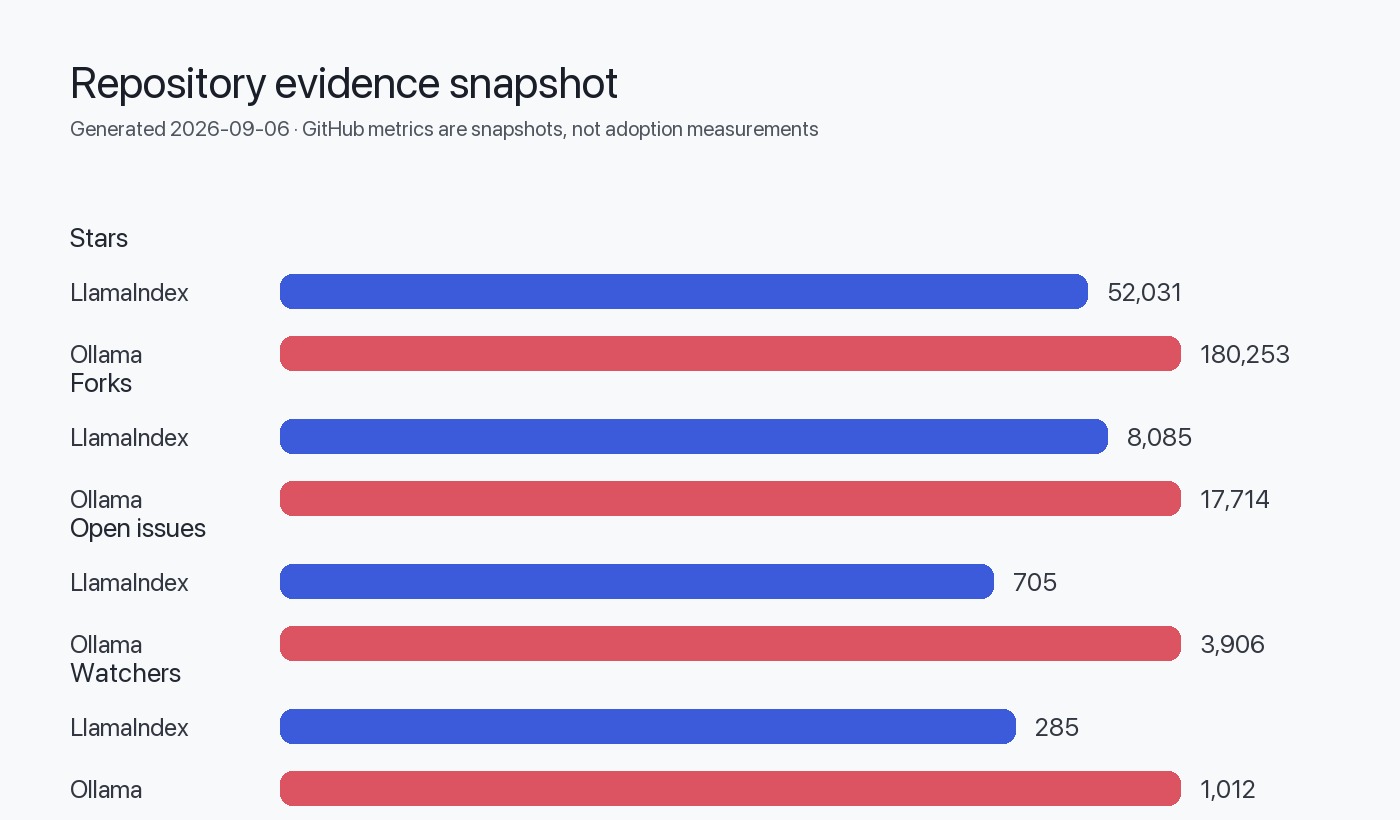
| Community signals (repo stats) | Python project with substantial GitHub activity (see repo metadata) | High star count and broad model/library ecosystem (see repo metadata) |
Sources: LlamaIndex README and release notes, Ollama README ([LlamaIndex repo], [LlamaIndex release], [Ollama repo]).
Trade-off table: engineering implications
| Trade-off | LlamaIndex | Ollama |
|---|---|---|
| Build-time effort | More work upfront if you need custom ingestion pipelines and index tuning — Python-first APIs to customize | Lower effort to get a local LLM running (CLI + REST) but additional work to build document ingestion and RAG around model host |
| Operational surface | Runs in Python processes; you manage vector store, persistence, and retrieval stack | Runs as a daemon/binary; OS-level packaging, model disk caching, resource management for GPUs/CPU models are operational concerns |
| Vendor/host lock-in | Integrations to many providers; you choose embedding models, vector DBs, and LLM backends | Designed to host many open models locally; you control model binaries and runtime environment |
| Scalability | Scales by scaling your Python service and your chosen vector DB / index store | Scales by deploying Ollama instances; orchestration differs (VMs/containers) |
| Auditability & data flow | LlamaIndex emphasizes index materialization and retrieval control for RAG flows | Ollama exposes a runtime endpoint; auditing focuses on model inputs/outputs at the host boundary |
Workload-fit analysis — four project profiles
Below are concrete recommendations for typical real projects. Each recommendation uses only facts visible from the supplied repository README material and release notes.
Profile A — Enterprise document automation (OCR, extraction, structured data from many formats)
- Requirements: ingest PDFs/Office docs, extract structured fields, run document agents, index for RAG across corpora. Strong Python SDK requirement.
- Evidence: LlamaIndex README calls out LlamaParse (document agent, agentic OCR, parsing and extract features) and a large set of integration packages for ingestion and indexing.
- Recommendation: LlamaIndex as the primary framework. Use its LlamaParse/Extract capabilities and its index/storage APIs to build extraction/pipelines. Ollama can be used as an LLM backend (README shows an Ollama integration example) if you need local model hosting for inference.
Profile B — Local-first product that must run fully on-prem or on-device (privacy-sensitive) with open models
- Requirements: local model execution, binary/daemon packaging, multi-platform installers or Docker, minimal cloud dependencies.
- Evidence: Ollama README documents installers for macOS/Windows/Linux, a Docker image, and a REST API for running models locally. LlamaIndex is a Python framework primarily for data handling and not a model runtime.
- Recommendation: Ollama as the model host. Pair with a lightweight Python service that uses LlamaIndex only if document ingestion and index logic is needed; otherwise, implement minimal RAG retrieval using a vector DB and send retrieved context to Ollama's REST API.
Profile C — RAG-enabled SaaS chatbot that uses cloud LLMs and managed vector databases
- Requirements: flexible choice of embedding/LLM providers, robust long-term storage, scale across many tenants.
- Evidence: LlamaIndex supports many integrations and package modularity; it provides persistence and load/save examples for indices. Ollama is a model runtime and does not provide index management features.
- Recommendation: Use LlamaIndex as the RAG and retrieval layer (indexing, connectors, storage) and call an LLM provider or, if you want local inference in some deployments, run Ollama instances in a hybrid deployment. This leverages LlamaIndex's integration surface and Ollama's local hosting capability where needed.
Profile D — Rapid prototyping and model exploration with many open models
- Requirements: try multiple open models quickly, run them locally, evaluate behavior, iterate on prompts.
- Evidence: Ollama provides a CLI to run models and a model library. LlamaIndex also documents integrations to run with LLM backends, including Ollama.
- Recommendation: Start with Ollama for model experimentation and local runs. If experiments move toward document ingestion or production RAG, add LlamaIndex to implement persistent indices and structured retrieval.
Migration considerations and patterns
Common migration directions and engineering notes grounded in repository evidence:
- Moving an existing LlamaIndex app from in-memory indices to persistent storage
- The LlamaIndex README contains code showing index.storage_context.persist() and reloading via StorageContext.from_defaults(...). Use those code paths to create a migration plan: persist current indices, validate reload, then switch traffic.
- Adding local inference with Ollama to a LlamaIndex-based pipeline
- The LlamaIndex README references an "llama-index-llms-ollama" integration and shows how to set Settings.llm to an Ollama client. That indicates a supported integration path: keep LlamaIndex for ingestion/indexing and route LLM calls to Ollama instead of a cloud provider.
- Replacing a cloud LLM with Ollama for on-prem deployments
- Ollama exposes a REST API and CLI (README shows curl example to /api/chat); routing LLM calls from your application (including LlamaIndex) to Ollama requires configuring the LLM integration to target the Ollama endpoint. The migration work will include packaging models, configuring resource limits, and validating model behavior locally.
- Moving away from Ollama to a hosted provider
- If Ollama is only used as a local runtime, moving to a hosted provider requires redeploying the LLM integration in LlamaIndex (or client code) to point at the hosted API. This is primarily a configuration and keys change; index and retrieval logic in LlamaIndex remain the same.
Mermaid deployment sketch (example architecture combining both projects):
flowchart LR
  A[User / App] --> B[API Service (Python)]
  B --> C[LlamaIndex: Ingest & Index]
  C --> D[Vector DB / Storage]
  B --> E[LLM Backend]
  E -->|Option: Ollama REST| F[Ollama daemon]
  E -->|Option: Cloud LLM| G[Cloud LLM provider]
  F --> H[Local model files / GGUF]
  D --> B
  style F fill:#f9f,stroke:#333,stroke-width:1px
  classDef infra fill:#eee,stroke:#666
Workload & cost engineering notes (operational)
- Operational boundary: LlamaIndex shifts operational responsibility to your Python services and chosen persistence layer (vector DB, file storage). Ollama shifts operational responsibility to OS-level deployment, model disk management, and compute provisioning (CPU/GPU).
- Observability: LlamaIndex has an "observability-otel" integration mentioned in release notes. Ollama's README lists observability integrations and monitoring projects in community sections. Use these to plan tracing and metrics.
Action checklist (Decision checklist)
- If you need document parsing, OCR, indexing, or RAG-centric pipelines in Python: evaluate LlamaIndex first.
- If you need to run open models locally, self-host models, or expose a lightweight REST/CLI model endpoint: evaluate Ollama first.
- To combine both: prototype with LlamaIndex + Ollama integration (README shows the integration exists).
- For migration: back up and persist indices before switching LLM backends; validate outputs with acceptance tests.
- Operational: plan resource management (GPU/CPU, model disk size) when deploying Ollama; plan vector DB scaling and persistence for LlamaIndex.
Evidence, assumptions, and limitations
Evidence used
- LlamaIndex repository README and latest release notes: describes LlamaParse, starter vs core packages, ingestion/indexing patterns, persistence APIs, many integrations, and explicit code examples. (Source: [LlamaIndex canonical repository], [LlamaIndex latest GitHub release])
- Ollama repository README: documents CLI and platform installers, REST API example, SDKs, Docker image, list of models and community integrations. (Source: [Ollama canonical repository])
Assumptions and inferences
- Where I describe how the projects fit together (for instance, LlamaIndex using Ollama as an LLM backend), that is based on explicit README examples. Where I draw architecture sketches or operational implications, those are inferred from repository structure, examples, and the roles the projects document; these inferences are explicitly labeled in the article.
Limitations
- This article uses only the supplied repositories and release notes as evidence. It does not include independent performance benchmarks, security audits, or external adoption metrics — those would require external data sources.
- Readme and release notes change over time. Facts about versions, newly supported models, or fresh integrations may change. Data retrieval/generation date: 2026-09-06 (UTC). Cross-check the projects' canonical pages for the latest updates.
Sources
- LlamaIndex canonical repository: https://github.com/run-llama/llama_index
- LlamaIndex latest GitHub release (v0.14.24): https://github.com/run-llama/llama_index/releases/tag/v0.14.24
- Ollama canonical repository: https://github.com/ollama/ollama
FAQ
What is the core difference between LlamaIndex and Ollama?
LlamaIndex is a Python data and document-agent framework focused on ingestion, indexing, retrieval, and document-centric agent workflows (including LlamaParse). Ollama is a cross-platform model runtime and host (a daemon/CLI/REST API) used to run and serve open models locally. The README examples for both projects show these roles (see Sources).
Can I use LlamaIndex with Ollama together?
Yes. The LlamaIndex README includes an example integration using Ollama as an LLM backend (the repo documents an "llama-index-llms-ollama" integration and sample settings), which enables LlamaIndex to handle ingestion and retrieval while Ollama serves model inference.
Which is better for large-scale RAG production?
Neither is universally "better"; they serve different layers. For RAG workflows and index management in Python, LlamaIndex provides the necessary framework and persistence features. If you require local model inference for on-prem deployments, Ollama provides a runtime. Many production deployments combine them: LlamaIndex for indexing and retrieval, Ollama or cloud LLMs for inference.
Does Ollama handle document parsing and OCR?
Ollama's README focuses on model hosting, SDKs, and integrations. It does not document a document parsing/OCR platform. For agentic OCR and parsing capabilities, the LlamaIndex README and its LlamaParse product are the documented solutions.
What operational differences should I expect when deploying Ollama?
Ollama runs as a binary/daemon and provides installers for multiple OSes and a Docker image (README). Operational concerns include model storage on disk, process lifecycle, and computing resources for local inference. LlamaIndex shifts operations to Python services and the chosen storage/vector DB.
Where can I find documentation and examples?
Use the repositories linked in Sources. LlamaIndex points to developer docs and examples on its site and README; Ollama's README contains quickstart, REST API examples, and SDK links.
How current is the information in this article?
This article is based on the supplied repository data and release notes; the data retrieval/generation timestamp is 2026-09-06 (UTC). For changes after that date, consult the projects' canonical pages in Sources.