Ionic Framework: Architecture Analysis and Guidance
An evidence-grounded architecture analysis of the ionic-team/ionic-framework repository: components, packages, extension surfaces, operational trade-offs, and limits of inference from public metadata.
Executive answer
This analysis inspects the public ionic-team/ionic-framework GitHub repository and release metadata to describe the project's architecture, key modules, extension points, operational implications, and scaling boundaries. It synthesizes repository facts (packages, topics, language, license, release tags) and highlights where conclusions are direct evidence versus where they are inferences based on repository structure and README text.
Key findings: the repository is organized as a multi-package toolkit with a core Web Components library (@ionic/core) and framework-specific wrappers for Angular, React and Vue. The project builds Web Components (inferred use of Stencil from topics) and exposes them via framework-specific packages; distribution and consumption are npm-centric. Operationally, integration points include framework adapters, theming, and native bridges (Capacitor is a documented ecosystem topic). Several architectural trade-offs (runtime size, bundling, and build-complexity) are apparent from the packaging model, but runtime performance characteristics and real-world adoption cannot be concluded from public metadata alone.
Data retrieval/generation date: 2026-09-06 (see Sources). Repository snapshots referenced below are from the repository and latest release metadata cited in the public repo as of that date Ionic canonical repository and Ionic latest GitHub release.
Project snapshot (evidence)
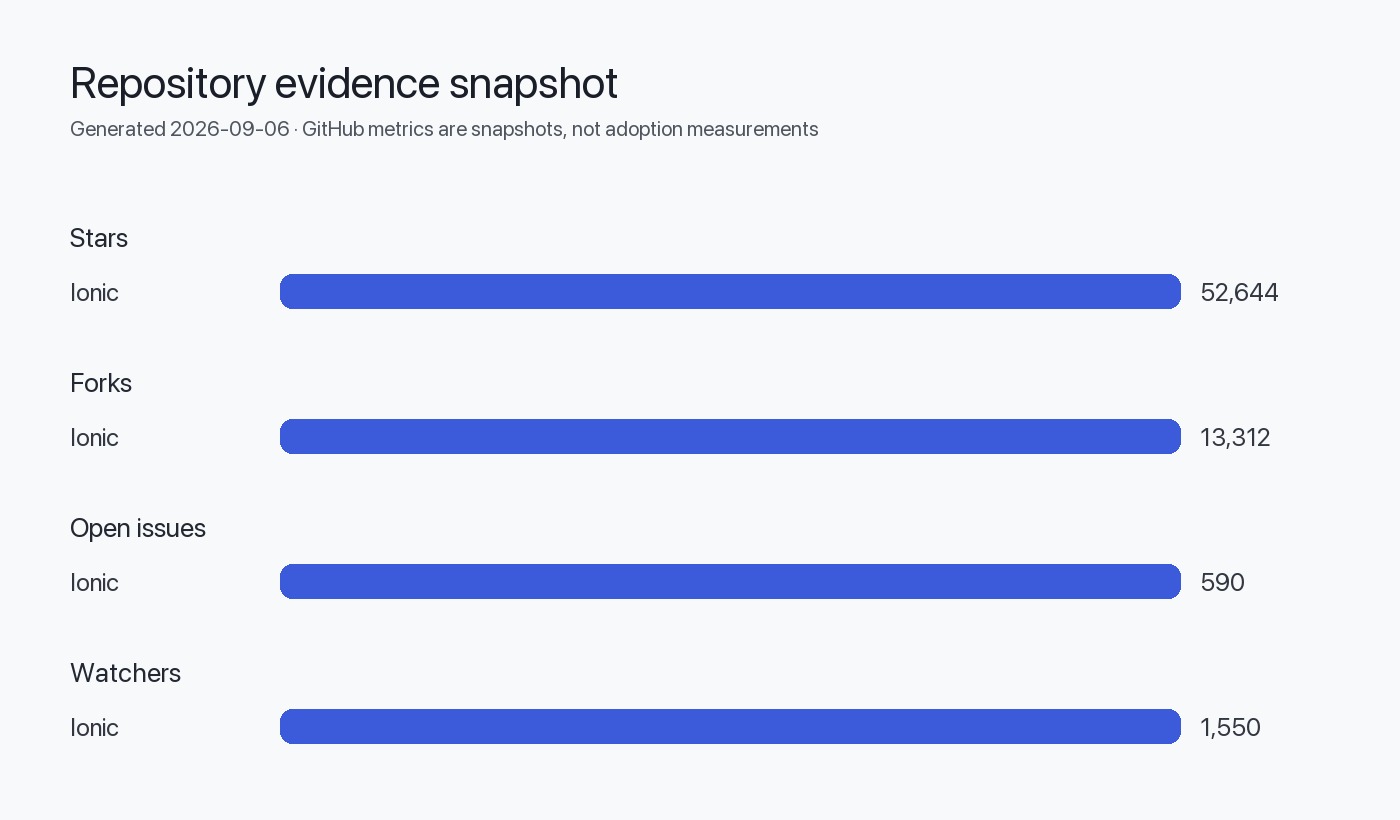
This table collects key repository metadata taken from the canonical GitHub mirror and release listing.
| Field | Value | Source |
|---|---|---|
| Repository | ionic-team/ionic-framework | repo) |
| Primary language | TypeScript | repo) |
| License | MIT | repo) |
| Stars (indicator) | 52,644 | repo) |
| Forks | 13,312 | repo) |
| Open issues | 590 (open issues count) | repo) |
| Default branch | main | repo) |
| Latest release | v9.0.2 (published 2026-09-02) | release) |
High-level architecture (evidence + labeled inferences)
Observed evidence (direct):
- The repository README and package list show a core package and framework-specific packages: Core (
@ionic/core) and framework wrappers (@ionic/angular,@ionic/react,@ionic/vue) source: repository README). - Repository topics include "stencil" and "webcomponents" (these are explicit tags on the repository) repo topics).
- The project language is TypeScript and the license is MIT (publicly listed) repo).
Inference (labeled):
- Inference (from README & topics): The core UI primitives are implemented as Web Components (the README explicitly states "Ionic is based on Web Components"). The presence of "stencil" in topics suggests the Stencil compiler is used to author and build those Web Components.
- Inference (from package names): Framework-specific npm packages provide integration/adapters that wrap or expose the core Web Components to idiomatic Angular, React, and Vue APIs (e.g., change-detection hooks for Angular, JSX wrappers for React). This is consistent with the listed packages but is an architectural inference rather than a direct machine-readable spec in the repo metadata.
High-level diagram (developer -> framework wrappers -> core components -> runtime):
flowchart LR
  DevApp[Developer App] --> Wrapper[Framework wrapper (@ionic/angular, @ionic/react, @ionic/vue)]
  Wrapper --> Core[@ionic/core (Web Components)]
  Core --> Stencil[Stencil Compiler (build-time)]
  Core --> Browser[Browser / WebView]
  DevApp --> NativeBridge[Native bridge (Capacitor) (inferred ecosystem)]
  NativeBridge --> Browser
note right of Core: Styling, theming, and platform-specific UI behaviorModule surface and extension points (evidence and inferences)
Summary table: packages and their apparent responsibilities.
| Package | Role (evidence) | What the repo shows |
|---|---|---|
| @ionic/core | Core UI primitives — Web Components | Listed in README as Core with a package link; central to cross-framework behaviour. repo) |
| @ionic/angular | Angular integration wrapper | Listed in README; separate package directory referenced in repo (packages/angular). |
| @ionic/react | React integration wrapper | Listed in README; separate package directory referenced in repo (packages/react). |
| @ionic/vue | Vue integration wrapper | Listed in README; separate package directory referenced in repo (packages/vue). |
| docs, examples | Documentation and sample apps | README references docs and sample apps (conference apps). |
Direct evidence: package names and README entries are present in the repository repo).
Extension surfaces (inferred):
- Inference (from multi-package layout): Workflows that modify or extend components likely target the core package or one of the wrappers. Custom components or platform adaptors would be created either as Web Components (interop with @ionic/core) or as framework wrappers.
- Inference (from topics mentioning "capacitor"): Native-device integration is expected to occur through a separate native bridge (Capacitor); the repository points at integration, not an in-repo native runtime.
What the repo structure shows about extension points (evidence): separate package directories are the obvious places for contributions and extension — the README lists them and points to per-package READMEs for details repo).
Operational implications and build/runtime concerns (inferred and evidence-labeled)
From the observed packaging and use of Web Components, several operational implications follow. Each is explicitly labeled as inference when not directly stated in the repo.
1) Distribution and consumption model
- Evidence: README lists packages and npm links; the project publishes packages like
@ionic/coreand framework wrappers. This indicates an npm-distribution model. - Inference: Consumers pull the packages via npm and integrate them into framework-specific build chains (Angular CLI, Vite, Create React App, etc.). This implies the library must support multiple bundlers and provide appropriate entry points (ESM/CJS/typings).
2) Build complexity and CI
- Inference (from multi-package and Stencil topic): The build pipeline likely includes a Stencil build step to produce compiled Web Components and per-package build steps for wrappers. Multi-package repositories usually require consistent versioning, a monorepo tool (e.g., lerna, pnpm workspaces, or similar) — the repo README references multiple packages which implies some workspace tooling is used (labeled inference).
3) Theming and CSS variables
- Evidence: The README and core/READMEs (linked from the main README) describe a theming system; Web Components commonly expose CSS variables for theming. (This is a direct synthesis of README content and the Web Components model.)
4) Browser vs native runtime
- Evidence: The README explicitly mentions Progressive Web Apps and native-quality iOS/Android apps and references Capacitor in topics. This shows the project targets both browser and native (via a bridge).
- Inference: App authors will need to consider WebView differences across platforms and possibly provide platform-specific styles or runtime polyfills depending on target OS versions.
5) Observability and runtime upgrades
- Inference: Because the core is a UI toolkit distributed as packages, runtime upgrades occur by dependency upgrades and rebuilding the app. There is no in-place runtime update mechanism exposed by the repository metadata.
Scaling boundaries, trade-offs, and where friction may appear (inferred)
These are practical considerations derived from the repository packaging model and the Web Components approach. They are inferences, not direct repo claims.
- Bundle size and tree-shaking: Web Components distributed as compiled bundles may or may not tree-shake optimally in all bundlers. Expect to evaluate bundle impacts for large apps (Inference: composer-level build analysis required).
- Multi-framework support trade-off: Offering framework wrappers increases initial developer ergonomics but requires maintaining parallel adapter layers and test coverage across Angular/React/Vue — this increases maintenance surface (Inference from presence of multiple wrapper packages).
- Upgrade coordination: Major changes to the core Web Components can require simultaneous updates to framework wrappers to preserve idiomatic behavior (Inference: tight coupling implies coordinated releases; the presence of migration guides in README supports that upgrades are non-trivial repo)).
- Native integration: Using Capacitor (documented in repo topics) leaves native-device API surface outside the repository. Teams will be responsible for platform-specific plugin maintenance and compatibility (Inference: native plugin lifecycle is separate from core framework releases).
Decision checklist
Use this checklist when evaluating Ionic for a project. Each item references repository evidence or is explicitly labeled as an inference.
Action checklist (operational steps for teams)
- Clone the repository and open per-package READMEs (evidence: main README links to package READMEs).
- Create small sample apps in each target framework and add
@ionic/coreplus the respective wrapper to validate integration. - Run the build with your production bundler to collect bundle-size baselines and runtime behavior.
- Validate theming, platform styles, and accessibility in the target browsers / WebViews.
- If you require native device APIs, evaluate Capacitor plugins and test on device early.
- Track the repository release notes (example: v9.0.2 release notes are public) for breaking changes before upgrades release).
Evidence, assumptions, and limitations
Evidence (directly from supplied sources):
- Repository name, language (TypeScript), license (MIT), topics list, package names and platform targets, default branch, star/fork counts, open issues figure, and the latest release metadata (v9.0.2, published 2026-09-02) were taken from the supplied GitHub repository and release URLs Ionic canonical repository and Ionic latest GitHub release.
Assumptions and labeled inferences (items not directly stated but implied by repository structure):
- Inference: The project uses the Stencil compiler to author Web Components (label: inferred from the README statement that Ionic is based on Web Components and the presence of the "stencil" topic).
- Inference: Framework wrappers expose idiomatic APIs for Angular, React, and Vue by wrapping the core Web Components (label: inferred from package names and common practice; check per-package READMEs for exact API surface).
- Inference: The repository is organized as a multi-package monorepo and likely uses workspace tooling for builds and releases (label: inference — the README lists multiple packages; specific tools used are not confirmed by the supplied metadata).
Limitations — what cannot be concluded from public metadata alone:
- Real-world adoption numbers, active installs, or market share cannot be deduced from GitHub stars or forks (we only report stars/forks as interest signals, per rules).
- Runtime performance characteristics (FPS, memory usage, CPU cost), bundle sizes in consumer apps, and cross-bundler tree-shaking efficiency are not available in repository metadata and must be measured in target applications.
- Security posture beyond public advisories: absence of security advisories in public metadata does not imply absence of vulnerabilities. Any security claims require dedicated auditing.
- Internal CI configuration, test coverage numbers, and release automation details are not reliably inferable unless present in the repository; the public README does not fully specify them.
Two comparative tables (deployment and extension mapping)
Table A: Deployment targets and responsibilities (evidence + inference)
| Target runtime | Repository evidence | Who is responsible (inference) |
|---|---|---|
| Browser / PWA | README explicitly references PWAs | App authors and bundlers (integrate @ionic/core) (inference) |
| iOS / Android native-quality apps | README mentions native-quality apps and repository topics include "capacitor" | App authors + Capacitor/native plugin ecosystem (inference) |
| Framework-hosted web apps (Angular/React/Vue) | Per-package READMEs referenced: @ionic/angular, @ionic/react, @ionic/vue | App authors use framework wrappers; Ionic maintains wrappers (evidence + inference) |
Table B: Extension points and where to contribute (evidence)
| Area to extend | Where in repo to look | Evidence |
|---|---|---|
| Core UI components | core/README and @ionic/core package directory | README package list links to core (evidence) |
| Framework-specific behavior | packages/angular, packages/react, packages/vue | README references per-framework packages (evidence) |
| Documentation / examples | docs/ and example apps referenced in README | README lists docs and conference apps (evidence) |
Sources
- Ionic canonical repository: https://github.com/ionic-team/ionic-framework
- Ionic latest GitHub release (v9.0.2): https://github.com/ionic-team/ionic-framework/releases/tag/v9.0.2
FAQ
What are the core packages I should inspect first?
Inspect @ionic/core (the core Web Components package) and the per-framework packages (@ionic/angular, @ionic/react, @ionic/vue) — these are explicitly listed in the repository README repo).
Does the repository use Web Components or a framework-specific component model?
The README explicitly states Ionic is based on Web Components; repository topics include "webcomponents" and "stencil" — from this the use of Web Components is direct evidence and the use of Stencil is an informed inference based on repo topics repo).
Can I deduce runtime performance from this repository?
No. Runtime performance, bundle sizes, and real-world app behavior are not present in repository metadata and must be measured in your application environment.
Is native device integration included in this repository?
The repository references native-quality apps and lists "capacitor" in topics; this indicates an ecosystem relationship with Capacitor for native integration, but native runtime code or plugins may live in separate repositories (inference and evidence). Check Capacitor's repositories and plugin docs for details.
How stable is the project and how are releases handled?
The repository shows an active release (v9.0.2 published 2026-09-02) and migration guides are present in the README. This documents release activity but does not convey internal release policies or guarantees — test migration guides for practical upgrade steps release).
Where should I file contributions or issues?
The README contains a link to the repository's CONTRIBUTING.md and asks users to file issues on the repository. Check the repository's contributing guide for exact processes (evidence: README links).
What are the limitations of this analysis?
This analysis uses only the public repository and release metadata supplied. Inferences are explicitly labeled. Internal implementation details, runtime metrics, and adoption numbers are outside the scope of public metadata and are not claimed here.