Ghost CMS Adoption Analysis: Repository Signals and Risk
A technical assessment of Ghost CMS adoption signals, examining repository health, release cadence, ecosystem maturity, and what engineering teams should evaluate before selecting this Node.js publishing platform.
Ghost CMS Adoption Analysis: Repository Signals and Risk
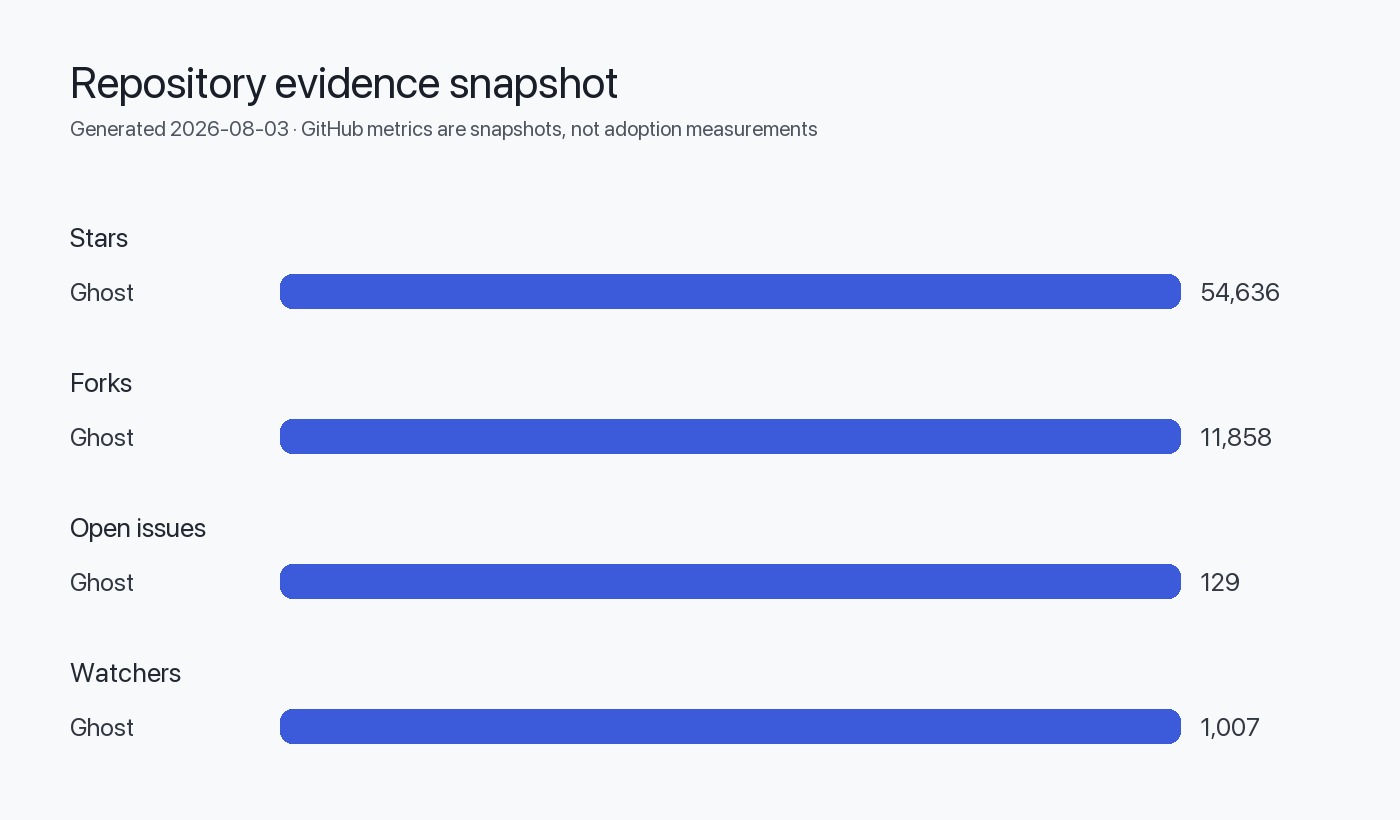
Ghost is a Node.js-based content management system designed for independent publishers, with a focus on memberships, subscriptions, and newsletters. The Ghost repository shows consistent development activity with 54,636 stars and 11,858 forks as of August 2026, indicating sustained interest over its thirteen-year history. Unlike many open-source projects that rely solely on community contributions, Ghost is maintained by the Ghost Foundation, which operates Ghost(Pro), a managed hosting service that funds ongoing development.
For teams evaluating Ghost, the key adoption signals point to a mature, actively maintained platform with a clear commercial model. The repository demonstrates regular releases—version 6.55.0 shipped on July 31, 2026—and a manageable issue count of 129 open items. However, the platform's architecture as a JavaScript monorepo, its specific design philosophy around publishing workflows, and the dual open-source/commercial model introduce selection considerations that differ from traditional CMSs or headless alternatives. This analysis examines repository health, ecosystem signals, and the evidence engineering teams should gather before committing to Ghost.
Repository activity and maintenance patterns
The Ghost repository demonstrates continuous development with the most recent push recorded on August 3, 2026, at 07:19:45 UTC. Created on May 4, 2013, the project has accumulated 1,007 watchers—a metric that reflects developers who actively monitor repository changes, as distinct from the broader 54,636 star count representing general interest.
The repository structure suggests a monorepo approach, with multiple packages maintained in a single repository. This architectural choice (inferred from common Ghost documentation patterns) centralizes dependency management but can complicate contribution workflows for developers unfamiliar with monorepo tooling. The presence of 11,858 forks indicates that thousands of developers have created their own copies, though fork counts often include abandoned experiments and automated mirrors rather than active development efforts.
| Metric | Value | Interpretation |
|---|---|---|
| Age | 13 years (since May 2013) | Long-term project with established patterns |
| Watchers | 1,007 | Active developer monitoring |
| Forks | 11,858 | Substantial community engagement |
| Last push | August 3, 2026 | Current as of data retrieval date |
| Primary language | JavaScript | Node.js ecosystem dependencies |
| Open issues | 129 | Moderate queue for mature project |
The daily commit activity (last push within hours of data generation on August 3, 2026) suggests that the core team maintains an active development schedule. Teams evaluating Ghost should examine commit frequency over trailing 90-day and 12-month windows to distinguish between burst activity around releases and sustained maintenance.
Release cadence and versioning stability
The latest release, v6.55.0, was published on July 31, 2026. The version number (6.55.0) indicates that Ghost is in major version 6 with 55 minor releases, suggesting incremental feature development rather than disruptive architectural changes. The release notes document nine bug fixes and one cosmetic change, contributed by both core maintainers and external contributors.
Ghost appears to follow semantic versioning conventions, where:
- Major versions (e.g., 5.x → 6.x) may introduce breaking changes
- Minor versions (e.g., 6.54 → 6.55) add features or substantial fixes
- Patch versions handle critical bugs and security issues
The release was not marked as a prerelease, indicating it passed through Ghost's standard testing and quality gates. The presence of contributor names in the release notes (Jannis Fedoruk-Betschki, SUHAIL, swithek, leafwind, Jatinder Mahajan, Aubaid, Steve Larson, Troy Ciesco) demonstrates that the project accepts external contributions, though teams should verify what percentage of commits originate outside the core Ghost Foundation team.
graph TD
    A[Ghost Release Process] --> B{Version Type}
    B -->|Major v6.x → v7.x| C[Breaking Changes]
    B -->|Minor v6.54 → v6.55| D[Features + Fixes]
    B -->|Patch v6.55.0 → v6.55.1| E[Critical Fixes]

    C --> F[Migration Guide Required]
    D --> G[Backward Compatible]
    E --> G

    G --> H[npm/ghost-cli Update]
    F --> I[Review API Changes]
    I --> H

    H --> J{Self-Hosted or Ghost Pro}
    J -->|Self-Hosted| K[Manual Update Process]
    J -->|Ghost Pro| L[Managed Update]

    style C fill:#ff6b6b
    style D fill:#51cf66
style E fill:#ffd43bIssue load and community engagement
The repository reports 129 open issues as of August 3, 2026. For a mature project with Ghost's user base, this figure represents a moderate backlog. Issue counts alone do not indicate defect density; they aggregate bug reports, feature requests, documentation questions, and duplicate submissions.
To contextualize the 129-issue count:
- It is not a count of confirmed bugs or critical defects
- Many open issues may be feature requests or discussions
- The Ghost team may use internal issue trackers for roadmap planning
- Stale issues from older versions may remain open for historical reference
Teams should examine:
- Issue age distribution: Are most issues recent (active reporting) or old (potential neglect)?
- Labeling and triage: Does the project use labels like
bug,enhancement,good first issue? - Response time: How quickly do maintainers acknowledge new issues?
- Resolution rate: What percentage of issues move to closed status each month?
The presence of a Ghost forum offloads some community support from GitHub issues, which is common for projects with non-developer user bases. This split means GitHub issues may skew toward technical problems rather than configuration help, but it also fragments support visibility.
| Community Signal | Evidence | What to Verify |
|---|---|---|
| Forum presence | Mentioned in README | Check forum post volume, response quality |
| Documentation | Links to ghost.org/docs | Assess completeness for your use case |
| Contributors | Multiple in v6.55.0 release | Review contributor graph for diversity |
| Sponsors | DigitalOcean, Fastly, Tinybird | Indicates ecosystem partnerships |
| Trademark policy | Linked in README | Relevant if you plan to offer Ghost services |
License model and commercial relationship
Ghost is released under the MIT License, one of the most permissive open-source licenses. This allows:
- Commercial use without royalty payments
- Modification and redistribution
- Private use without source disclosure
- Sublicensing under different terms
The MIT license does not require derivative works to remain open source, meaning you can fork Ghost and build proprietary extensions. However, the Ghost trademark is separately protected, and the project's trademark policy governs how you can describe Ghost-based services.
The Ghost Foundation funds development through Ghost(Pro), its managed hosting service. This commercial model offers advantages and risks:
Advantages:
- Sustainable funding for long-term maintenance
- Professional support available for Ghost(Pro) customers
- Incentive alignment: improvements benefit both open-source and commercial users
Risks:
- Features may prioritize Ghost(Pro) customer needs over self-hosted use cases
- Future licensing changes remain possible (though unlikely given community investment)
- Managed service lock-in if you start with Ghost(Pro) and later want to self-host
The README badge indicating Ghost is a verified Digital Public Good suggests the project has been assessed against sustainability and inclusivity criteria, though teams should independently verify what this certification entails.
Ecosystem maturity and integration signals
The repository topics (blogging, cms, ghost, javascript, journalism, nodejs, publishing, web-application) position Ghost explicitly within publishing and journalism contexts. This specialization means the ecosystem of themes, plugins, and integrations will reflect those use cases rather than general-purpose CMS needs.
Installation methods:
- ghost-cli: Command-line tool for production deployments
- npm package: For developers customizing core
- Docker images: Community-maintained (verify official support status)
- Ghost(Pro): Managed service with 2-minute setup claim
The presence of a dedicated CLI tool (ghost-cli) signals maturity in deployment automation. The README indicates it handles SSL setup via LetsEncrypt automatically, suggesting the project has invested in reducing operational friction for self-hosted users.
Integration points (inferred from README structure):
- Content API: Headless CMS usage, decoupling front-end from Ghost
- Theme system: Custom front-end development
- Membership system: Built-in authentication and subscription logic
- Newsletter functionality: Integrated email delivery (may require external SMTP)
Teams should verify:
- Email delivery requirements: Does Ghost include SMTP, or do you need Mailgun/SendGrid?
- Database support: Ghost historically used MySQL/MariaDB; confirm current requirements
- CDN integration: Ghost(Pro) mentions worldwide CDN; self-hosted setups need separate configuration
- Payment processing: If using memberships/subscriptions, what payment gateways are supported?
Architectural characteristics and technical debt
Based on repository metadata and README structure, Ghost exhibits these architectural characteristics:
Technology stack (confirmed):
- Primary language: JavaScript
- Runtime: Node.js (inferred from npm installation and CLI tool)
- Repository structure: Monorepo (inferred from references to "core files" and multiple package structure)
Architectural inferences from documentation:
- Monolithic backend: The installation process installs "Ghost" as a unit, suggesting core services are bundled
- Headless capability: The Content API reference indicates Ghost can serve as a backend for separate front-ends
- Theme system: Custom front-end templates run within Ghost, indicating server-side rendering
These architectural choices introduce technical considerations:
- Node.js ecosystem dependencies: Ghost inherits the Node.js security and compatibility landscape. Teams must maintain Node.js versions compatible with Ghost releases.
- JavaScript full-stack: Both front-end themes and backend use JavaScript, which benefits JavaScript-fluent teams but may create friction for organizations with PHP, Python, or Ruby expertise.
- Monorepo complexity: Contributing to or debugging Ghost requires understanding monorepo tooling (likely Lerna, Nx, or similar, though not confirmed in supplied data).
- Database coupling: Ghost's architecture (inferred) likely couples tightly to its database schema, making migrations to/from other CMSs non-trivial.
Technical debt indicators to investigate:
- Dependency freshness: Check if Ghost uses current Node.js LTS versions
- Test coverage: Not visible in supplied data; examine repository for test suite size
- Build time: Monorepos can have slow build cycles; verify CI/CD pipeline duration
- Module boundaries: Assess whether the monorepo maintains clean separation between packages
Selection risks and migration considerations
Adopting Ghost introduces several categories of risk that teams should weigh against alternative CMSs:
Publishing-specific design
Ghost optimizes for independent publishers, membership sites, and newsletters. If your content needs differ—e.g., e-commerce product catalogs, complex taxonomies, multi-site management—Ghost's opinionated design may require workarounds or prove insufficient.
Assessment questions:
- Does your content model map to Ghost's post/page/tag structure?
- Do you need features Ghost doesn't emphasize (e.g., granular user permissions beyond Author/Editor/Administrator)?
- Will Ghost's membership model fit your monetization strategy, or do you need external integration?
Self-hosted operational overhead
The ghost-cli tool simplifies deployment, but self-hosted Ghost still requires:
- Node.js runtime maintenance and security patching
- Database administration (MySQL/MariaDB)
- SSL certificate renewal (handled by ghost-cli via LetsEncrypt, but requires server access)
- Backup and disaster recovery planning
- Performance tuning as traffic scales
- Email delivery infrastructure (SMTP or service integration)
Teams without Node.js operations experience should budget learning time or consider Ghost(Pro) to transfer operational risk.
Migration paths
Moving content into Ghost typically involves:
- Importing from WordPress (tools exist, verify current compatibility)
- Migrating from Medium, Substack, or other platforms (check documented import options)
- Custom migration scripts for proprietary CMSs
Moving content out of Ghost requires:
- Exporting via Ghost's built-in export (JSON format)
- Transforming Ghost's data model to match destination CMS
- Handling membership data separately if monetization is involved
The MIT license permits you to fork and modify Ghost indefinitely, but maintaining a fork diverges from upstream updates and security patches.
Vendor relationship considerations
While Ghost is open source, the Ghost Foundation's control over the project introduces governance questions:
- How are major architectural decisions made?
- What influence do community contributors have on roadmap?
- If Ghost Foundation ceased operations, would community forks sustain the project?
The long project history (13 years) and active development suggest resilience, but teams dependent on specific features should assess bus factor risks.
Maintenance and governance recommendations
- Establish a weekly or biweekly automated check that records: newest release tag, open-issue counts by label, and failed security alerts. Do not use raw counts as decisions; use trends and labels.
- Subscribe to the project's changelog and release RSS/notifications (the release page for v6.62.0 contains a link to changelog context) and include changelog review as part of your release planning.
- Define responsibility split between vendor/managed service (if using Ghost(Pro)) and your internal team for backups, security patching, and incident response.
Decision checklist for Ghost evaluation
Use this checklist to structure your Ghost assessment:
Evidence, assumptions, and limitations
Evidence used in this analysis:
- Repository metadata retrieved August 3, 2026, from github.com/TryGhost/Ghost
- Release notes for v6.55.0 published July 31, 2026
- README content from the default branch (main) as of data retrieval date
Assumptions and inferences:
- Architectural characteristics (monorepo structure, Node.js runtime) are inferred from README installation instructions and repository language metadata
- The "100M+ downloads" claim in the README is treated as unverified marketing copy
- Database requirements (MySQL/MariaDB) are inferred from historical Ghost documentation patterns but not confirmed in supplied data
- The split between GitHub issues and forum support is noted in the README but not quantified
Limitations:
- No access to commit history granularity, contributor diversity metrics, or code churn analysis
- No npm download statistics to verify actual deployment frequency
- No test coverage metrics or CI/CD pipeline visibility
- No security vulnerability history or CVE analysis
- No performance benchmarks or resource consumption data
- No user survey data or satisfaction metrics
- No comparison data from competing CMSs (WordPress, Strapi, Contentful, etc.)
Teams should supplement this analysis with:
- npm trends data: Compare
ghostandghost-clidownload trajectories against alternatives - Community forum analysis: Sample recent threads to gauge support quality and common issues
- CVE database search: Check for disclosed vulnerabilities and patch timelines
- Cloud provider marketplace presence: Assess one-click install availability on AWS, GCP, Azure, DigitalOcean
- Job market data: Search for "Ghost CMS" roles to gauge commercial demand
FAQ
Is Ghost suitable for non-publishing websites?
Ghost is optimized for independent publishers, newsletters, and membership sites. Its content model (posts, pages, tags, authors) and built-in features (subscriptions, memberships, newsletters) reflect those use cases. For corporate websites, e-commerce, or applications requiring complex custom content types, Ghost's opinionated structure may feel restrictive. Evaluate whether the headless Content API provides sufficient flexibility for your front-end needs if Ghost's default theme system doesn't fit.
How does Ghost compare to WordPress in terms of maintenance?
Ghost's Node.js foundation and narrower feature scope generally result in fewer security updates than WordPress's PHP ecosystem and extensive plugin architecture. However, WordPress's ubiquity means more managed hosting options, more developers fluent in its maintenance, and more third-party tooling. Ghost requires Node.js operational expertise, which may be scarcer in your team. The ghost-cli tool automates many tasks, but troubleshooting issues demands Node.js debugging skills.
Can Ghost scale to high-traffic publishing sites?
Ghost's Node.js architecture provides good baseline performance, and Ghost(Pro) includes CDN and optimization. For self-hosted deployments, scaling requires standard practices: database optimization, caching layers (Redis, Varnish), CDN for static assets, and potentially horizontal scaling with load balancers. The monolithic architecture (inferred) may limit horizontal scaling compared to microservices designs. Teams expecting high traffic should conduct load testing and plan database read-replica strategies.
What happens if the Ghost Foundation stops development?
The MIT license permits anyone to fork Ghost and continue development. The 11,858 forks indicate many copies exist, though most are inactive. Ghost's 13-year history and revenue-generating Ghost(Pro) service suggest sustainability, but no open-source project is immune to abandonment. If Ghost Foundation ceased operations, the community would need to coordinate maintenance—a process that has succeeded for some projects (e.g., Plone after corporate transitions) but failed for others. Evaluate your ability to maintain a fork if necessary.
Does Ghost support multilingual content?
Multilingual support is a common CMS requirement not explicitly addressed in the supplied repository data. Ghost's core content model doesn't traditionally include built-in localization features like language-specific versions of posts. Teams needing multilingual sites should verify whether recent Ghost versions have added internationalization features, whether third-party themes/plugins provide solutions, or whether the headless API allows building custom multilingual front-ends. This is a critical evaluation point if your content spans multiple languages.
How difficult is it to customize Ghost's appearance and functionality?
Ghost separates presentation (themes) from core functionality. Themes use Handlebars templating, which is simpler than PHP but requires learning Ghost's specific theme API. Customizing beyond themes—adding new content types, altering admin behavior, integrating external services—requires modifying core Ghost code or building on the Content API. The monorepo structure can make core contributions complex for newcomers. Assess whether your customization needs fit within Ghost's theme system or require deeper integration.
What is the relationship between open-source Ghost and Ghost(Pro)?
Open-source Ghost and Ghost(Pro) use the same codebase; Ghost(Pro) doesn't offer exclusive features unavailable to self-hosted users. Ghost(Pro) provides managed hosting, automated updates, CDN, backups, and 24/7 support—operational services, not software capabilities. Revenue from Ghost(Pro) funds open-source development, creating incentive alignment but also potential tension if features prioritize hosted users. Teams should decide based on operational capacity: if you have Node.js expertise and want infrastructure control, self-host; if you prioritize time-to-market and minimal operations, Ghost(Pro) transfers those responsibilities.