Fastify repository spotlight — fast, extensible Node.js
A technical repository profile of fastify/fastify (GitHub). Includes maintenance signals, inferred architecture notes, evaluation checklist, and a responsible adoption path.
Executive answer
Fastify (fastify/fastify) is a JavaScript-based web framework repository focused on low-overhead HTTP servers, a plugin-first architecture, and schema-driven validation and serialization. The project exposes a stable core API, maintains a broad plugin ecosystem, and emphasizes performance and developer ergonomics. Key repository signals that support these claims include an active release history, CI workflows shown in the project README, a recent security-oriented release, and metadata such as stars and forks indicating community interest (fastify/fastify on GitHub).
This profile synthesizes repository metadata and README documentation into an actionable evaluation: who Fastify is best for, where it shines (performance-sensitive services, plugin-driven teams, JSON Schema-orientated validations), its maintenance posture, and a practical, evidence-based adoption checklist. Data and repository facts in this article were retrieved from the canonical repository and its latest release information on 2026-09-06 (generation date: Sep 6, 2026).
Repository snapshot
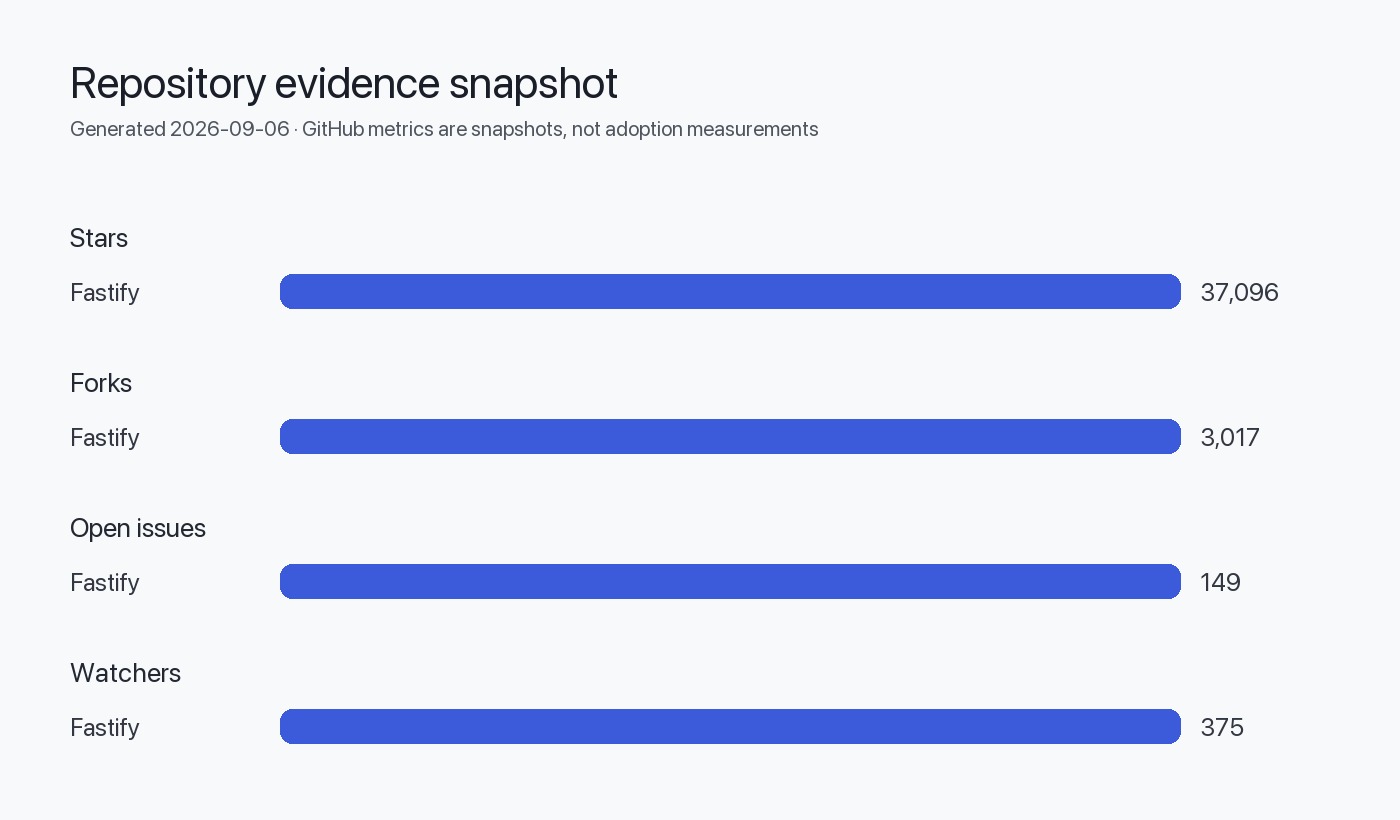
The following table condenses the repository facts used throughout this profile (all values come from the repository metadata and latest release noted in Sources):
| Field | Value |
|---|---|
| Repository | fastify/fastify |
| Description | Fast and low overhead web framework, for Node.js |
| Primary language | JavaScript |
| License | MIT |
| Stars (interest signal) | 37,096 |
| Forks | 3,017 |
| Open issues (signal) | 149 |
| Default branch | main |
| Created | 2016-09-28 |
| Last push (metadata) | Sep 5, 2026 |
| Last repo update (metadata) | Sep 5, 2026 |
| Latest release | v5.12.2 (published 2026-09-04) |
Sources: the repository metadata and the v5.12.2 release notes are available in the project's GitHub pages; see Sources section for links.
Purpose and intended users
Purpose (as described in repository materials): provide a low-overhead, extensible web framework for Node.js that prioritizes developer experience and runtime performance. Supported features and emphases, drawn from the repository README and linked documentation, include:
- Schema-based validation and serialization (JSON Schema recommended by maintainers).
- A plugin architecture intended to encourage encapsulation and reusability.
- Integration with the Pino logging library for low-impact structured logging.
- Guidance and tooling for both development and production usage (dev generators, CLI tools referenced in the README).
Intended users (inferred from the README and documented guides):
- Backend developers building HTTP services in JavaScript or TypeScript who need a structured plugin model and explicit schema validation.
- Teams that require predictable performance characteristics and want to control serialization costs with compiled schemas.
- Contributors and organizations that prefer an active open-source project with CI and governance.
Maintenance and health signals
This section compiles concrete maintenance signals visible in the repository metadata and README. Each row cites source evidence.
| Signal | Evidence (repository) | Interpretation |
|---|---|---|
| Active releases | Latest release: v5.12.2, published 2026-09-04 (release notes) | Recent releases, including security fixes, indicate ongoing maintenance. |
| CI and workflows | README links to CI badges: ci.yml, package-manager-ci.yml, website.yml | Presence of CI workflows implies automated tests and package checks; check actual workflow status when evaluating a checkout. |
| Security policy | README links to SECURITY.md (Responsible Disclosure) | The project documents a security disclosure process. Follow that for reporting issues. |
| Community interest | 37k+ stars, 3k+ forks | Strong attention from the community; useful when assessing ecosystem momentum but not a usage metric. |
| CII Best Practices | README shows CII best-practices badge (link) | Badge indicates attention to maintenance practices, but verify badge status on the CII site. |
Release and security notes (evidence)
The repository's most recent public release included a section labeled "Security release" and listed fixes for multiple GitHub security advisories. See the project's release page for v5.12.2 for the specific advisories addressed (v5.12.2 release). Do not assume which versions are affected beyond what the release and advisories explicitly specify; consult the release and the repository's SECURITY.md for scope.
Architecture and design (inferred and documented)
The repository README and docs repeatedly emphasize a plugin-first design, schema-driven validation, and low-overhead runtime. The following architectural conclusions are inferred from the README structure, documentation titles, and conventional patterns used in the Node.js ecosystem. These are labeled as inferred, per site policy.
Inferred architectural summary (inferred from README and repository structure):
- Fastify exposes a core server instance with a lifecycle that supports hooks, decorators, and scoped plugins.
- Routes and their validation/serialization are intended to be described with JSON Schema or the project's Fluent Schema helpers.
- The plugin system provides encapsulation boundaries, enabling teams to register behavior (decorators, hooks, routes) without global side effects.
The diagram below sketches a high-level flow and plugin encapsulation model — treat it as interpretation rather than a verbatim spec.
flowchart LR
  A[Client Requests] --> B[Fastify Core HTTP Server]
  B --> C{Route Matching}
  C -->|matched| D[Route Handler]
  D --> E[Schema-based Validation & Serialization]
  D --> F[Plugin Decorators & Hooks]
  F --> G[Third-party Plugins]
  subgraph Inferred
    F
    G
  end
  E --> H[Response]
  C -->|not found| I[Not Found Handler]
  style F stroke:#f66,stroke-width:1px
%% NOTE: The plugin/decorator/hook layout is inferred from README and docs.Evidence-backed strengths
The repository materials and metadata support the following strengths:
- Performance orientation: the README highlights performance as a primary goal and includes synthetic benchmark results that show low framework overhead for a "hello world" scenario (benchmarks repository referenced in the docs). These are synthetic and should be used only as a comparative indicator, not a production guarantee (fastify/fastify README).
- Extensible plugin architecture: documentation and multiple guides listed in the README emphasize plugin development, encapsulation, and a plugins team in the project's governance structure.
- Schema-first validation path: the project recommends using JSON Schema to validate inputs and serialize outputs and documents a compilation step intended to reduce per-request costs.
- Active maintenance and governance: evidence of CI workflows, a security disclosure policy, CII Best Practices badge, and a named lead/teams structure indicate institutionalized maintenance practices.
Limitations and caveats
Limitations below are derived from repository metadata and documentation references; where we infer behavior from textual evidence the statement is labeled.
- JavaScript primary language: the repository lists JavaScript as the primary language. If your team requires native support for other runtime languages, evaluate cross-platform options separately.
- Synthetic benchmarks: the README includes synthetic benchmark numbers (hello-world style); these represent framework overhead in a controlled scenario and do not predict application-level performance in real workloads. Always benchmark your actual application.
- Security scope must be validated per release: the repository shows recent security-related fixes (v5.12.2). When adopting, verify specific advisories and affected versions in the release notes and security advisories referenced by the project rather than relying on summary language.
- Architectural inference: some structural conclusions in this profile (plugin encapsulation, lifecycle hooks) are inferred from README content and documentation indexes; consult the repository's reference documentation for definitive behavior.
Evaluation checklist (quick gate for technical teams)
Use this checklist to decide whether to consider Fastify for a project. Mark each item with Yes/No and add notes.
| Criterion | Why it matters | Pass? | Notes |
|---|---|---|---|
| Does the team use Node.js/JavaScript or TypeScript? | Fastify is JavaScript-first (docs include TypeScript guidance). | ||
| Do you need schema-based validation or predictable serialization costs? | Fastify recommends JSON Schema and compiles schemas for serialization. | ||
| Will a plugin-first architecture help enforce boundaries? | Fastify emphasizes plugins and encapsulation in docs. | ||
| Is low framework overhead a priority? | README highlights performance and includes synthetic benchmarks. | ||
| Can the team maintain dependencies and patch releases? | Active releases and CI exist, but you must track security advisories. |
Action checklist (step-by-step adoption path)
- Repository validation
- Confirm the current release and changelog for any security advisories relevant to your target versions (v5.12.2 release page).
- Inspect CI workflow files and run the test suite locally on your Node.js versions.
- Prototype and benchmark
- Build a minimal service using your target routes and data shapes.
- Implement JSON Schema for request/response shapes and measure serialization/validation costs with realistic payloads.
- Plugin strategy
- Map functionality you expect to be shared or isolated into plugins. Use encapsulation patterns from the docs to avoid global state leakage.
- Observability and logging
- Confirm logging integration (Pino is referenced in project docs) and adapt structured logging to your observability stack.
- Security and upgrade plan
- Subscribe to repository releases and security advisories. Create a patch/upgrade plan for production deployments.
- Production rollout
- Stage release behind feature flags and run canaries under production-like load. Monitor latency percentiles and error rates during rollout.
Responsible adoption path and governance considerations
- Licensing: Fastify is published under an MIT license in its repository metadata — that license permits broad reuse but confirm compatibility with your project's legal constraints.
- Security reporting: the project exposes a SECURITY.md and a "Security Responsible Disclosure" badge in the README. Use the repository's documented process to report vulnerabilities.
- Contributing and support: the project documents contributing guidelines and maintains a "Fastify help" support area. If your organization depends on the framework long-term, consider participating in the ecosystem or sponsoring maintainers, as the project lists sponsor options in the README.
Evidence, assumptions, and limitations
- Repository metadata and README content (stars, forks, open issues, language, license, docs list, badges) from the canonical repository (fastify/fastify).
- Latest release notes (v5.12.2, published 2026-09-04) and the release description mentioning security fixes (v5.12.2 release).
Assumptions and how they were handled
- Inferred architecture: where architectural conclusions are drawn from the README layout, docs indexes, or repository naming, they are explicitly labeled as inferred and should be verified against the project's reference documentation.
- Benchmarks: the README includes synthetic benchmark numbers. This profile treats them as indicators of the project's performance emphasis but advises teams to run application-specific benchmarks.
Limitations
- No external telemetry: repository stars and forks are interest signals and do not translate directly into adoption numbers or production footprints. We do not claim customer lists or usage patterns beyond repository-provided documentation.
- Temporal snapshot: metadata values (stars, issues, last push) were current as of data retrieval on 2026-09-06. For time-sensitive decisions, re-check repository state and release notes.
Two practical comparison tables
Table A — metadata and maintenance quick reference
| Item | Value |
|---|---|
| Repo | fastify/fastify |
| Stars | 37,096 |
| Forks | 3,017 |
| Open issues | 149 |
| Latest release | v5.12.2 (2026-09-04) |
| Language | JavaScript |
| License | MIT |
Table B — docs and ecosystem signals
| Asset | Present (per README) | Why it matters |
|---|---|---|
| Getting Started guide | Yes | Lowers onboarding cost for new teams |
| Guides & Reference docs | Yes | Indicates investment in documentation |
| Plugin ecosystem & examples | Yes (examples repo referenced) | Facilitates real-world usage patterns |
| CI workflows | Yes (badges: ci.yml, package-manager-ci.yml, website.yml) | Automated checks and releases |
| Security policy | Yes (SECURITY.md) | Provides responsible disclosure path |
Sources
- Fastify canonical repository: https://github.com/fastify/fastify
- Fastify latest GitHub release (v5.12.2): https://github.com/fastify/fastify/releases/tag/v5.12.2
FAQ
What is Fastify best suited for?
Fastify is targeted at Node.js teams that want a low-overhead HTTP framework with a plugin architecture and schema-driven validation. Its documentation and design emphasize performance and encapsulation (fastify/fastify).
Is Fastify actively maintained?
Yes. The repository shows active releases and CI workflows in its README. The latest published release in the data used for this article is v5.12.2 (published 2026-09-04) and the repository contained recent pushes as of 2026-09-05; verify live CI and commit activity when you evaluate the project for production use.
Does Fastify provide security guidance?
The project documents a SECURITY.md and the v5.12.2 release indicates recent security fixes. Follow the project's security disclosure process and review release notes for affected versions (v5.12.2 release).
Are the benchmark numbers representative of real-world performance?
No—benchmark figures in the README are synthetic "hello world" tests meant to compare framework overhead. Use application-specific benchmarks with representative payloads to assess performance impact.
What language and license does the project use?
The repository's primary language is JavaScript and it is released under the MIT license (repository metadata) — confirm compatibility with your legal requirements.
How should a team adopt Fastify safely?
Follow the Action checklist: validate releases and advisories, build a prototype with representative payloads, instrument logging/observability, and stage rollouts. Subscribe to repository releases for security updates.
Where can I get help or contribute?
The README directs users to a Fastify help area and contributing guidelines. The project also maintains a Discord and sponsorship links; use those channels to ask about contribution or support pathways.