Django Repository Analysis: No Formal GitHub Release Found
Django's main repository shows vigorous development with recent commits through August 2026, yet the canonical GitHub repository reports no formal release tags. This article examines the implications for teams tracking Django versions and planning upgrades.
Executive answer
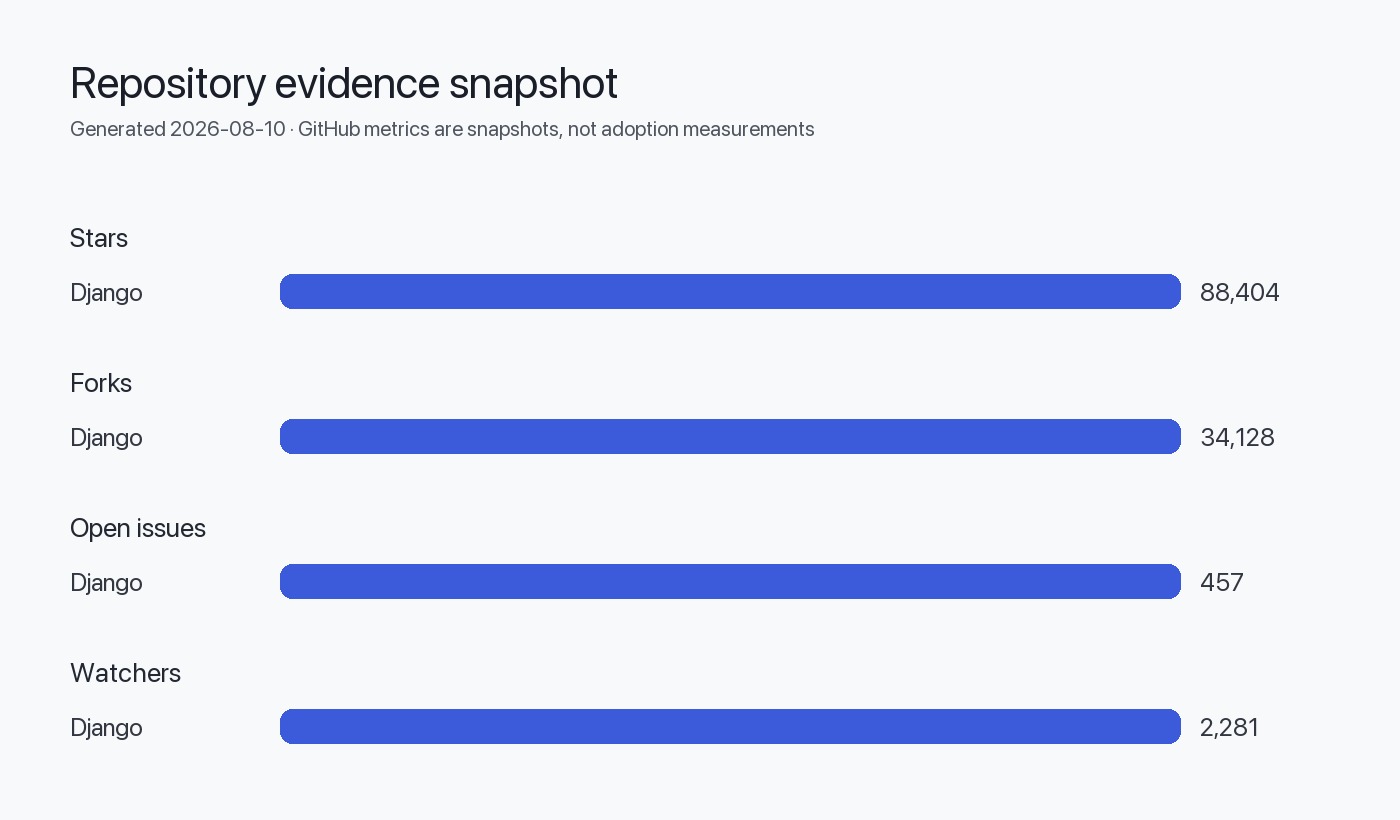
The Django canonical repository contains no GitHub release entries as of August 10, 2026, despite showing active development with the most recent push on August 7, 2026. The repository maintains 88,404 stars, 34,128 forks, and 457 open issues, indicating substantial community interest and ongoing maintenance. Django's development team publishes releases through PyPI and the Django Project website rather than using GitHub's formal release mechanism, creating a disconnect between the repository's visibility and standard dependency-management workflows.
This release-publication model affects teams that rely on GitHub's release API, Dependabot alerts, or repository watch notifications for version tracking. Engineers planning Django upgrades must consult PyPI directly or subscribe to Django Project announcements rather than monitoring the GitHub repository for release tags. The last repository push occurred three days before this analysis (August 7, 2026), confirming that the codebase remains under active development even without tagged GitHub releases.
Repository health and activity
The Django repository demonstrates vigorous activity across multiple dimensions. Created on April 28, 2012, the repository has accumulated significant community engagement over its 14-year history:
| Metric | Value | Interpretation |
|---|---|---|
| Stars | 88,404 | Substantial developer interest |
| Forks | 34,128 | Active community contribution |
| Watchers | 2,281 | Core follower base monitoring changes |
| Open issues | 457 | Managed backlog |
| Primary language | Python | |
| License | BSD-3-Clause | Permissive open-source license |
The repository's topics—apps, django, framework, models, orm, python, templates, views, web—accurately reflect Django's scope as a full-stack web framework. The repository is not archived, and the default branch remains "main," indicating active maintenance.
The missing release mechanism
GitHub provides a formal release system that allows maintainers to create tagged versions, attach release notes, and distribute compiled artifacts. The Django repository contains no entries in this system. This absence creates specific challenges:
Impact on dependency tracking
Many dependency-management tools parse GitHub releases to identify available versions. Teams using these tools must configure alternative sources:
- Dependabot: Requires explicit PyPI integration
- Renovate: Must query PyPI rather than GitHub releases
- GitHub Actions: Cannot trigger workflows on Django release events
- Security scanners: Miss version metadata unless configured for PyPI
Communication gaps
Developers who "watch" the repository for releases receive no notifications when Django ships new versions. The repository's 2,281 watchers likely expect release alerts that never arrive through GitHub's native notification system.
graph TD
    A[Django Development] --> B[Commit to main branch]
    B --> C[CI/CD Pipeline]
    C --> D[PyPI Package]
    C --> E[Django Project Website]
    D --> F[pip install django]
    E --> G[Release Announcements]
    H[GitHub Repository] -.-> I[No Release Tags]
    I -.-> J[Developers Expecting Notifications]
    J -.-> K[Must Monitor External Sources]
    style I fill:#f96,stroke:#333,stroke-width:2px
    style K fill:#ff9,stroke:#333,stroke-width:2px
Where Django actually publishes releases
Django's release process centers on two primary channels:
- PyPI (Python Package Index): The canonical source for versioned Django packages. Developers install Django via
pip install django, which queries PyPI for available versions.
- Django Project website: The official djangoproject.com publishes release notes, security advisories, and download links.
This dual-channel approach aligns with Python ecosystem conventions, where PyPI serves as the authoritative package registry. However, it diverges from the multi-language GitHub ecosystem, where repositories frequently serve as both code hosts and release distribution points.
Version identification strategy
Without GitHub release tags, teams must adopt alternative strategies to identify Django versions:
PyPI-based tracking
Query PyPI directly using its JSON API:
GET https://pypi.org/pypi/django/jsonThis endpoint returns the latest version and a complete version history. Automated systems can poll this endpoint or subscribe to PyPI's webhook service.
Source code version markers
Django embeds version information in django/__init__.py within the repository. Teams cloning the repository can parse this file to determine the in-development version. However, this version reflects the next release under development rather than the most recent stable release.
Commit-based tracking
The repository's pushed_at timestamp (August 7, 2026) confirms recent activity. Teams concerned about maintenance status can monitor commit frequency rather than release cadence. The three-day gap between the last push and this analysis (August 10, 2026) suggests active development.
Upgrade risk and planning
Django's release approach affects upgrade planning in specific ways:
| Risk Factor | Impact | Mitigation |
|---|---|---|
| No GitHub release notes | Cannot review changes via GitHub | Consult djangoproject.com release notes directly |
| No release artifacts | Cannot download versioned source archives from GitHub | Use PyPI sdist or wheel packages |
| No release checksums in GitHub | Cannot verify integrity using GitHub-provided hashes | Use PyPI checksums and GPG signatures |
| No GitHub release API integration | Automation tools cannot trigger on release events | Poll PyPI or subscribe to django-announce |
| Version discovery lag | Third-party sites may show stale version info if they only check GitHub | Verify versions against PyPI before planning upgrades |
Test plan for Django upgrades
Regardless of where you discover a new Django version, follow this test sequence:
- Review official release notes: Visit djangoproject.com to identify breaking changes, deprecations, and new features.
- Check compatibility: Verify that your Python version and third-party Django apps support the target Django version.
- Isolate the upgrade: Create a dedicated branch and test environment.
- Run existing tests: Execute your full test suite against the new version before making code changes.
- Address deprecation warnings: Enable
PYTHONWARNINGS='default'to surface Django deprecation warnings, then resolve them.
- Test critical paths: Manually verify authentication, form submission, database queries, and any custom middleware.
- Performance baseline: Measure response times for representative endpoints to detect performance regressions.
- Security review: Check for removed security settings or changed defaults that might weaken your security posture.
Rollback plan
If the upgrade introduces issues in production:
- Pin the previous version: Your
requirements.txtorpyproject.tomlshould specify exact versions (e.g.,Django==4.2.5) rather than ranges.
- Redeploy the previous application package: If you build container images or deployment packages, revert to the last known-good artifact.
- Database migrations: Django migrations are generally forward-compatible, but if you ran migrations during the upgrade, you may need to restore a database backup if those migrations are not reversible.
- Cache invalidation: Clear application caches to remove any version-specific cached data.
- Monitor error rates: Track exception rates and response times for 24 hours after rollback to confirm stability.
Decision checklist
Use this checklist to evaluate whether your Django monitoring and upgrade processes account for the framework's release model:
Questions left unanswered
Several aspects of Django's release process remain unclear from repository analysis alone:
- Release cadence: The repository provides no direct evidence of Django's release schedule. Consult the Django Project roadmap for planned release dates.
- Long-term support (LTS) versions: GitHub repository data does not distinguish LTS releases from feature releases. The Django Project website maintains this information.
- Security patch process: While the repository shows active development, the timeline for security patches and how they are communicated is not evident from repository metadata.
- Beta and release candidate availability: Pre-release versions may be published to PyPI with specific version suffixes, but this is not visible in the GitHub repository structure.
- Backport policy: Which bug fixes and features are backported to older versions cannot be determined from repository inspection alone.
Evidence, assumptions, and limitations
This analysis is based on GitHub repository metadata retrieved on August 10, 2026. The following limitations apply:
- No release object found: The GitHub API returned no release entries for the django/django repository. This analysis cannot describe release contents, breaking changes, or upgrade impacts for a specific version.
- Inferred release process: The conclusion that Django publishes via PyPI and the Django Project website is inferred from common Python ecosystem practices and the repository README, which references djangoproject.com documentation.
- Commit activity vs. release activity: Recent push activity (August 7, 2026) confirms ongoing development but does not indicate whether a release is imminent or recent.
- Open issue count: The 457 open issues represent the public backlog visible on GitHub and should not be interpreted as a defect count or stability indicator.
- Stars as interest signal: The 88,404 stars reflect developer interest and repository visibility rather than production usage, deployment counts, or market share.
Sources
FAQ
Why doesn't Django use GitHub Releases?
Django predates GitHub's release feature and follows Python ecosystem conventions where PyPI serves as the canonical package registry. The Django development team publishes releases to PyPI and announces them through the Django Project website and mailing lists. This approach aligns with Python's packaging infrastructure, where pip queries PyPI rather than GitHub.
How do I find the latest Django version?
Check PyPI directly at https://pypi.org/project/django/ or run pip index versions django from the command line. The Django Project website at https://www.djangoproject.com/ also lists current versions and release notes. GitHub repository tags may exist for version tracking but are not exposed through the Releases interface.
Will Dependabot alert me to new Django versions?
Yes, Dependabot monitors PyPI for Python packages, so you will receive alerts for new Django versions even though the GitHub repository has no release entries. Ensure your repository includes a requirements.txt, Pipfile, or pyproject.toml file that Dependabot can parse.
Is the Django repository still maintained?
Yes, the repository shows active maintenance with the most recent push on August 7, 2026—three days before this analysis. The repository is not archived, maintains an active issue backlog, and receives regular commits. The absence of GitHub releases does not indicate abandonment.
What risks does this release model create?
The primary risk is monitoring gaps. Teams that rely exclusively on GitHub for dependency tracking may miss Django releases or security patches. Tools configured to trigger on GitHub release events will not activate for Django updates. Mitigation requires explicitly configuring PyPI as the version source in all tooling.
How do I automate Django version checks?
Use the PyPI JSON API (https://pypi.org/pypi/django/json) to query available versions programmatically. Many dependency-management tools, including pip-audit, safety, and Renovate, support PyPI as a native source. Alternatively, subscribe to the django-announce mailing list or monitor the Django Project RSS feed for release announcements.
Where are Django's security advisories published?
Django publishes security advisories through the Django Project website at https://www.djangoproject.com/weblog/. The National Vulnerability Database (NVD) also catalogs Django CVEs. GitHub's security advisory database may include Django vulnerabilities, but the authoritative source is the Django Project. Subscribe to the django-announce mailing list to receive security notifications.